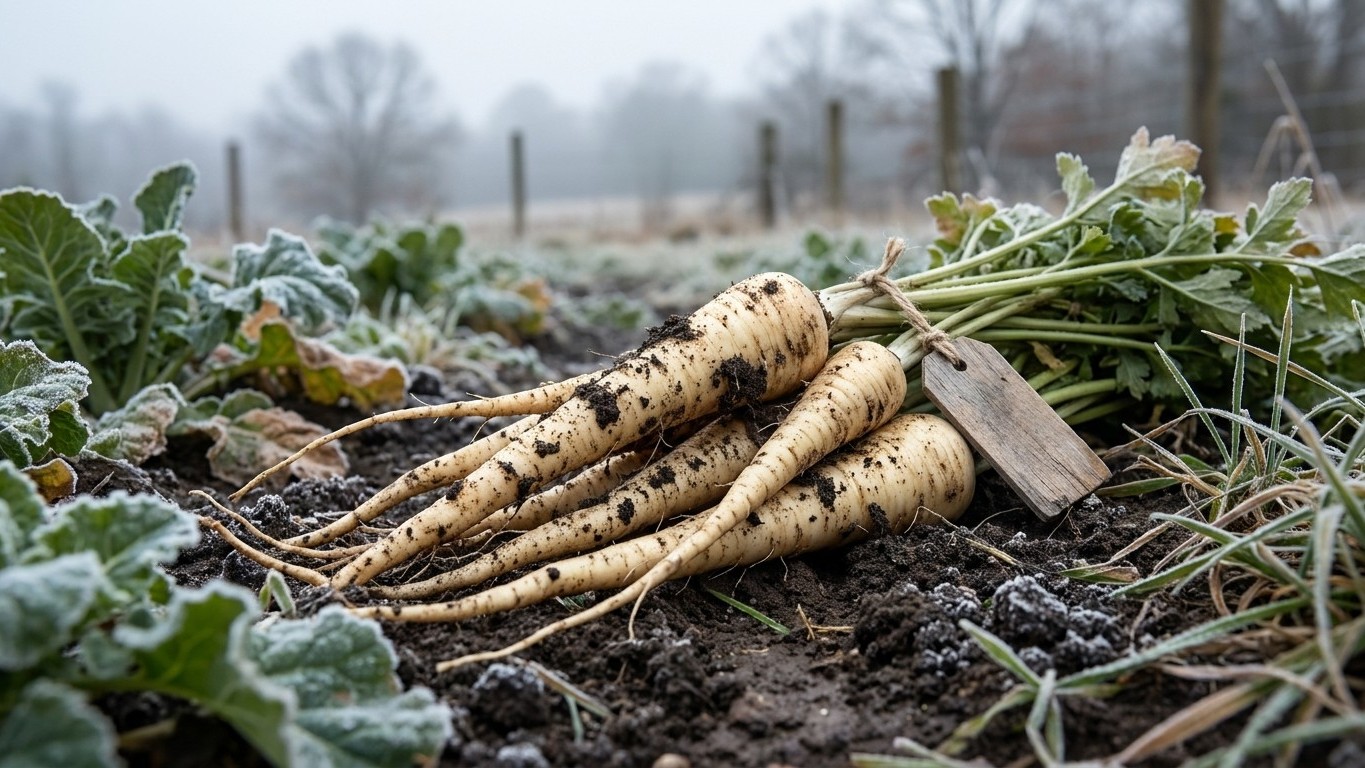

Yes. Manitoba’s winters deliver far more than the “several frosty weeks” a parsnip needs to convert its stored starch into sugar. Around Winnipeg, the coldest month averages a mean minimum of -6.6°F, and the frost season runs from late September through late May. That’s not a marginal case. A parsnip left in this ground after the first fall frost will sweeten reliably, provided the sowing timeline and soil texture cooperate.
The short answer
The question that settles this isn’t the hardiness zone label stamped on a seed packet. It’s whether the ground actually gets cold enough, for long enough, to push a parsnip root through the starch-to-sugar conversion that makes it worth growing in the first place. In Manitoba, referenced against the Winnipeg station, the coldest month has a mean daily minimum of -6.6°F. That figure describes ordinary winter nights across a typical cold month, not a rare deep freeze. It tells you this isn’t a place that flirts with frost and moves on. It’s a place where cold settles in and stays.
That distinction matters because parsnips are unusual among root vegetables. According to Utah State University Extension, they taste best after several weeks of cool, frosty weather, which triggers the conversion of stored starch into sugar. A parsnip pulled in August is edible but flat, almost woody. The same root left in the ground through a string of frosty nights turns noticeably sweeter, sometimes dramatically so. This isn’t a garnish detail. It’s the entire reason growers leave parsnips in the soil deliberately rather than harvesting them at the first sign of maturity.
A mean coldest-month minimum near -6.6°F rules out any concern that this territory delivers only a token frost or two before winter softens. Several frosty weeks, stacked one after another, is exactly what this number implies. Compare that to a milder region where the coldest month barely dips below freezing on average. There, a parsnip might size up just fine and still taste bland, because the sugar conversion needs sustained cold exposure, not a single overnight dip. Manitoba doesn’t have that problem.
None of this means every parsnip grown here automatically tastes sweet. Frost exposure is the trigger, but the plant still has to reach a mature root size before the cold arrives, and the soil still has to let the root grow straight rather than forked. Those are separate questions, addressed below. But on the narrow question the title asks, the answer holds: this is frost-exposure territory, and parsnips sown and grown correctly here will sweeten, not just size up.
Does the season fit?
Parsnips need 100 to 120 days from the day they’re seeded in place, sown directly into the garden bed 2 to 3 weeks before the last expected spring frost. There’s no transplanting step to shortcut this. The clock starts at seeding, and seeds themselves are slow: expect 14 to 21 days just for germination, during which the bed looks empty and it’s tempting, wrongly, to assume the sowing failed and start over.
- Sowing date: Winnipeg’s average last spring frost falls on May 23, so seeding 2 to 3 weeks earlier lands around May 2 to May 9. That date is a mean, not a guarantee, meaning frost arrives later than May 23 in roughly half of all years, so treat early May as a working target rather than a locked date.
- Germination window: adding the 14 to 21 days parsnips typically take to emerge pushes visible seedlings into mid-to-late May, right around when the last frost risk is easing.
- Maturity window: counting 100 to 120 days forward from that early May sowing places full maturity somewhere between mid-August and early September.
- Frost-free span: the gap between the May 23 average last spring frost and the September 22 average first fall frost runs about 122 days.
- The arithmetic: the 100-to-120-day maturity window fits inside that 122-day frost-free span with almost no slack if sowing slips even a week late, but real breathing room if sowing happens on schedule in early May.
The fit is tight rather than loose, but it works, and it works in the crop’s favor. Maturity lands close to the September 22 average first fall frost, meaning the roots reach harvestable size right as the cold that sweetens them begins to arrive. That timing isn’t an accident of luck; it’s close to the ideal sequence for a crop that needs to size up before it needs to chill. A grower who sows late, say, after mid-May, compresses that margin further and risks the roots still bulking up when the first hard cold hits, which caps their final size even if the flavor still develops.
What goes wrong here
- Forked roots from heavy or stony ground: Utah State University Extension notes parsnips want deep, sandy soil, and any heavy soil must be double dug before sowing. In compacted or rocky Manitoba clay, taproots hit resistance and split into two or three prongs instead of growing straight down. The remedy is working the bed deeply, a full spade’s depth or more, and removing stones before seeding, not after the roots have already met them.
- Forked roots from overwatering: this is a separate cause from soil texture, and it happens even in well-prepared beds. Excess water encourages shallow, erratic root branching as the plant chases moisture unevenly. The fix is watering evenly and moderately through the season rather than flooding the bed after dry spells, which is often when overwatering happens by accident.
- A season that runs out: sowing later than the early-May window, or losing time to a slow, patchy germination, eats directly into the 100-to-120-day requirement. Given how tightly the 122-day frost-free span already matches that requirement, any delay in sowing shrinks the margin the crop needs to mature before frost limits growth. Sowing as close to early May as soil conditions allow protects that margin.
- A winter too mild to sweeten: this isn’t Manitoba’s problem, given a coldest-month mean minimum of -6.6°F, but it’s worth naming because growers moving from a milder province sometimes assume any parsnip left in cold ground will sweeten equally. It won’t, if the frost exposure is only occasional rather than sustained. Manitoba’s winters supply the sustained cold this crop needs; a warmer microclimate wouldn’t.
Common questions
Do I need to cover parsnips before the first frost?
No. The point of leaving them in the ground is direct exposure to the cold. Covering the bed to block frost would defeat the sweetening process Utah State University Extension describes.
Can I sow parsnips later if I miss the early May window?
You can, but the 100-to-120-day requirement leaves little room to spare against Manitoba’s roughly 122-day frost-free span, so a late sowing risks roots that are still undersized when the cold that sweetens them arrives.
Why did my parsnip seeds seem to fail?
Germination normally takes 14 to 21 days. A bed that looks empty after a week hasn’t failed; it’s still within the expected window, and re-sowing too early just adds a second, later batch to compete with the first.
Is sandy soil required, or just preferred?
Utah State University Extension describes deep, sandy soil as the goal, with double digging as the workaround for heavy ground. Sandy soil isn’t mandatory, but heavy, undug soil is the direct cause of forked roots described above.