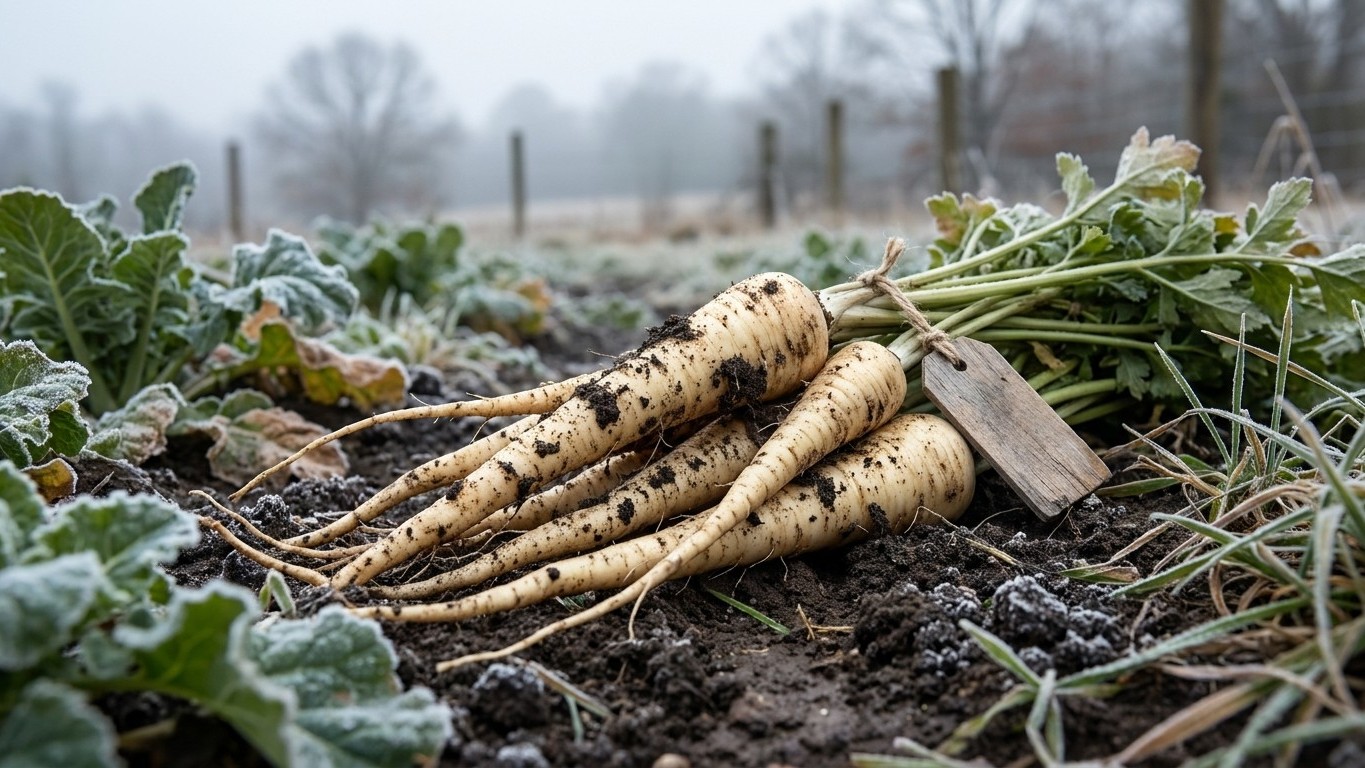

Yes, in most of Maryland parsnips will sweeten, not just grow. The state’s coldest month brings a mean daily minimum of 25.4°F, cold enough to deliver the sustained frosty stretch that turns stored starch into sugar. But how that plays out depends on where in Maryland you’re digging, and on how you time the sowing.
The short answer
The question that actually decides this isn’t “how cold does it get on the worst night of the year.” It’s whether the territory delivers several consecutive weeks of frosty weather while the roots are still sitting in the ground. Maryland, at least around the Baltimore reference station used for the state’s official climate normals, posts a coldest-month mean minimum of 25.4°F. That’s well below freezing on an average night in January, and it’s not a one-off cold snap: it’s the monthly average, which means the cold sticks around long enough to do the work parsnips need.
That number matters more than a hardiness zone label ever could. A hardiness zone tells you the coldest extreme a perennial plant might survive over years. It says nothing about how many weeks of frost a root vegetable sitting in the topsoil will actually experience in a normal winter. Parsnips don’t care about the zone map. They care about exposure, night after night, to temperatures that push them into that starch-to-sugar conversion. A 25.4°F mean minimum for the coldest month is a strong signal that Maryland gardens get that exposure, not just once, but repeatedly across weeks of winter weather.
There’s regional texture worth flagging before anyone assumes uniform results across the state. Western Maryland, up in Garrett and Allegany counties, runs colder and the frost season arrives earlier and lingers longer into spring. Gardeners there can expect the sweetening process to kick in with room to spare, and probably to arrive sooner in the fall. The Eastern Shore is the opposite case: milder winters, later frost onset, fewer of those hard, cold nights. A parsnip grown near the Chesapeake’s eastern edge can still mature into a perfectly fine root. Whether it reaches the same depth of sweetness as one pulled from a Garrett County garden is a separate question, one that comes down to how many frosty nights that particular patch of ground actually logs.
So the answer isn’t a flat yes for every zip code. It’s a yes for the state’s climate as measured at its reference point, with a caveat that colder inland and mountainous areas will likely sweeten parsnips more reliably and more deeply than the milder coastal fringe. Anyone gardening near the water should treat sweetness as a bonus outcome to watch for, not a guarantee baked into the local winter.
Does the season fit?
Parsnips need 100 to 120 days from seeding to reach maturity, and they’re sown directly in place, not started indoors and transplanted. Layer onto that a germination period of 14 to 21 days before any green even shows above the soil, and the math starts to matter. Here’s how it plays out against Maryland’s frost calendar.
- Find the sowing window. Utah State University Extension’s guidance calls for sowing 2 to 3 weeks before the last spring frost. Maryland’s last spring frost falls between April 3 and April 16, near the Baltimore reference station. That puts the sowing window at roughly mid-March to early April for most of the state, with Western Maryland’s mountainous counties running weeks later and the Eastern Shore trending a bit earlier.
- Account for germination. Parsnip seed is notoriously slow to sprout, 14 to 21 days is normal. A seed dropped into cold March soil may not show a seedling until well into April. That’s expected, not a failure, and it’s the reason gardeners are warned not to dig up the row and re-sow just because nothing’s visible after a week.
- Count the maturity window. From the actual seeding date, add 100 to 120 days. A sowing in mid-March lands maturity somewhere between late June and mid-July. A sowing in early April pushes maturity into July.
- Compare against the fall frost date. Maryland’s first fall frost, again near Baltimore, arrives between October 26 and November 5. That leaves a wide gap, often three to four months, between when the roots reach maturity in summer and when the first real frost hits.
- Use that gap on purpose. Parsnips are cold-hardy and are meant to stay in the ground through that gap. The extra months aren’t wasted time; they’re the run-up to the frosty weeks that convert starch to sugar. Harvest gets pushed to after the first frost, not right when the roots technically mature.
Measured against a 100-to-120-day requirement, Maryland’s frost-free season, typically 194 to 216 days depending on location, fits comfortably. There’s slack built in even after accounting for slow germination, which is rare for a cool-season root crop this far south of the northern tier.
What goes wrong here
- Forked, misshapen roots in heavy or stony ground. Maryland soils range from sandy loam on the Eastern Shore to heavier clay-influenced ground in the Piedmont, and rocky, compacted soil in parts of the west. Parsnips push a single taproot straight down, and any obstruction, a rock, a clay pan, undecomposed organic matter, forces the root to split around it. Utah State University Extension recommends deep sandy soil and, where the ground is heavy, double digging the bed before sowing to loosen it well past the depth the root will reach.
- Forked roots from overwatering. This is a separate cause from soil texture, not a variation of it. Excess moisture, especially uneven watering that alternates soggy and dry, can also cause the taproot to fork or branch as it searches for a consistent moisture gradient. The fix is steady, moderate watering rather than heavy soaking followed by dry stretches.
- A season that runs out before the roots size up. This is a low risk across most of Maryland given the wide gap between maturity and first frost, but a very late sowing, pushed past early April by wet spring soil, can compress the timeline. Sowing at the front edge of the recommended window, rather than the back edge, keeps the buffer intact.
- A winter too mild to sweeten. Root maturity and root sweetness are two different milestones. A parsnip can size up perfectly fine on the Eastern Shore and never get the deep, cold exposure that a Western Maryland root gets. There’s no fix for this beyond harvesting later in the season and letting the roots sit through as many frosty nights as the local climate provides before pulling them.
Common questions
Do parsnips need to be dug up before winter in Maryland?
No. Parsnips are cold-hardy and are typically left in the ground through the early frosty weeks of fall and into winter, since that exposure is what develops sweetness. They’re usually harvested after the first frost rather than before it.
Can I sow parsnips in summer instead of spring in Maryland?
The guidance calls for sowing 2 to 3 weeks before the last spring frost, which for Maryland falls between April 3 and April 16 depending on location. A summer sowing would compress the 100-to-120-day maturity window against the arriving fall frost, leaving little margin.
Why hasn’t anything sprouted three weeks after I sowed parsnip seed?
That’s normal. Germination takes 14 to 21 days, sometimes stretching toward the longer end in cool spring soil. Digging up the row and re-sowing before that window closes usually just delays things further.
Does the hardiness zone tell me whether my parsnips will sweeten?
No. A hardiness zone measures the coldest extreme a perennial plant might survive over time. Sweetening depends on repeated exposure to frosty weather while the roots sit in the ground, which is better measured by a coldest-month mean minimum, like Maryland’s 25.4°F, than by a zone number.