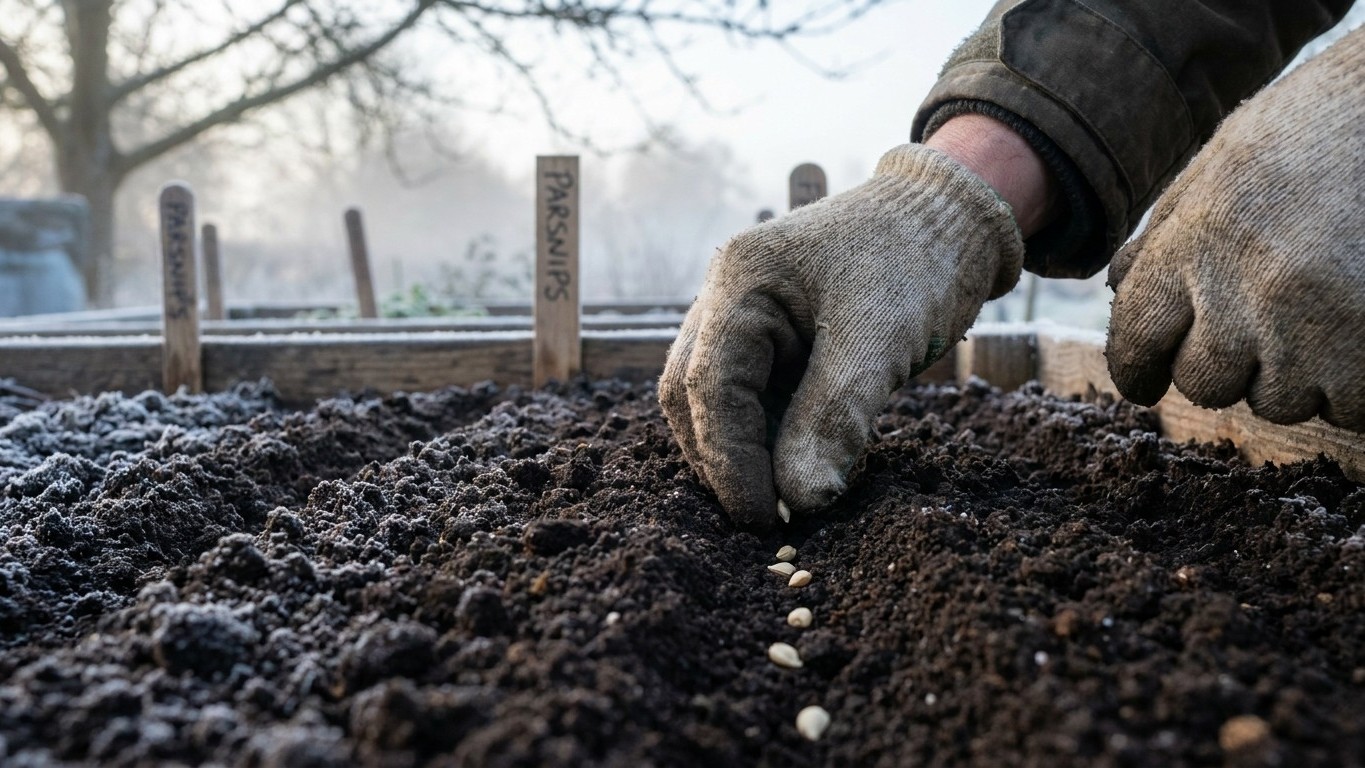

Nebraska gardeners get a clear yes on parsnips: the state’s winters run cold enough to trigger the frost sweetening this root crop depends on, and the frost-free season, while not generous, gives seeds sown in place enough runway to mature before the ground locks up. Sow from mid-March through early April, two to three weeks ahead of the last spring frost, and plan on a harvest that stretches into or past the first hard freeze.
The short answer
Everything about growing a good parsnip comes down to one question: does the ground here actually freeze, and for how long? Not the hardiness zone label on a seed packet, but the real, measured cold. At the Omaha reference station, the average daily minimum temperature during the coldest month sits at 15.2°F, based on NOAA NCEI Climate Normals covering 1991 to 2020. That’s not a fluke cold snap. That’s the typical low, night after night, for weeks at a stretch.
That number matters because parsnips don’t taste like much when they’re just grown. Utah State University Extension is blunt about this: the root needs several weeks of cool, frosty weather before harvest to convert its stored starch into sugar. A parsnip pulled from soil that never really froze is edible, sure, but flat. A parsnip left in ground that dropped into the teens repeatedly, week after week, comes out tasting like it earned its sweetness the hard way.
Nebraska clears that bar without much argument. A coldest-month average minimum of 15.2°F means the soil isn’t flirting with frost once or twice and calling it winter. It’s sitting below freezing for a sustained stretch, which is exactly the exposure the crop needs to convert starch to sugar. Compare that to a coastal or Deep South garden where the coldest month might average minimums in the 40s, and the difference is obvious: those gardeners grow a fine-looking parsnip that stays starchy. Nebraska gardeners grow one that sweetens.
So the short answer holds up under scrutiny. This isn’t a state where you’re gambling on whether winter shows up. The cold is reliable enough that the harder question isn’t “will it get cold enough,” but “will the parsnip have finished growing before that cold arrives.” That’s a timing problem, not a climate problem, and it’s worth working through carefully before you drop seed in the ground. The reference figures below come from the Omaha weather station specifically, and gardens elsewhere in the state, especially those farther west or at higher elevation, should expect their own frost dates to run on a different schedule, often a week or two earlier in fall and later in spring.
Does the season fit?
Parsnips are sown directly in place, not transplanted, and the 100 to 120 days USU Extension cites run from the day seed goes into the ground, not from germination or from any later thinning date. Here’s how the arithmetic works out for a Nebraska garden using the Omaha reference dates.
- Set the last spring frost. At the Omaha station, the last spring frost falls somewhere between April 12 and April 23, based on the 1991-2020 NOAA NCEI freeze probability data. That’s the anchor point for everything that follows.
- Count back two to three weeks for sowing. Parsnip seed goes in before that last frost date, not after, since the crop tolerates cold soil early on. Two to three weeks ahead of April 12 to April 23 lands the sowing window somewhere between roughly late March and the second week of April, depending on how the local frost date shakes out.
- Add the wait for germination. Parsnip seed is famously slow, and Utah State University Extension notes it takes 14 to 21 days to sprout. Don’t mistake bare soil for a failed planting during that stretch and re-sow out of impatience. That germination window is baked into the crop’s timeline, not a delay on top of it.
- Run the clock to maturity. From the seeding date, the root needs 100 to 120 days to size up and reach harvest readiness.
- Check where that lands against the first fall frost. The Omaha station’s first fall frost falls between October 15 and October 26. Sowing in late March to early April and counting forward 100 to 120 days puts maturity somewhere in early to mid July at the earliest reading, and comfortably before the October frost window on the latest reading.
- Read the margin. Even the tightest version of this math, a late sowing in the second week of April counted out to 120 days, lands in early August, still more than two months ahead of the first fall frost. The season fits comfortably, with weeks to spare for the crop to sit in the ground and take on the cold exposure it needs to sweeten before you dig it.
That margin is the real advantage of gardening in Nebraska rather than in a shorter-season climate: there’s no need to rush the harvest the moment the roots reach a usable size. Leaving them in place through several frosty weeks in October, and even into November where soil isn’t frozen solid, is what turns an average root into a genuinely sweet one.
What goes wrong here
- Forked roots from heavy or stony ground. Nebraska’s soils range widely, and dense clay or ground riddled with rock fragments forces a parsnip’s taproot to split around the obstruction instead of growing straight down. Utah State University Extension recommends deep sandy soil for this crop, and where the ground is heavier, it should be double dug to loosen it well below the depth the root will eventually reach.
- Forked roots from overwatering. This is a separate cause from soil texture, and it trips up gardeners who assume more water always helps a root crop. Excess moisture, especially uneven watering that soaks the bed heavily after a dry stretch, can cause the same forking as compacted ground even in soil that’s otherwise loose. Even, moderate watering through the growing season avoids the problem.
- A season that runs out before the root sizes up. This shows up when sowing slips past the recommended window, whether from a late seed order or a wet spring that delays garden work. Given how much margin Nebraska’s frost dates provide, this is avoidable, but it does happen when gardeners wait until after the last frost date to sow instead of two to three weeks ahead of it.
- Pulling the crop before it’s had its frosty weeks. A root that’s sized up and ready by late summer can still be dug too early, before the cold exposure that converts starch to sugar has had time to work. Since Nebraska’s coldest month runs a reliable 15.2°F average minimum, the fix here isn’t climate, it’s patience: leave mature roots in the ground through several hard frosts rather than harvesting the moment they look ready.
Common questions
Can I sow parsnips earlier than two to three weeks before the last frost in Nebraska?
The seed tolerates cold soil, which is why the standard timing already puts sowing ahead of the last frost date rather than after it. Pushing much earlier than that window risks seed sitting in ground too cold or too wet to germinate at all, and since germination already takes 14 to 21 days under decent conditions, colder soil only stretches that further.
Do I need to wait for a frost before harvesting parsnips in Nebraska?
The root doesn’t need frost to survive or to reach full size, but it does need several weeks of cold exposure to develop the sweetness parsnips are known for. Given the state’s coldest month averages a 15.2°F daily minimum, leaving mature roots in the ground through multiple frosty spells rather than pulling them at first opportunity is what makes the difference.
How long does parsnip seed actually take to sprout?
Fourteen to 21 days, according to Utah State University Extension. That’s slow compared to most garden vegetables, and it’s a common reason gardeners assume their seed failed and till the bed under, only to have missed sprouts appear later.
Why did my parsnips come out forked instead of straight?
Two separate causes produce the same result. Heavy, compacted, or rocky soil forces the taproot to split as it grows downward, which double digging or working in deep sandy soil corrects. Overwatering, particularly uneven soaking after dry spells, causes the same forking even in loose soil, so even moisture through the season matters just as much as soil texture.