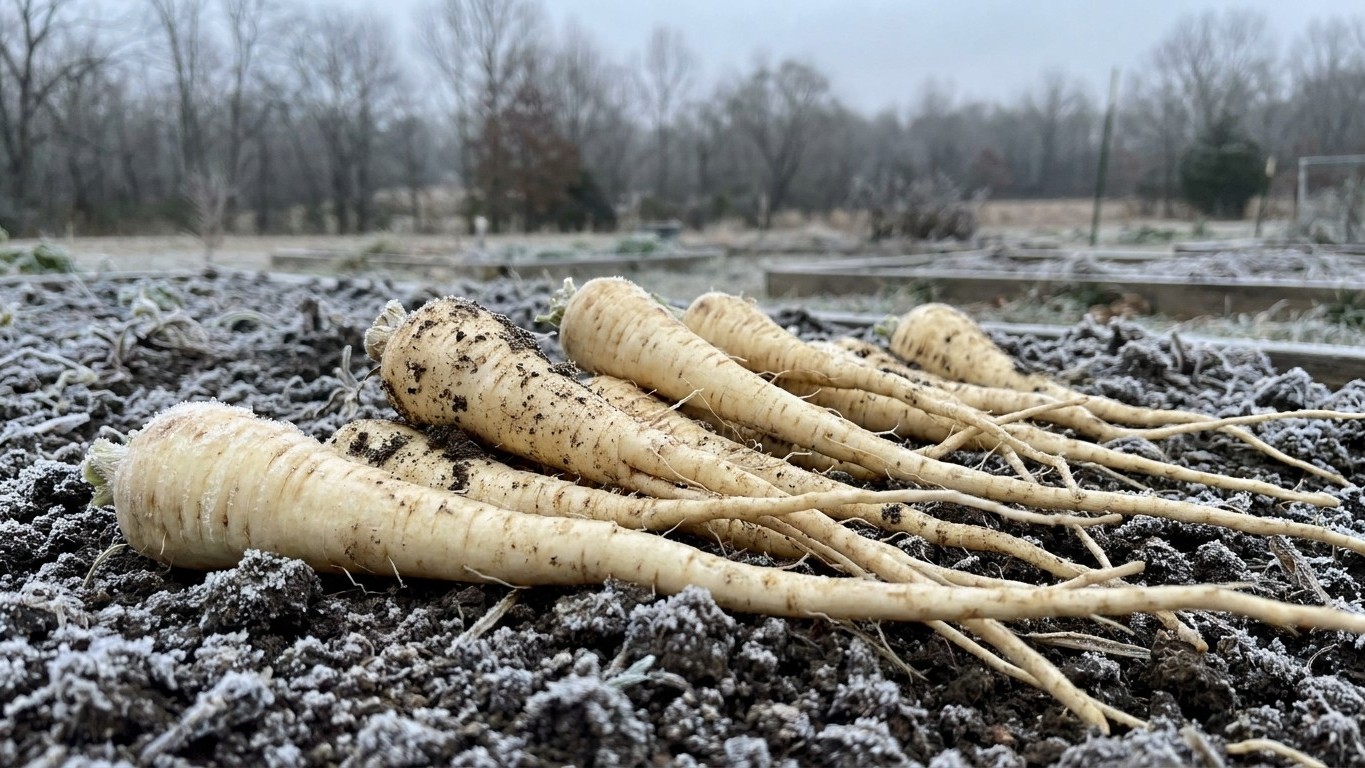

Yes, parsnips grown in Nebraska will sweeten, not just grow. The Cornhusker State supplies the one thing this root vegetable needs after it reaches full size: repeated, hard frost. Winter lows here run deep and consistent, more than enough cold exposure to convert stored root starch into sugar. The remaining question is timing. Below is the frost math for this state, the failures Nebraska soil and weather actually cause, a safety warning almost no garden page mentions, and where to check these numbers against your own county.
The short answer
Does this territory deliver several frosty weeks? That question decides whether a Nebraska-grown parsnip merely grows or actually sweetens, and the answer here is unambiguous. At the reference station in Omaha, the mean minimum temperature during the coldest month sits at 15.2 degrees Fahrenheit, according to NOAA NCEI Climate Normals covering 1991-2020. That figure is not a record low from one unusually rough night. It is the average low across the entire coldest month, meaning nights in that range happen over and over, not as a fluke.
That distinction matters because sweetening has nothing to do with surviving winter. It is about repeated exposure to frost while the root sits in the ground. Parsnips push starch into sugar as a cold defense, and that conversion needs several weeks of freezing nights, not a single early frost or a mild dip that stays just outside true cold. A hardiness zone answers a different question entirely: whether a perennial plant survives a region’s winter minimum. It says nothing about how many frosty nights actually stack up, or how deep that cold reaches into the row where the root sits. Nebraska’s 15.2 F average minimum for the coldest month means the frosty stretch parsnips need shows up reliably, season after season.
So the short answer holds: parsnips grown in Nebraska will sweeten, provided they stay in the ground long enough after maturity to catch that cold. Pulling a mature root the week after the first light frost skips most of the payoff. Leaving it through several hard freezes is what produces the sweet, nutty flavor growers describe. In a state where winter arrives with real force, that patience gets rewarded rather than risked, since parsnips tolerate freezing soil better than almost any other root crop.
What Nebraska does not guarantee on its own is a forgiving growing season or ideal soil texture, both of which decide whether the roots reach harvest size before that cold arrives. Those are separate questions, covered next. But on the narrow question this title asks, cold exposure rather than hardiness zone is what settles it, and Nebraska’s winters supply that cold in abundance.
Does the season fit?
- Start with the sowing window. Parsnips go directly into the ground as seed, 2 to 3 weeks before the last spring frost. Using the Omaha reference dates of April 12 to April 23, that puts sowing somewhere between late March and early April, depending on how the spring is running.
- Add germination time before expecting any green. Parsnip seed is slow, 14 to 21 days before seedlings appear. A gardener who seeds in late March may see nothing until mid-April, and that gap is normal rather than a sign of failure or a reason to re-sow.
- Count 100 to 120 days from the seeding date, not the sprouting date. From a late-March sowing, that lands the root at harvestable maturity between roughly June 30 and July 20. From an early-April sowing, maturity lands closer to mid-July through the first week of August.
- Set that against the first fall frost. Omaha’s first fall frost falls between October 15 and October 26, per the same NOAA NCEI normals.
- Read the margin. Even in the tightest scenario, roughly ten weeks separate maturity in early August from the earliest fall frost in mid-October. In the earliest scenario, the gap runs closer to three and a half months. Either way, the season fits comfortably, with enough spare time for the crop to sit through several freezing nights before the ground locks up.
What goes wrong here
- Forked roots from heavy or stony ground. A parsnip root pushes straight down until it hits resistance, and Nebraska’s denser loess and clay patches, or a buried stone, will split it into two or three legs instead of one. Utah State University Extension notes that deep sandy soil suits parsnips best, and that heavy soil has to be double dug to loosen it before the root ever needs to fight its way through.
- Forked roots from overwatering. This is a separate cause from soil texture, not a variation of it. Inconsistent, heavy watering pushes the root to branch as it chases moisture unevenly. Steady, moderate watering rather than deep soaks followed by dry spells keeps the taproot growing in one clean line.
- A season that runs out before harvest. Because germination alone eats up 14 to 21 days, a gardener who delays sowing past the window before the last frost, or forgets to account for that slow sprouting, can end up racing the first fall frost with an undersized root. The fix is sowing promptly within the 2 to 3 week pre-frost window and not waiting for warmer soil that isn’t required.
- A winter too mild to sweeten. Not the typical Nebraska problem given the 15.2 F coldest-month average, but it still happens when roots get pulled right after the first light frost instead of being left through several hard freezes. The remedy is patience: let the ground go through repeated freezing nights before digging, rather than harvesting at the first sign of cold.
Before any of that flavor talk matters, there’s a warning that belongs on every parsnip page and rarely shows up on any of them. North Carolina Extension Gardener Plant Toolbox states it plainly: “All parts of this plant contain furocoumarins which can make skin sensitive to light causing burns so be sure to wear gloves, long sleeves and long pants when dealing with it.” That covers the root, the leaves, the stems, and the sap, not just the foliage someone might brush past while weeding.
The mechanism is what makes this surprising rather than obvious. The burn does not come from the sap alone. It comes from sap plus sunlight together. That’s why it tends to show up after a bright afternoon of harvesting or pulling tops, and why the reaction often doesn’t appear for hours after the skin contact happened, long after anyone would think to connect it back to the garden. Because sunlight is the second half of the reaction, washing the skin afterward doesn’t undo exposure that already happened in daylight. The protection that actually works is covering up beforehand: gloves, long sleeves, long pants, before hands and forearms ever touch the plant.
Checking this against your own county
Every frost date in this article comes from a single reference station at the Omaha airport, and NOAA NCEI is clear that this is a point measurement, not a statewide promise. Suburban and rural gardens across Nebraska typically see the last spring frost arrive later and the first fall frost arrive earlier than these numbers show, often by one to two weeks, and more at higher elevation. A garden west of Omaha, or one sitting in a low frost pocket, could easily run on a different calendar.
The most reliable way to confirm your own numbers is Nebraska Extension, the state’s land-grant extension service, at extension.unl.edu. County offices there track local frost data and soil conditions that a single airport station can’t capture, and they can confirm whether your specific ground needs the double-digging heavy soil calls for before you commit a season to it.
Common questions
Can parsnips be transplanted instead of sown in place? The 100 to 120 day maturity window used here runs from the seeding date because parsnips are grown as a direct-sown crop; the taproot doesn’t tolerate the disturbance of transplanting well.
How long does parsnip seed take to germinate? 14 to 21 days, per Utah State University Extension, which is slow enough that bare soil after two weeks doesn’t mean the sowing failed.
Does leaving parsnips in the ground over winter work in Nebraska? The season math shows several weeks of buffer before the first fall frost, and Nebraska’s cold winters are exactly the exposure the crop needs to sweeten, so leaving mature roots in place through repeated freezes fits the state’s climate well.
Is the skin reaction from parsnip sap the same in every state? The furocoumarin mechanism described by NC State Extension is a property of the plant itself, not of any particular region’s climate, so the same gloves-and-long-sleeves precaution applies wherever parsnips are grown.