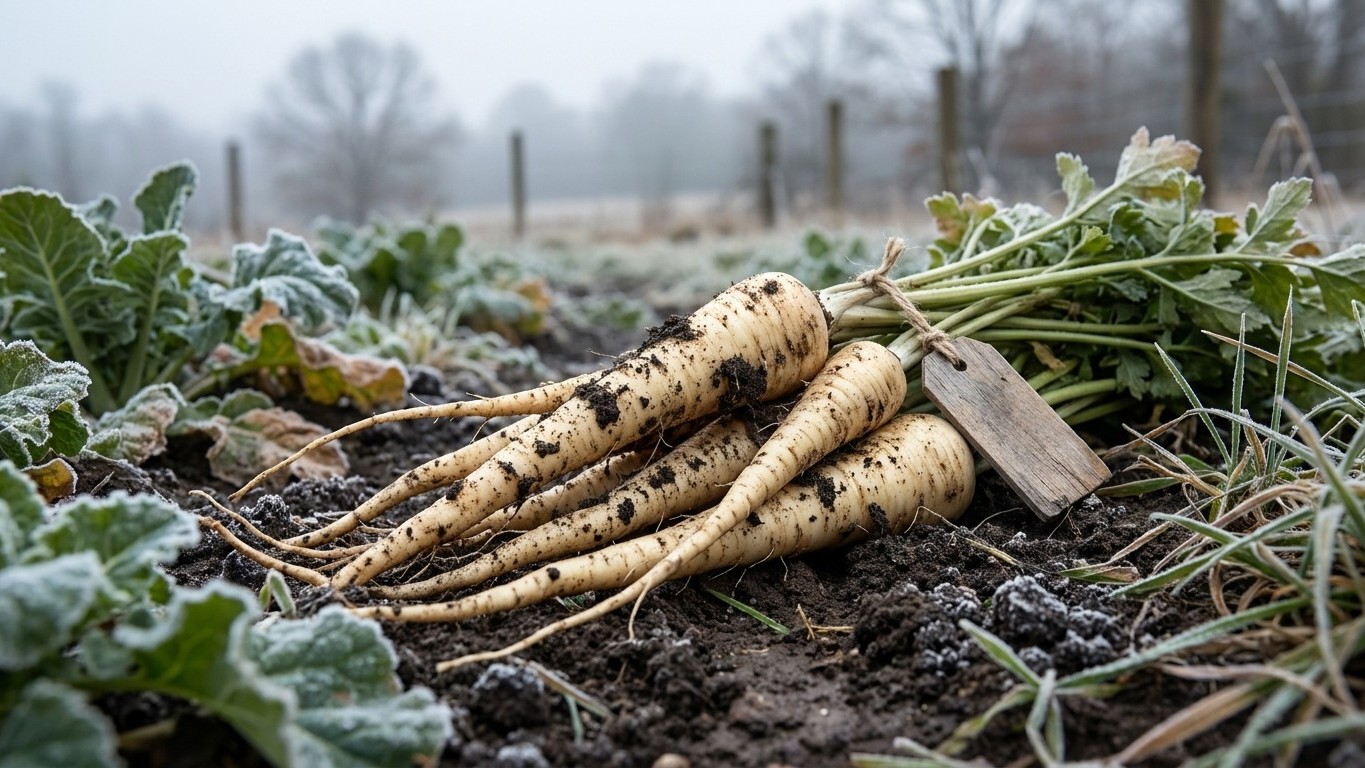

Yes, in most of Nebraska. The mean daily minimum of the coldest month sits at 15.2°F, which means the ground gets weeks of genuine frost exposure, not just a light nip. That’s exactly the condition parsnips need to convert their stored starch into sugar. The catch isn’t whether it gets cold enough here. It’s whether your season is long enough to grow the root before that cold arrives.
The short answer
Parsnips don’t sweeten from a number on a hardiness zone map. They sweeten from repeated exposure to freezing temperatures while the root sits in the ground, undisturbed, converting starch to sugar over several weeks. Nebraska’s climate data settles this question quickly: the coldest month averages a daily minimum of 15.2°F, based on NOAA NCEI Climate Normals for the 1991-2020 period at the Omaha reference station. That’s not a brief cold snap. That’s a sustained stretch of genuinely freezing nights, which is the mechanism parsnips depend on.
A milder state, one where the coldest month barely dips below freezing at night, can grow a perfectly fine-looking parsnip that never develops much sweetness. The root matures, sits in cool soil, and simply doesn’t get the sustained chill it needs to trigger the starch conversion. Nebraska doesn’t have that problem. The frost here is real, it’s repeated, and it lasts long enough to do the job the crop requires.
So the biological answer is yes: a parsnip grown in Nebraska soil and left in the ground through the early cold will sweeten, provided it reaches maturity before the ground freezes solid. That second part matters more than people expect. Sweetening isn’t automatic just because a state has cold winters. It requires the timing to line up, meaning the root needs to be full-sized and sitting in workable soil when those frosty weeks arrive, not still small and immature.
This is also where the state’s soil profile matters, though only as a starting point. Much of Nebraska sits on deep loess, a windblown silt soil that’s often praised for its depth and drainage. That’s a genuine advantage for a root crop like parsnip, which prefers loose, deep ground free of rocks and clumps. But loess isn’t uniform across the state, and plenty of home gardens sit on heavier, more compacted soil, especially in older residential lots or areas with clay subsoil. The state’s general soil reputation tells you what’s typical, not what’s actually under your raised bed or backyard plot. A shovel test before planting will tell you more than any soil map.
The practical takeaway: Nebraska’s winter cold is not the limiting factor for sweet parsnips. The season length and the soil texture are. Get those two right, and the frost will do exactly what it’s supposed to do.
Does the season fit?
Parsnips need 100 to 120 days from the day they’re seeded directly into the ground, according to Utah State University Extension, the only source cited here for growing guidance. That count starts at seeding, not at germination and not at transplanting, since parsnips are always sown in place. Germination itself is slow, typically 14 to 21 days, so don’t assume a bare patch of soil three weeks in means failure. It usually just means the seed hasn’t sprouted yet.
- Set the sowing window. Utah State’s guidance calls for sowing 2 to 3 weeks before the last spring frost. At the Omaha reference station, the last spring frost falls between April 12 and April 23. That puts the sowing window at roughly late March to early April, depending on how the season is running.
- Add the maturity period. From an early-April sowing, 100 days lands around mid-July; 120 days pushes into early August. Even sowing at the later edge of the window, in mid-April, the crop is fully mature well before fall frost arrives.
- Check it against the first fall frost. The Omaha station’s first fall frost falls between October 15 and October 26. That leaves roughly ten to twelve weeks of open season between full maturity and the first freeze, plenty of buffer for a crop that only needs 100 to 120 days.
- Count the frosty weeks after maturity. Because the crop matures so far ahead of the first frost, the root can sit in the ground through October, November, and into the coldest stretch of the year, absorbing exactly the sustained chill that triggers sweetening.
The math works comfortably here, not tightly. Nebraska’s frost-free season is generous enough that even a late sowing, or a slow germination stretch, still leaves weeks to spare before the ground freezes hard. That’s a more forgiving margin than many parsnip-growing regions get, and it means gardeners have room to adjust the sowing date without risking a rushed harvest.
One caution worth repeating: these dates come from a single airport weather station. Rural and suburban gardens across Nebraska, especially those at higher elevation or away from urban heat, often see the last spring frost arrive later and the first fall frost arrive earlier, sometimes by a week or two. Check your own county’s frost history before locking in a sowing date.
What goes wrong here
- Forked roots in heavy or stony ground. Parsnips push straight down, and anything that blocks that path, compacted clay, rocks, or old root debris, splits the taproot into forks. Nebraska’s loess soil is often deep and workable, but plenty of yards sit on heavier ground underneath. Double dig the bed to at least 12 inches and remove stones before sowing, exactly as Utah State University Extension recommends for heavy soil.
- Forked roots from overwatering. This is a separate cause from soil texture, and it’s easy to mix the two up. Too much water, especially in irregular bursts, encourages the root to branch rather than grow straight. Keep moisture even rather than heavy, watering deeply but infrequently once the seedlings are established.
- A season that runs out before the root matures. This is less of a risk in Nebraska than in shorter-season states, since the frost-free window comfortably covers the 100 to 120 day cycle. But a late sowing, pushed past the recommended window because of a wet spring or a delayed start, can still cut it close. Sow as early as the last-frost window allows, not later.
- Harvesting before the sweetening has had time to work. This isn’t the same as a mild winter that never gets cold enough, which is a real problem in warmer states but not one Nebraska faces given its 15.2°F coldest-month minimum. Here, the mistake is impatience: pulling the roots after the first light frost instead of waiting through several additional frosty weeks. Let the crop sit through repeated freezes before digging, and the sugar conversion will be far more pronounced.
Common questions
When should parsnips be sown in Nebraska?
Aim for 2 to 3 weeks before the last spring frost, which at the Omaha reference station falls between April 12 and April 23. That puts sowing in late March to early April for most of the state, though local frost dates can run later, especially at elevation or in rural areas.
How long until parsnips are ready to harvest?
Utah State University Extension puts the full cycle at 100 to 120 days from seeding, not from germination. Since germination alone can take 14 to 21 days, patience early on matters as much as the total count.
Do parsnips need frost to taste good?
Yes. The sweetness comes specifically from exposure to several weeks of cool, frosty weather after the root has matured, which converts stored starch into sugar. A parsnip pulled before that exposure will grow fine but taste flat and starchy.
Can parsnips stay in the ground over a Nebraska winter?
Many gardeners leave mature roots in place through the early frosty weeks specifically to build sweetness, digging them once the ground is still workable but well after several hard freezes. Once the soil freezes solid, harvesting becomes difficult, so timing the dig before deep freeze sets in matters more than trying to overwinter the whole crop underground.