
In most New Mexico gardens, pumpkin seed goes into the ground once soil holds at 65 F, usually well into spring, with harvest wrapping up before the first hard freeze in fall. But that single sentence hides the real math home gardeners need: the state’s short growing season means the plant’s blooming stage, not its planting date, actually decides whether a pumpkin ripens or stays green on the vine.
The short answer
At the reference weather station used for New Mexico’s climate normals, the first fall frost typically arrives between October 29 and November 9, according to NOAA NCEI’s 1991-2020 U.S. Climate Normals. That window is the hard stop for an unprotected pumpkin vine. Nearly everything about timing pumpkins in this state works backward from that stop.
Utah State University Extension puts a pumpkin’s post-flowering clock at 45 to 55 days: from the moment a female flower opens and sets fruit, that’s how long it needs before the pumpkin finishes maturing. Run that subtraction against New Mexico’s frost window and a picture forms. Using the earliest possible frost date, October 29, against the longest maturation period, 55 days, the last safe flower needs to open around September 4. Using the latest frost date in the window, November 9, against the shortest maturation period, 45 days, a flower opening as late as September 25 could still make it. Laid out side by side, the arithmetic looks like this:
| Scenario | Frost date used | Maturation period | Latest safe flowering date |
|---|---|---|---|
| Earliest frost, longest maturation | October 29 | 55 days | Around September 4 |
| Latest frost, shortest maturation | November 9 | 45 days | Around September 25 |
That gives New Mexico gardeners a safe flowering window roughly bounded by early September on one end and late September on the other, not a single date to circle on the wall calendar. A flower that opens in early October is, on either end of that range, already racing declining daylight and falling nighttime temperatures. Pumpkins that don’t finish coloring before frost typically stay pale green, with thin skin that won’t cure or store well.
Two things narrow this margin further. NOAA notes that the dates above come from a single reference station, and suburban and rural gardens across New Mexico often see frost arrive one to two weeks earlier than that reference, with higher elevations, common across much of the state, seeing it earlier still. A grower in a mountain valley should treat mid-September, not late September, as the real deadline for open flowers. Second, 45 to 55 days is a range, not a guarantee: a run of cool nights in September can push a fruit toward the long end of it, or past it entirely. The practical move is to check your own county’s typical first frost against local extension records rather than leaning on the reference date alone, and to treat the last two weeks of September as the point past which new flowers are a gamble rather than a plan.
When to sow here
Working out a sowing date means resisting the urge to circle the last spring frost on the calendar and plant the next day. Pumpkin seed sown into cold soil either rots or sits dormant for weeks, waiting on warmth it isn’t getting. Here’s how the sequence actually plays out in New Mexico.
- Start from the last spring frost window. At the reference station, that falls between March 31 and April 12, per the same NOAA NCEI climate normals. That date only tells you when the air is likely safe. It says nothing about what’s happening a few inches underground.
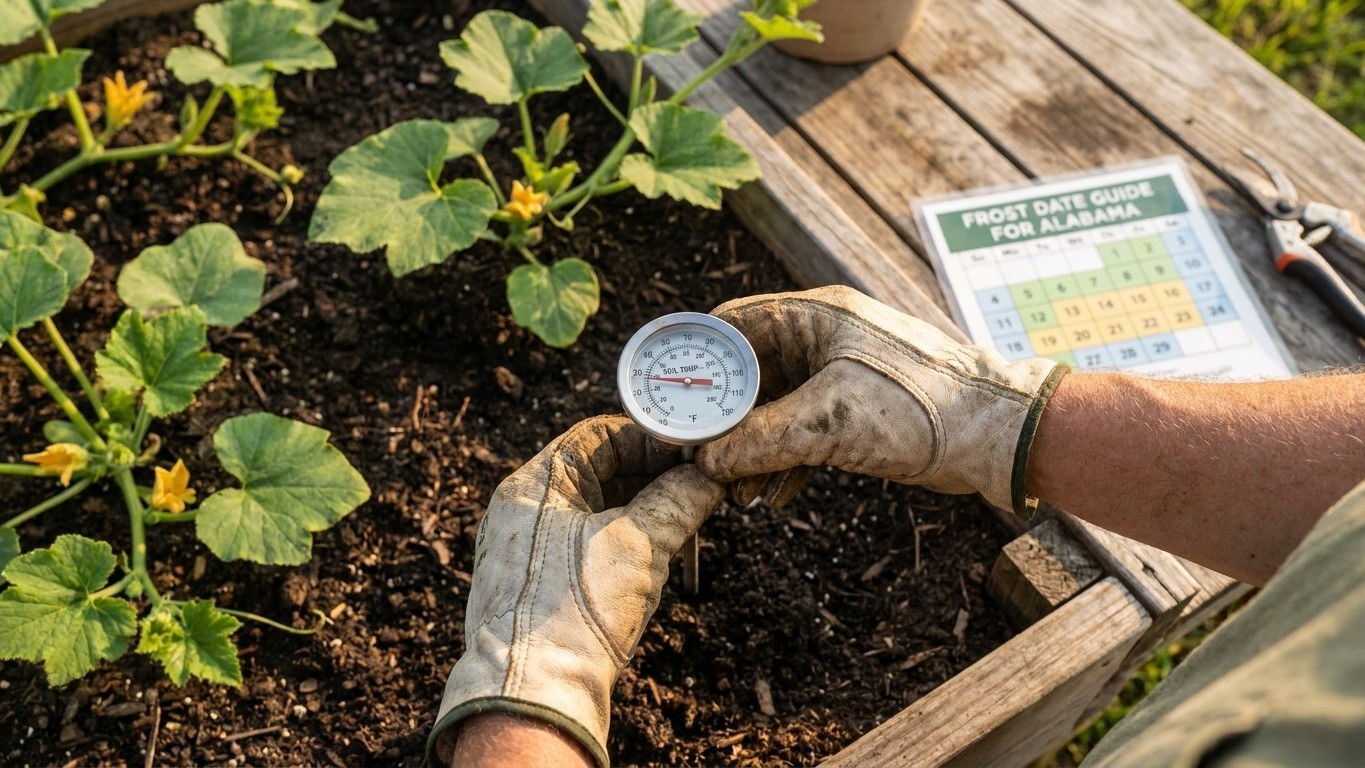
- Wait for the soil, not the calendar. Utah State University Extension is specific that pumpkin seed goes in once soil temperature reaches 65 F, and soil warms far slower than air, especially in New Mexico’s drier, high-elevation gardens where cold nights pull heat back out of the ground overnight. The gap between the last frost date and 65 F soil commonly stretches into weeks rather than days, which pushes actual sowing well past that April frost window for most of the state. The exact number of weeks depends on soil type, sun exposure, and elevation, so treat the frost date only as the earliest possible starting line, never as the sowing day itself.
- Use a soil thermometer instead of a guess. Push it two to four inches down at midmorning for several consecutive days. One warm afternoon after a cold week doesn’t mean the root zone has actually caught up.
- Use row covers if you want to move earlier. Clear plastic or fabric row covers trap daytime heat and can buy roughly two weeks on the sowing date by warming the soil underneath faster than bare ground would warm on its own. That two-week head start matters in a state where the safe flowering window closes in September.
- Count forward toward the flowering deadline. Once seed is in the ground, the vine still needs real time to grow before it produces its first female flowers. The earlier the soil legitimately reaches 65 F, the more cushion the plant carries into that September cutoff described above.
None of this changes with variety choice. It changes with elevation, soil composition, and how exposed a bed is to wind, which is why two gardens twenty miles apart in New Mexico can hit 65 F soil weeks apart from one another.
What goes wrong here
New Mexico’s frost-to-frost window is tight enough that small delays compound quickly. These are the failures that show up most often, and what actually fixes them.
- A late flower that never colors. Flowers opening after the safe window described above, roughly early to late September at the reference station and earlier still in colder, higher gardens, may set fruit, but that fruit runs out of warm days before its skin hardens and colors fully. Once the calendar moves into late September, pinch off new flowers, and even some smaller, later-set fruit, so the plant redirects energy into pumpkins that already have a head start.
- A fruit caught by frost before harvest. Utah State University Extension recommends harvesting with the stem attached and moving pumpkins somewhere they won’t freeze, advice that only helps if you act before the first fall frost date, not after it. Track the local frost forecast rather than relying on the reference dates alone, and plan the harvest day ahead of the cold snap rather than reacting to a surprise freeze warning.
- A vine that dies back before the skin hardens. Powdery mildew, drought stress, or an early cold snap can kill foliage while fruit is still soft-skinned, and without leaves shading and feeding the fruit, growth stalls before ripening finishes. Keep vines watered evenly through late summer and address foliar disease as soon as it appears, since a collapsed vine in August gives a pumpkin no realistic chance to catch up before the season ends.
- Insect pressure that weakens vines at the worst possible time. Squash bugs and cucumber beetles both target pumpkin vines in New Mexico gardens and can speed up vine collapse right when the plant needs its remaining weeks intact. For identification and control specific to this state, see our pages on squash bugs in New Mexico and cucumber beetles in New Mexico.
Common questions
Can I still sow pumpkins in June in New Mexico?
It depends on how quickly the vine reaches flowering and how much cushion is left before local frost. The general math is unforgiving: a June sowing needs the plant to flower with enough runway to finish the full 45 to 55 day post-flowering period before the first fall frost. In gardens that see frost by late October, that leaves little margin for a slow start or a cool stretch of nights in September.
Does soil temperature really matter more than the frost date?
For germination, yes. Utah State University Extension ties sowing specifically to a 65 F soil temperature rather than the last frost date, because pumpkin seed won’t germinate reliably in cold soil even when the air above it is frost-free. The frost date matters on the other end of the season, for deciding when the harvest deadline lands.
Should I start pumpkin seed indoors instead of direct sowing?
That choice comes down to how much cushion the garden needs before New Mexico’s September flowering deadline. Starting indoors and transplanting after the soil warms can recover the early weeks that direct-sown seed would otherwise lose waiting on cold ground, which matters most in higher-elevation gardens with a shorter effective season.
How do I know it’s time to harvest before frost hits?
Utah State University Extension advises harvesting with the stem still attached and storing pumpkins somewhere they won’t freeze. Watch the local forecast rather than the reference frost date alone, since rural and higher-elevation New Mexico gardens often see frost arrive one to two weeks earlier than the dates recorded at reference weather stations.