
In the Northwest Territories, pumpkin flowers need to open by late July to the first few days of August to leave enough time to Ripen Before Frost. That deadline comes straight from working backward from the average first fall frost near September 18, using the 45- to 55-day window Utah State University Extension gives for flowering to harvest. It’s one of the tightest windows covered on this site, and it starts with the flower, not the seed.
The short answer
Environment and Climate Change Canada’s 1981-2010 climate normals put the average first fall frost at the YELLOWKNIFE A station on September 18. That’s a mean, not a promise: in one year out of two, frost arrives later than that date, and in the other, it arrives earlier. Treat September 18 as the middle of a window, never as a date you can pencil in and forget. And remember this figure comes from a single station near Yellowknife, a territory this size isn’t one climate, and northern or upland communities can run weeks behind what that station records.
Utah State University Extension’s guidance is that a pumpkin needs 45 to 55 days from the moment its flower opens (and is pollinated) to reach a ripe, hard-skinned fruit ready for harvest. That clock starts at flowering, not at the day you drop seed in the ground or set out a transplant. Confusing the two is the single most common mistake gardeners make with this crop, and in a growing season as short as this territory’s, it’s the mistake that costs you the harvest.
Run the arithmetic against the mean frost date and you get the last safe flowering window. Count back 45 days from September 18 and you land on August 4. Count back the full 55 days and you land on July 25. That gives a window running from July 25 to August 4: a flower opening any later than that risks a fruit still green, or barely turning color, when the first hard frost arrives.
Because September 18 is only a midpoint, and frost can just as easily show up a week or two earlier, the safer target inside that window is the earlier end. A flower open by late July, rather than one that only opens in the first days of August, buys the full 55 days of the maturity range instead of the bare minimum of 45. Given how far north this territory sits, and how much variation exists between one community and the next, that cushion matters more here than almost anywhere else this site covers.
When to sow here
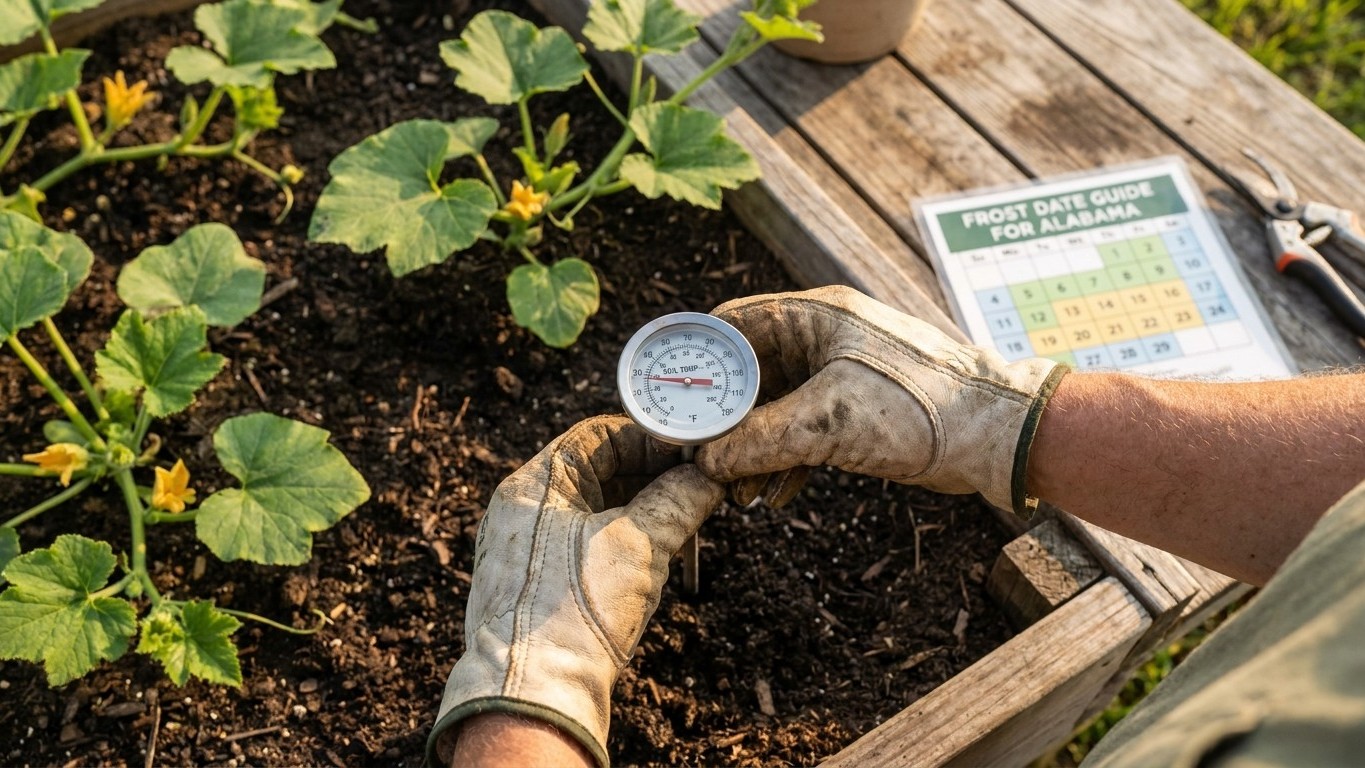
None of this works unless the sowing date itself is right, and that’s where a second number matters just as much as the frost date. Utah State University Extension’s guidance is that pumpkins go in the ground once soil temperature reaches 65°F, not on the calendar date of the last frost. Those two things are not the same, and conflating them is the second most common mistake made with this crop.
- Start from the last spring frost mean. The Canadian Climate Normals for YELLOWKNIFE A put the average last spring frost at May 25. Like the fall date, this is a midpoint: some years the last frost falls earlier, some years later, and it comes from one station, not the whole territory.
- Add the lag between air and soil. Air temperature climbs past the frost line well before soil ten or twelve inches down catches up, and in a climate this cold, that lag runs longer than it does farther south. Soil here often doesn’t hold steady at 65°F until well into June, sometimes later, even though the air has been frost-free for weeks by then.
- Count what row covers buy you. Row covers, laid over the bed, can warm the soil underneath faster than bare ground would warm on its own, buying roughly two weeks against an uncovered plot. In a territory where the whole flowering window is measured in days, two weeks is not a small thing; it can be the difference between a flower opening July 28 and one opening mid-August.
- Sow as soon as the soil, not the air, says yes. Skip the temptation to sow the week after the average last frost. Check the soil itself, or use covers to push that date earlier, then sow. Every week gained at the sowing end is a week of cushion at the flowering end, three months later.
Utah State University Extension names nine pumpkin varieties in its guidance without attaching days-to-maturity, size, or color figures to any of them. That’s useful as a reminder: a variety name alone tells you nothing about whether it fits this territory’s window. What decides that is the 45- to 55-day flowering clock above, not the name on the seed packet.
What goes wrong here
- A late flower that never colors. A flower opening in mid-August, past the July 25 to August 4 window, is racing a clock it can’t win against a mean frost of September 18. The remedy is upstream: sow the moment soil hits 65°F, use row covers to pull that date earlier by roughly two weeks, and don’t wait on the calendar last-frost date to make that call.
- A fruit caught by frost before the skin hardens. Utah State University Extension is specific that pumpkins should be harvested with the stem attached, before frost hits, and stored somewhere they won’t freeze. A fruit still soft-skinned when frost arrives won’t keep regardless of where you store it afterward, so the fix has to happen weeks earlier, at flowering, not at harvest.
- A vine that dies back before the skin hardens. Cool nights and shortening days late in the season can knock back vine growth before the fruit has finished hardening its rind, even if frost hasn’t hit yet. Watching the flowering date, not just the fruit, is the only way to know if a given vine has enough season left to finish the job.
- Insect pressure eating into an already short window. Squash bugs and cucumber beetles can slow a vine down at exactly the point it can least afford delay. Rather than repeat that guidance here, see this site’s dedicated pages on squash bugs in the Northwest Territories and cucumber beetles in the Northwest Territories for how to manage them in this climate specifically.
Common questions
Is September 18 a safe date to plan around?
No. It’s the average first fall frost recorded at the YELLOWKNIFE A station over the 1981-2010 period, meaning frost falls later than that in roughly half of all years and earlier in the other half. Plan against the earlier possibility, not the average.
Does the 45- to 55-day window start when I sow the seed?
No. Utah State University Extension’s figure runs from the day the flower opens and is pollinated to the day the fruit is ripe. Sowing date and transplant date don’t enter into that count at all.
Can I just sow earlier to dodge the whole problem?
Only as far as the soil allows. Sowing before soil reaches 65°F won’t speed anything up and can set germination back instead. Row covers are the one tool documented here for moving that soil-ready date earlier, by roughly two weeks.
What temperature should I store pumpkins at after harvest?
Utah State University Extension’s guidance doesn’t publish a specific storage temperature, humidity level, or keeping time for pumpkins. Its only instruction is to keep them somewhere they won’t freeze, harvested with the stem attached.