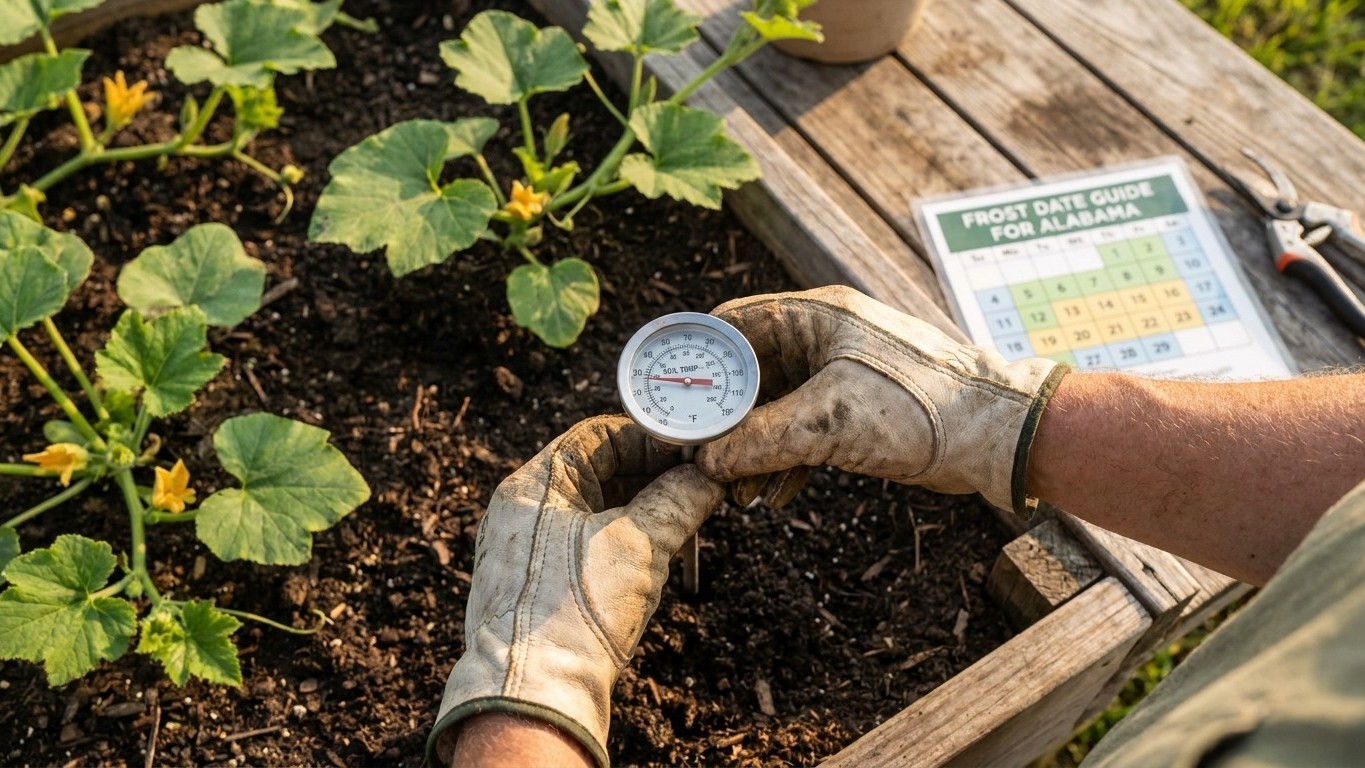

In Nova Scotia, pumpkin seed goes into the ground once the soil holds steady at 65°F, which typically lands in late May to early June, well past the average May 7 last frost. That planting window exists because the vine needs its flowers open by late August to early September, giving the fruit the 45 to 55 days it needs to mature and color before the average October 18 first fall frost shuts the season down.
The short answer
Start with the end date and work backward. Nova Scotia’s average first fall frost, drawn from the Halifax Stanfield International Airport station, lands on October 18. Utah State University Extension puts pumpkin maturity at 45 to 55 days after flowering, not from the day you drop seed in the ground. Count back 45 days from October 18 and you land on roughly September 3. Count back the full 55 days and you land closer to August 24. That gives a flowering window, not a single date: a pumpkin flower that opens any later than early September is racing a clock it’s likely to lose.
This is where the frost date itself needs a second look. October 18 is a mean, calculated from three decades of Environment and Climate Change Canada records. A mean is the midpoint of a spread, not a guarantee. In roughly half of all years on record, the first frost at that station actually arrived later than October 18. In the other half, it arrived earlier. Treat the date as the center of a range rather than a line you can plant right up against.
That statistical wrinkle matters more in Nova Scotia than it would somewhere with a drier, more continental climate. The province sits surrounded by ocean, and coastal air moderates temperature swings but doesn’t eliminate them. A cold snap riding in off the Atlantic in late September can hit vines that would otherwise have had another two or three weeks to finish ripening fruit. Growers who treat September 3 as their hard deadline for flowering, rather than August 24, are gambling on the second half of the average.
The safer read of the numbers pushes the target flowering window into late August, giving fruit the full 55-day cushion rather than the bare 45. Anyone gardening north of the Halifax Stanfield area, or at elevation, or well inland from the moderating coast, should assume their own frost date runs later in the calendar than the airport’s, which pushes the safe flowering window earlier still, not later. A province is not one climate, and the station behind this number is one point on a much larger map.
When to sow here
- Don’t sow at the last frost date. May 7 marks the average date air temperatures stop dropping below freezing, but pumpkin seed doesn’t germinate off air temperature. It needs the soil itself to hold at 65°F, and soil in a maritime climate like Nova Scotia’s warms slower than the air above it. Expect that mark to arrive weeks after May 7, generally not until late May or into the first days of June.
- Check the soil, not the calendar. A simple soil thermometer pushed to seed depth, checked in the morning before the sun has warmed the surface, is the only reliable way to know the 65°F line has actually been crossed. Guessing by the date alone risks seed rotting in cold, wet ground before it ever germinates.
- Use row covers to buy time. Clear or floating row cover laid over the planting area ahead of sowing traps solar heat in the soil and can advance that 65°F threshold by roughly two weeks. That head start matters directly: it shifts the whole chain of flowering and fruit-set two weeks earlier, widening the cushion before the October frost.
- Start indoors if the outdoor window feels tight. Seed started under cover a few weeks ahead of the outdoor soil target, then transplanted out once the ground has warmed and frost risk has passed, gives the same effect as the row cover: an earlier effective start date without asking the seed to sit in cold soil.
- Aim for the earliest safe date, not the average one. Given that the soil takes weeks past May 7 to reach 65°F, and that flowering needs to happen by late August at the latest, the practical sowing window in most of the province sits in the final week of May through the first week or two of June, sooner where row covers or transplants are used.
What goes wrong here
- A late flower that never colors. When sowing slips into mid-June, or a cool spring delays soil warming further, flowering can push past the early-September cutoff. The fruit sets, swells, and then simply runs out of season before it turns orange. The remedy is upstream: sow at the earliest date the soil allows, and use row covers to move that date up rather than accepting a late start and hoping the fall runs mild.
- A fruit caught by frost. Because October 18 is only a mean and frost arrives earlier in roughly half of all years, fruit that’s still finishing its color when a cold snap lands in late September or early October can be damaged before harvest. The remedy is to track the local forecast closely once the calendar turns to late September, and to bring in any fruit ahead of a predicted frost, storing it, per the source’s own guidance, somewhere it will not freeze.
- A vine that dies back before the skin hardens. Cool, damp fall conditions common near the coast can kill foliage back before the rind has had time to harden into a shell that will keep in storage. A collapsed vine also leaves fruit exposed to pests already covered on this site, including squash bugs and cucumber beetles, both of which speed vine decline once it starts. The remedy again traces back to timing: an early sowing date gives the vine more healthy weeks before the season’s cool, wet stretch sets in, and a hardened rind by the time that stretch arrives.
Common questions
Can I still sow pumpkins in June in Nova Scotia?
Early June sowing is workable if the soil has genuinely reached 65°F by then, which lines up with how long it typically takes coastal soil to warm past the May 7 average last frost. Sowing much later than the first couple of weeks of June starts to squeeze the flowering window that needs to close by early September.
What’s the latest safe date to transplant pumpkin seedlings?
There’s no single published cutoff date for transplanting, but the underlying math holds regardless of whether seed goes in directly or as a transplant: flowering needs to happen by roughly late August to early September to leave 45 to 55 days before the October 18 average frost.
Do I need to worry about a light frost before October 18?
The Environment and Climate Change Canada figure used here is a single average first-frost date, not a separate light-frost or hard-freeze threshold. No additional cutoff for a milder early frost is published in the source behind this figure, so the safest approach is to treat October 18 as the midpoint of a range and watch the local forecast closely as September ends.
How do I know my soil has actually reached 65°F?
A soil thermometer, inserted to the depth you plan to sow, read in the morning before direct sun skews the surface reading, is the most direct way to confirm it. Air temperature and calendar dates are both unreliable substitutes, since Nova Scotia’s maritime soil consistently lags behind the air above it.