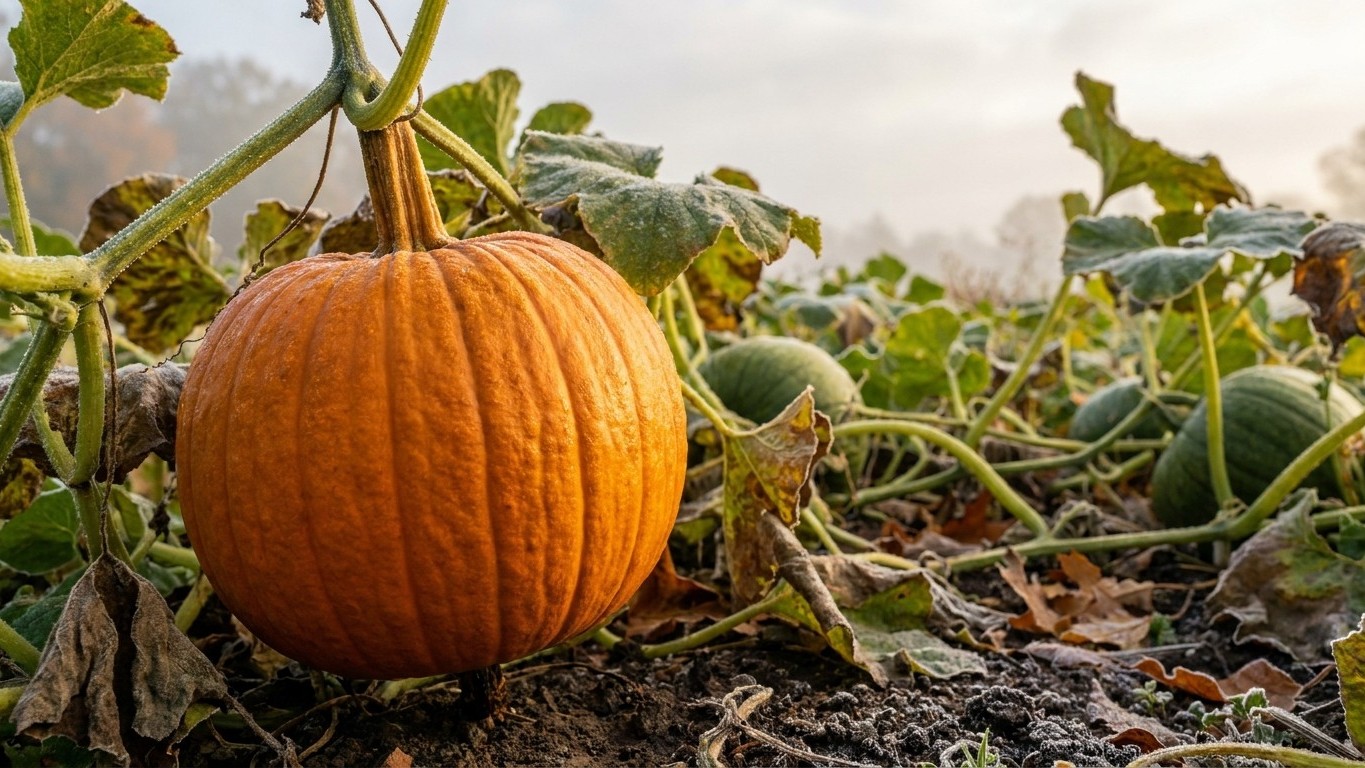

Yes, but the margin is thin. Will Pumpkins Ripen Before Frost in Nova Scotia? Nova Scotia’s frost calendar leaves pumpkin vines a narrow window: flowers need to open by roughly the last days of August or the first days of September for the fruit to color up and harden before the province’s average first frost. Sow late, and the crop is racing a clock that doesn’t leave much slack, especially since that frost date is only a midpoint, not a guarantee.
The short answer
Nova Scotia’s average first fall frost lands on October 18, based on the Canadian Climate Normals recorded at the Halifax Stanfield International Airport station. That’s a mean, not a promise: in roughly one year out of two, the real first frost falls later than that date, and in the other half, it arrives earlier. Treat October 18 as the center of a window, not a line you can plan against with confidence.
Pumpkins need 45 to 55 days after their flowers open to turn from green fruit into a hard-skinned, harvestable pumpkin. That clock starts at flowering, not at the day the seed goes into the ground, and not at transplanting either. So to get a ripe fruit by the average frost date, work backward from October 18: subtract 45 days and the count lands near September 3; subtract 55 days and it lands near August 24. That gives a rough window, late August through the first days of September, as the point by which a flower needs to have opened for a realistic shot at ripening before frost, on an average year.
Because the frost date is a fifty-fifty midpoint rather than a guarantee, the safer target sits at the earlier edge of that window, not the later one. A flower that opens September 3 is betting on frost holding off past its average date, which only happens about half the time. A flower open by late August carries more room if the season runs a bit cool or frost shows up right on schedule.
This is also why the sowing date matters more here than it would in a warmer region: there’s less room downstream to absorb a slow start. A seed that goes in a week late, or a seedling that stalls in cool, wet soil, pushes flowering later and eats directly into that already narrow late-August-to-early-September margin.
None of this accounts for local variation across the province. The reference station sits at the Halifax airport; the Annapolis Valley, Cape Breton’s higher ground, and other inland or northern districts can run measurably cooler, with frost arriving earlier than the provincial reading suggests. October 18 is a reference point for one location, not a forecast for every backyard.
When to sow here
Getting pumpkin seed into the ground at the right moment in Nova Scotia means working from two different benchmarks, not one, and mixing them up is the most common timing mistake gardeners make here. For a full breakdown of these benchmarks, see When to Sow Pumpkins in Nova Scotia.
- Start from the last spring frost, but don’t sow yet. The average last spring frost at the Halifax Stanfield station is May 7. Like the fall figure, it’s a mean: frost arrives later than May 7 in roughly half of all years, so treating that date as a safe cutoff for tender pumpkin seedlings is a gamble.
- Wait for the soil, not the calendar. Pumpkin seed needs soil at 65°F to germinate reliably. Soil warms far slower than air in a maritime climate like Nova Scotia’s, where nearby ocean water keeps spring cool and damp well past the point when the air already feels like summer is coming. That gap means the 65°F soil threshold usually arrives well after May 7 has come and gone, not right alongside it.
- Test the ground before trusting it. A soil thermometer pushed a couple of inches into the bed, checked over several mornings, is the only reliable way to confirm the ground has actually crossed 65°F. Guessing from air temperature or the date on the calendar skips the step that actually predicts whether seed will germinate.
- Use row covers to claim back time. Floating row covers laid over a prepared bed can warm the soil and air underneath enough to buy about two weeks on the calendar, letting seed go in earlier than bare, uncovered ground would allow. In a season this tight, two weeks gained at the front end is two weeks of extra room at the back end, closer to that late-August flowering deadline.
- Count forward to flowering, not just to germination. Once seed is in warm soil, the plant still needs weeks to establish, run out its vines, and set its first female flowers, the ones that start the 45-to-55-day countdown once pollinated. Sowing late, even by a week, pushes flowering later and shrinks the margin before the cutoff calculated above.
In practice, gardeners who wait for a comfortable, frost-free-feeling day in late May or early June before sowing directly into open ground are often sowing right at the edge of what a Nova Scotia season can support.
What goes wrong here
- A late flower that never colors. When the first female flowers don’t open until mid-September, the 45-to-55-day clock can’t finish before frost, and the fruit stays green and immature on the vine. The fix is upstream: warm the soil early with row covers, confirm 65°F with a thermometer rather than a guess, and sow as soon as that reading holds, so flowering lands closer to late August than mid-September.
- A fruit caught by frost while it’s still sizing up. A pumpkin can be orange and nearly full-size yet still have a soft, unhardened skin when the first hard frost arrives, which damages the flesh and ends any further ripening. Watching the forecast in early-to-mid October and covering vines on threatened nights, or cutting the fruit with its stem attached and moving it somewhere it won’t freeze, protects fruit that’s close but not quite finished.
- A vine that dies back before the skin hardens. Foliage collapse, whether from disease pressure or from pests like squash bugs or cucumber beetles working through the season, can strip a plant of the leaves it needs to keep feeding a maturing fruit. Once the vine is gone, the pumpkin stops hardening no matter how many days remain before frost. Watching for early pest damage and addressing it promptly keeps the plant photosynthesizing through the full 45-to-55-day window instead of quitting halfway through it.
Checking this against your own county
Every figure above comes from one weather station, at the Halifax airport, and one set of climate normals. Nova Scotia isn’t one climate: the Annapolis Valley, the South Shore, Cape Breton’s uplands, and the Halifax area can all run on noticeably different frost schedules, and a property a few hundred feet higher or a few miles further from the coast can see frost weeks apart from the airport reading.
For expectations closer to a specific property, the Nova Scotia Department of Agriculture is the right next stop, along with local agricultural resource offices that track conditions county by county rather than from a single provincial station.
Common questions
Can I still sow pumpkins in June in Nova Scotia?
It’s possible, but risky. Working backward from the October 18 average frost, seed going in during June likely pushes flowering close to or past the safer late-August cutoff, leaving little room for a cool summer or an early frost.
Which variety ripens fastest here?
Days-to-maturity figures vary by variety and aren’t covered by the sources behind this page. Check the specific number printed on the seed packet and count forward from an expected flowering date, using the same 45-to-55-day rule from flowering to harvest.
What should I do if frost is coming and my pumpkin isn’t fully colored?
Cut it with the stem attached and move it somewhere it won’t freeze. That’s the extent of the storage guidance available here; no specific temperature or humidity figure is published for how long that buys.
Does one light frost ruin the whole crop?
This page’s sources don’t distinguish between a light frost and a hard freeze, only that pumpkins should be harvested before frost hits. Once frost has touched an unripe fruit or collapsed the vine, treat further ripening as unlikely.