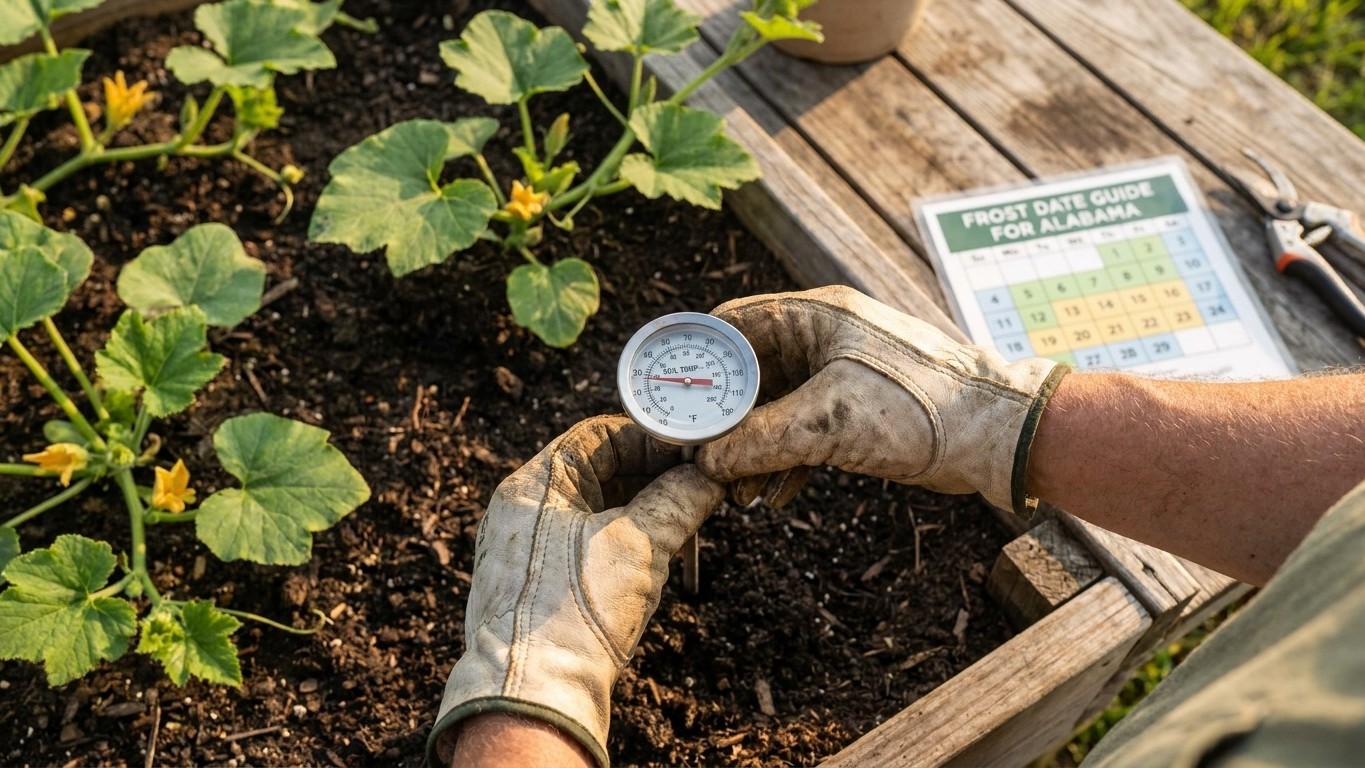

In Nunavut, sow pumpkin seed once the soil at seed depth has warmed to 65°F, not simply once the air clears frost. Around Rankin Inlet, the mean last spring frost lands June 19, but the real deadline works backward from fall: flowers need to open by the third week of July at the latest, because a fruit needs 45 to 55 days after bloom to ripen before the mean first fall frost of September 13. Both dates are averages, not guarantees, in a climate where the growing season barely holds open long enough for this crop.
The short answer
Start from the other end of the calendar. Rankin Inlet’s mean first fall frost lands September 13, and Utah State University Extension’s research on pumpkin growth puts fruit maturity at 45 to 55 days after the flower opens, not after the seed goes into the ground. Count backward from September 13 and the flower has to open somewhere between July 20 and July 30 to leave enough days for the fruit to size up, harden its skin, and turn from green to orange before frost closes the season.
That’s a narrow target, and it’s stricter than it sounds. A flower opening on July 30 needs the full 55 days just to make the September 13 cutoff, with no margin for a cool stretch or an earlier-than-average frost. A flower opening closer to July 20 has more breathing room inside that 45-to-55-day range. Either way, this window sits weeks earlier than pumpkin advice written for milder regions, because the frost-free stretch here runs roughly 86 days total, June 19 to September 13, one of the shortest on the continent.
Why the mean dates aren’t guarantees
Two cautions matter more here than almost anywhere else this crop gets grown. First, September 13 is a mean date pulled from the Canadian Climate Normals for the RANKIN INLET A station, covering 1981 to 2010, not a promise. Under Environment and Climate Change Canada’s own definition of a normal, frost arrives after that date in roughly one year out of two. Treat September 13 as the midpoint of a range, not a line to plant right up against.
Second, a single weather station can’t speak for a territory this size. Rankin Inlet sits on the Hudson Bay coast; inland and more northern parts of Nunavut run colder and shorter, sometimes by weeks. Anyone gardening outside the immediate Rankin Inlet area should treat the June 19 and September 13 means as approximate, and lean toward the earlier end of the flowering window rather than the later one.
Put together, the answer is to aim for flowers opening no later than late July, closer to July 20 than July 30 if at all possible, and to accept that even hitting that mark leaves little cushion against a cold snap stealing the last of the ripening days.
When to sow here
Sowing date has less to do with the calendar than with the soil thermometer. Utah State University Extension is specific on this: pumpkin seed goes into the ground once soil temperature reaches 65°F, a threshold with no fixed relationship to the last frost date. Air warms in days; soil warms in weeks, especially where cold ground holds its chill long after the air stops frosting.
Reading the soil instead of the calendar
Rankin Inlet’s mean last spring frost lands June 19, but soil reaching 65°F almost always trails that date, sometimes by a meaningful stretch, because the same conditions that keep this ground cold for most of the year don’t reverse themselves the moment the air clears. Utah State’s material doesn’t publish an exact lag figure for any particular region, so the working rule is to trust the soil thermometer over the frost date every time.
- Check soil, not air. Push a soil thermometer to seed depth in the actual planting spot. Don’t sow on one warm afternoon; sow once the reading holds at 65°F over several consecutive days.
- Expect the real sowing date to land well past June 19. Because soil trails air by weeks in cold, shallow ground, the practical window here lands later into summer than the mean frost date alone would suggest.
- Warm the ground on purpose. Black plastic mulch or a cold frame set over the row for a week or two ahead of sowing raises soil temperature faster than waiting on sun alone, which matters when the flowering deadline is already tight.
- Use row covers to buy time. A floating row cover over young plants can buy roughly two weeks of protected growing time, cushioning the sowing decision and any cool spell right after seeding.
- Start indoors where practical. Starting seed indoors and transplanting once outdoor soil and air hold steady saves days that would otherwise be spent waiting on marginal ground, and every day saved is a day added to the 45-to-55-day flowering clock that has to finish before September 13.
None of this changes the arithmetic from the section above. It only shifts when the vine can realistically get started, which decides whether a flower has any real chance of opening by late July.
What goes wrong here
Nunavut’s short season is the whole problem, and it shows up in three predictable patterns.
Three ways the season runs out
- A late flower that never colors. If the first female flower doesn’t open until early August, the fruit is still running its 45-to-55-day clock when the September 13 mean frost arrives, and fruit caught mid-ripening often stays green or pale rather than finishing its color. The fix is upstream: push sowing earlier through soil warming and row covers, and if a plant is clearly behind by late July, pinch off new blossoms so the vine puts its energy into fruit already set instead of starting a race it can’t win.
- A fruit caught by frost before harvest. Because September 13 is only a mean date, frost can arrive earlier in some years, catching fruit that looked close to ready. Utah State’s guidance is to harvest with the stem attached before frost hits and to move fruit somewhere it will not freeze, rather than leaving it on the vine hoping for a few more warm days that a mean date can’t guarantee.
- A vine that dies back before the skin hardens. Cold nights can knock foliage back well before the rind has toughened enough for storage, leaving a pumpkin that looks finished but bruises or softens quickly afterward. Once the vine has collapsed there is no fixing the rind from outside; the remedy is judging harvest by the fruit’s own hardness and stem condition rather than a calendar date, and using a soft-skinned pumpkin sooner rather than trying to store it.
Common questions
Can pumpkins actually finish ripening outdoors in Nunavut?
It’s possible, but the margin is thin. Flowers need to open by late July, soil needs to reach 65°F well before that, and frost needs to hold off until at least the September 13 mean date, which itself arrives earlier than average in half of all years. Every one of those pieces has to line up.
What happens if soil never reaches 65°F?
Seed sown into colder ground germinates poorly or rots before it sprouts. Rather than sowing on a fixed date, wait for the soil thermometer reading and use black plastic mulch, a cold frame, or an indoor start to reach that threshold sooner than bare ground would on its own.
How reliable is the September 13 frost date?
It’s a mean pulled from Canadian Climate Normals covering 1981 to 2010 at the RANKIN INLET A station, which means frost falls after that date about half the time and before it the other half. Treat it as a midpoint for planning, not a safe cutoff for harvest timing.
Should gardeners elsewhere in Nunavut use Rankin Inlet’s dates?
Only as a rough guide. Rankin Inlet sits on the Hudson Bay coast, and inland or more northern communities in the territory typically run colder with a shorter frost-free stretch. Where local frost records exist, they should take priority over the Rankin Inlet figures used here.