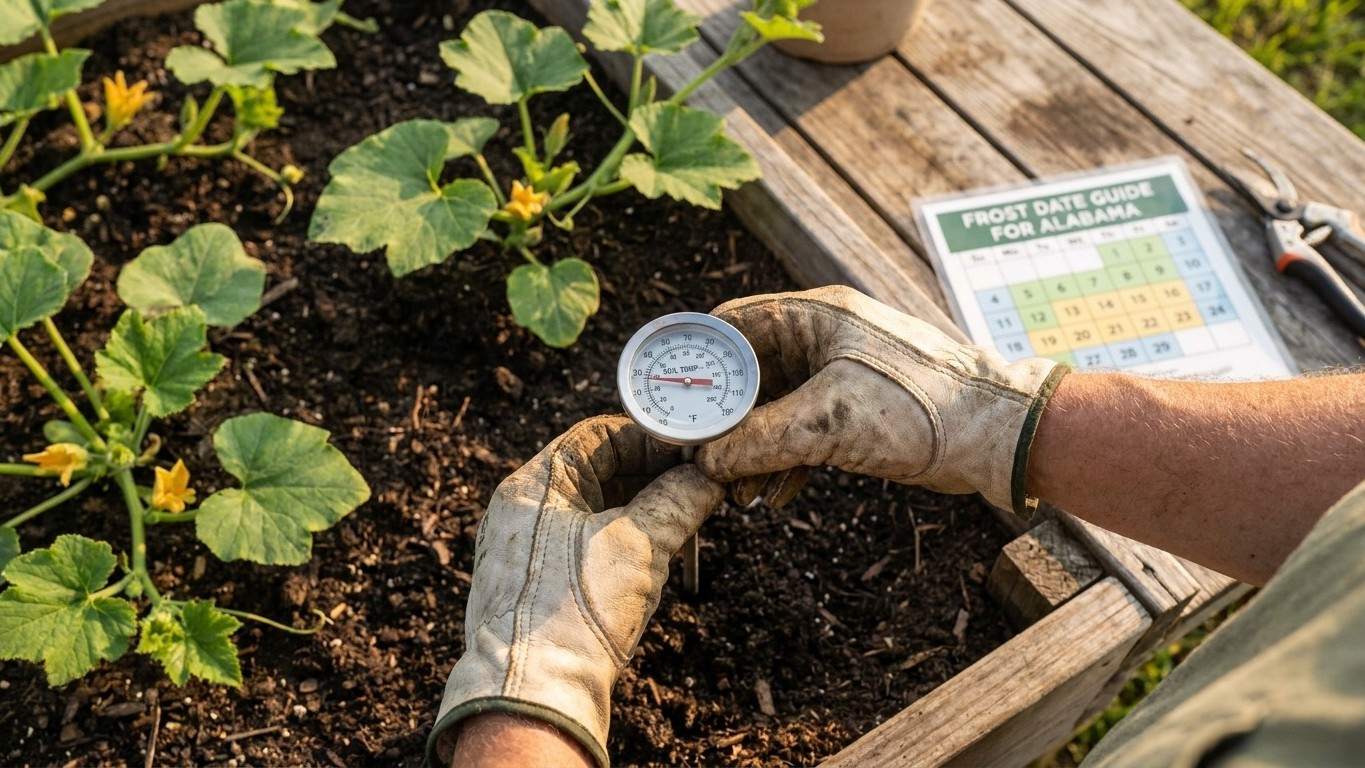

In Vermont, pumpkin seed goes into the ground once the soil itself reads 65 F, which lands two to three weeks past the last spring frost window of April 30 to May 10. Miss that mark and the math stops working: the state’s first fall frost, October 3 to October 13, can catch fruit before the rind ever hardens. Every decision about sowing, flowering, and harvest traces back to that fall date.
The short answer
Running the frost math backward
Start at the other end of the calendar. Vermont’s first fall frost lands somewhere between October 3 and October 13, according to NOAA NCEI’s 1991-2020 Climate Normals for the Burlington station, USW00014742. That window is the hard stop. Nothing ripens after it, and a hard freeze does real damage to any fruit still on the vine once it arrives.
Utah State University Extension puts pumpkin maturity at 45 to 55 days after flowering, not after seeding and not after transplanting. That distinction matters more than almost anything else here: a pumpkin plant can sit in the ground for weeks doing nothing but growing vine and leaf before it opens a female flower, and the clock that decides whether a fruit turns orange doesn’t start until that flower opens.
Run the subtraction both ways. If frost arrives on the early end of the window, October 3, and the fruit needs the full 55 days, the last flower with a real shot at ripening has to open by August 9. If frost holds off until October 13 and the fruit only needs 45 days, a flower opening as late as August 29 can still finish. That gives a working range rather than a single date: the final flowers on a Vermont pumpkin vine need to open somewhere between August 9 and August 29 to have a fair chance at a ripe, hardened rind before the ground freezes.
That range comes from crossing a measured frost probability window against a measured maturation window, nothing more. It’s also why the answer skews friendly. Burlington sits on Lake Champlain, the mildest corner of Vermont, so a grower there is working with the gentlest version of this math. The Green Mountains and the Northeast Kingdom run colder and their frost tends to arrive sooner, which would push the safe flowering deadline earlier still, even though no separate frost date for those regions appears in the data behind this page. A grower in those colder pockets should treat August 29 as optimistic and lean toward the earlier end of the window instead.
When to sow here
The sowing sequence
Working backward from a flowering deadline is only useful if it lands on a sowing date a person can act on. Here is how that chain runs in this state.
- Mark the last spring frost window first. NOAA NCEI’s Burlington data puts it at April 30 to May 10. That date matters for tender transplants like tomatoes, but it is not the number that governs pumpkin seed.
- Wait for the soil, not the air. Pumpkin seed sown into cold ground rots or simply sits ungerminated. Utah State University Extension’s guidance is to sow once the soil itself reaches 65 F, and soil warms far slower than the air above it. A calendar that says frost risk has passed by early May does not mean the top six inches of a garden bed have caught up to that warmth yet; the ground needs sustained sun and warmer nights to close that gap, and that takes real additional time after the air has already cleared frost range.
- Use a row cover to close the gap faster. A row cover laid over the bed traps daytime heat and can buy roughly two weeks, meaning soil under cover reaches 65 F sooner than bare, exposed soil in the same yard. That two-week cushion is often the difference between sowing in comfort and rushing to plant later than the season really allows.
- Decide between direct seed and transplant based on that cushion. Direct seeding is simplest once soil hits 65 F on its own. Starting seed indoors and setting transplants out after the last frost, under a row cover, lets a grower claim some of that two-week head start without asking bare ground to warm faster than it naturally will.
- Count forward as well as backward. Once seed goes in, the plant still needs weeks of vegetative growth before it flowers at all, and only then does the 45-to-55-day ripening clock begin. Sowing as early as the soil allows is what buys room for that whole sequence to finish before the October frost window closes in.
None of this replaces checking the actual soil. A thermometer pushed a few inches down on a sunny afternoon gives a more honest answer than any date circled on a calendar.
What goes wrong here
Three failure points tied to this season’s length
- A late flower opens and the fruit never colors. If a female flower opens after the safe window, roughly past August 29 even on the most forgiving version of the math, there simply are not 45 days left before the first fall frost arrives. The fruit sets and swells some, then stalls green, because the ripening clock Utah State University Extension describes never gets to run its full course. The fix sits upstream: sow earlier, use a row cover to shave weeks off the wait for 65 F soil, and give the plant full sun so it reaches flowering age sooner.
- A ripening fruit gets caught by the first fall frost. Even a fruit that flowered on schedule can sit exposed when frost lands on the early end of the October 3 to October 13 window. Utah State University Extension’s advice is to harvest with the stem attached and move fruit somewhere it will not freeze; no specific storage temperature or keeping time appears in that guidance, only that freezing is what to avoid. Watching the forecast in early October and pulling fruit ahead of a hard freeze protects a rind that is close to hardened but not quite there yet.
- The vine dies back before the rind hardens. Vines can collapse early from disease or insect damage well before frost has anything to do with it. Squash bugs and cucumber beetles are common culprits in Vermont gardens, and both already have dedicated coverage on this site rather than repeated here: see squash bugs in Vermont and cucumber beetles in Vermont for identification and control. A vine that dies back with fruit still soft-skinned rarely finishes hardening on its own, so scouting through August and September matters as much as the sowing date does.
Common questions
Can I sow pumpkin seed right after the last spring frost in Vermont?
Not reliably. The last frost window (April 30 to May 10) marks when the air stops threatening tender seedlings, but pumpkin seed wants 65 F soil, which trails the air by weeks. Sowing directly on the frost date usually means cold, slow-germinating, or rotting seed.
What actually happens if a pumpkin flowers too late?
The fruit sets but runs out of time. With only 45 to 55 days between flowering and maturity, and the first fall frost landing October 3 to October 13, a flower opening after roughly late August leaves the fruit green and soft-rinded when the cold arrives.
Does the frost date really change much across Vermont?
The measured window here, October 3 to October 13, comes from the Burlington station on Lake Champlain, the mildest part of the state. The Green Mountains and the Northeast Kingdom run colder and frost typically arrives sooner in those areas, though no separate measured date for them is included in this data.
How do I actually check for 65 F soil instead of guessing?
A basic soil thermometer pushed a few inches into the bed, checked in the afternoon over a few consecutive sunny days, is the most direct way. Waiting for a warm afternoon isn’t enough on its own; the soil needs to hold that temperature, not just touch it once.