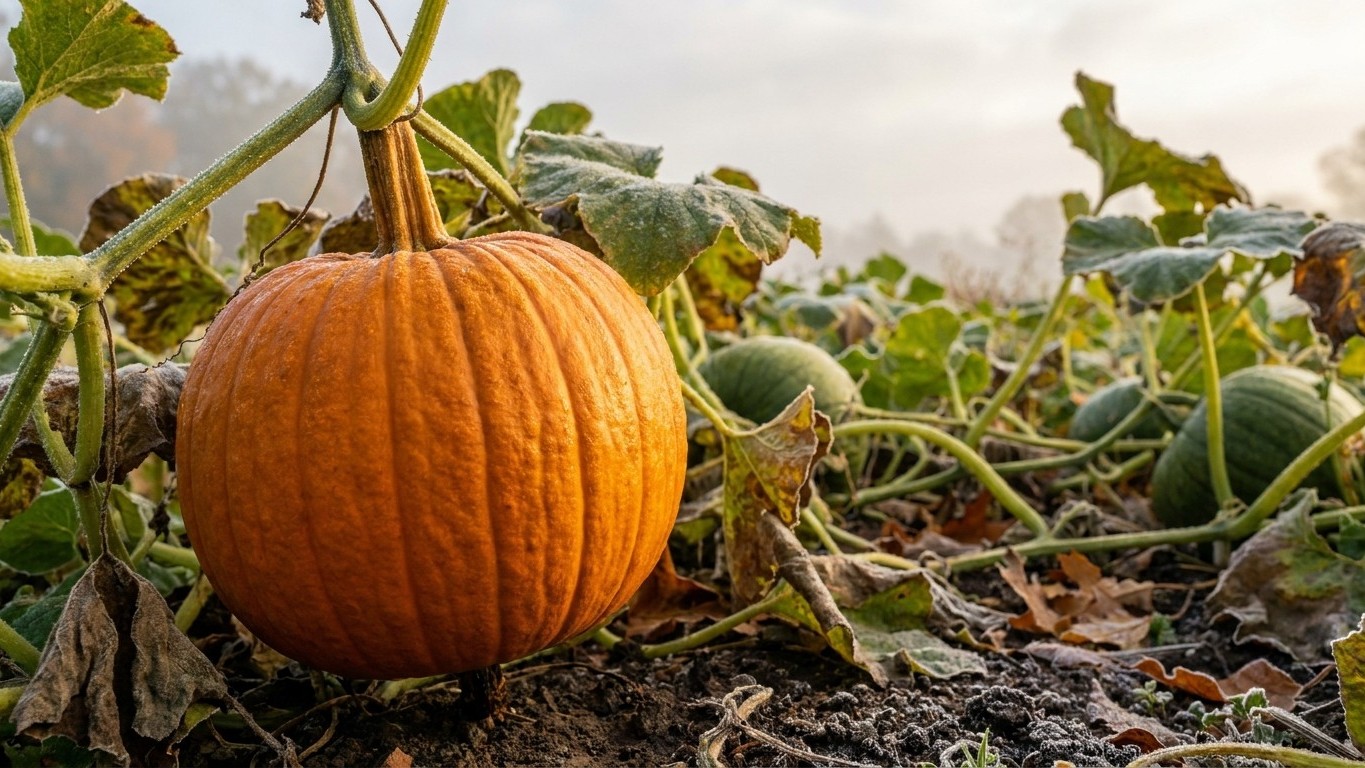

If you garden anywhere near Burlington, the math works in your favor most years, but only if the last flowers on the vine open before mid-to-late August. Push past that window and the fruit runs out of season before the rind fully colors and the stem cures. Everything below explains why that date matters more than your sowing date ever will, and answers the question every local grower eventually asks: Will Pumpkins Ripen Before Frost in Vermont?
The short answer
Start with the frost, not the seed packet. Around Burlington, the first fall frost typically arrives somewhere between October 3 and October 13, based on NOAA’s 1991-2020 Climate Normals for station USW00014742. That’s a real window, not a single day, and it shifts earlier the farther you move from Lake Champlain’s moderating effect. The Green Mountains and the Northeast Kingdom see frost land noticeably sooner than the lakeshore does.
Utah State University Extension puts pumpkin maturity at 45 to 55 days after flowering, not from the day you drop seed in the ground. That distinction changes everything about how you plan a Vermont pumpkin patch. A pumpkin doesn’t count down from germination; it counts down from the moment its flower opens and sets fruit. So the real question isn’t “when do I plant?” It’s “when does my last flower need to open to still finish before frost?”
Run the subtraction both ways. Take the earliest end of the frost window, October 3, and subtract the full 55 days: you land on roughly August 9. That’s your worst-case cutoff, the one that assumes an early frost and a slow-finishing fruit. Now take the latest end of the frost window, October 13, and subtract only 45 days: you land closer to August 29. That’s the best-case cutoff, assuming a later frost and a fast-finishing fruit.
So the honest answer is a window, not a date: somewhere between the second week of August and the last week of August is when your final flowers need to open. Growers close to Burlington, where the frost window runs later, have a bit more room to work with. Growers up in the hills or the Kingdom, where frost tends to arrive earlier than the lakeshore average, should treat the earlier end of that range, roughly August 9 to August 19, as the real deadline rather than the exception.
Nothing about this changes if you started your seeds indoors, used black plastic mulch, or picked a fast vine over a slow one. Those choices affect when flowering happens, not how long the fruit needs once it starts. The clock that matters is the one that starts at the flower, and it runs the same 45 to 55 days no matter how the plant got there.
When to sow here
Sowing date is a means to an end: getting flowers open early enough to hit that August window above. For a detailed breakdown of When to Sow Pumpkins in Vermont, see the guide linked here. But there’s a trap here that catches a lot of Vermont gardeners, and it has nothing to do with frost.
- Start from the last spring frost window, not the sowing date. NOAA’s Climate Normals put the last spring frost near Burlington between April 30 and May 10, with colder inland counties trailing behind that.
- Understand that soil warms on its own schedule. Pumpkin seed needs soil at 65 F to germinate reliably, and soil temperature lags air temperature by weeks, not days. The last frost passing doesn’t mean the ground underneath it is ready. Sowing into cold, wet soil usually means rot before germination, not an early start.
- Check the soil directly instead of trusting the calendar. A simple soil thermometer pushed a few inches down tells you more than any date on a chart. Sow when it reads 65 F, whenever that happens to fall.
- Use row covers if you want to move earlier. Row covers can buy roughly two weeks by trapping heat over the bed, which speeds up how soon that 65 F soil threshold gets hit. That two-week head start is often the difference between a comfortable flowering window and a tight one.
- Count backward from the flowering deadline, not forward from planting day. Once you know your realistic sowing date, check how many days your variety typically needs to reach flower (that figure isn’t standardized enough to print here, so check the seed packet), and confirm the resulting flower date lands inside the August window described above.
What goes wrong here
- A late flower that never colors. If the last blossoms open after the safe window, closer to September than August, the fruit sets but runs out of warm days before the rind finishes turning orange. The remedy is upstream: track your soil temperature and sowing date carefully enough that flowering wraps up inside the window, and don’t count on late-season flowers to produce anything usable.
- A fruit caught by frost before the stem cures. Utah State University Extension is specific that pumpkins should be harvested with the stem attached, before frost hits, not after. Once frost touches the fruit, quality drops fast. The remedy is to harvest early if a frost is forecast rather than gambling on a few extra days of color development.
- No clear answer on how to store the harvest. The Utah State University Extension guidance only says pumpkins should be kept “where they will not freeze,” without giving a storage temperature, humidity level, or keeping time. Don’t borrow a number from winter squash or another crop and assume it applies; if you need precision here, this source simply doesn’t provide it, so plan storage conservatively and check fruit condition often.
- A vine that collapses before the skin hardens. Vines weakened by squash bugs or cucumber beetles often die back early, cutting the fruit off from the leaves that were still feeding it. This site covers both of those pests in dedicated state pages; if your vines are yellowing or wilting mid-season, that’s the more useful place to diagnose the cause than a general pumpkin guide.
Checking this against your own county
Everything above is built on averages for the Burlington area, and Vermont’s frost timing is anything but uniform across the state. A garden in the Champlain Valley behaves differently from one in the Northeast Kingdom or up a mountain valley, sometimes by a couple of weeks in either direction. Before you lock in a sowing date based on this page, check your own county’s frost data and planting guidance with University of Vermont Extension. They track local conditions county by county, which is the level of detail a statewide average can’t give you.
Common questions
Can I still plant pumpkins in July in Vermont?
Only if your variety flowers fast enough to still finish inside the August flowering window described above, since maturity runs 45 to 55 days from flower, not from seed. Late sowing leaves very little margin against the October frost window.
Does soil temperature matter more than air temperature for sowing?
For germination, yes. Pumpkin seed needs 65 F soil to sprout reliably, and that threshold arrives weeks after the last spring frost passes, not on the same day.
What if my pumpkin is still green when frost is forecast?
Harvest it with the stem attached before the frost hits rather than waiting. A green pumpkin caught by frost won’t finish coloring afterward.
Is Burlington’s frost window typical for the whole state?
No. It’s the mildest corner of Vermont thanks to Lake Champlain. The Green Mountains and the Northeast Kingdom see frost arrive earlier, so check county-level data through University of Vermont Extension before relying on the Burlington window.