
West Virginia gardeners get one real planting window for pumpkins, and it’s set less by the calendar than by two numbers working against each other: the state’s first fall frost and the 45 to 55 days a pumpkin flower needs to turn into a ripe fruit. Sow too late, or too early into cold soil, and the math simply doesn’t clear before the first freeze.
The short answer
West Virginia’s first fall frost, according to NOAA NCEI’s 1991-2020 Climate Normals for station USW00013866, lands somewhere between October 18 and November 1. That’s the boundary. Everything about pumpkin timing in this state gets built backward from that window, not forward from spring.
Utah State University Extension puts the fruit-development clock at 45 to 55 days, but that clock starts when the flower opens, not when the seed goes into the ground. So the real question isn’t “when do I plant,” it’s “when does the last flower that still has time to finish need to open.” Run the subtraction against the earlier end of the frost window, October 18, and a 55-day pumpkin needs its final flower open by around August 24. A faster 45-day pumpkin has until roughly September 3. Push the calculation to the later end of the frost window, November 1, and those same varieties get until September 7 and September 17.
That gives a working range rather than a single cutoff: the last safe flower-opening date in West Virginia falls somewhere between late August and mid-September, depending on where in the state the garden sits and which end of the 45-to-55-day range that particular pumpkin runs. A vine tucked into a warm river valley near Charleston has more room than one on a ridge or in a higher hollow, since NOAA’s own data flags that Charleston sits in a river valley and that higher elevations across the state freeze noticeably earlier in fall.
This is the piece growers most often get backward. They count 45 to 55 days from the sowing date, land on a harvest date that looks safely inside the season, and then watch a fruit that set late sit green on the vine when frost arrives. The clock Utah State University Extension describes only starts once a flower is pollinated and the fruit begins forming, not when the vine first breaks ground. Everything upstream of that flower, germination, vine growth, the plant reaching flowering size, still has to happen first, and it eats into the calendar before the 45-to-55-day window even opens.
When to sow here
Sowing in West Virginia isn’t set by the last spring frost date on its own. It’s set by soil temperature, which lags well behind the air.
- Start with the frost window. NOAA NCEI’s Climate Normals for station USW00013866 put West Virginia’s last spring frost between April 9 and April 23. That date only tells you when the air stops threatening to freeze the plant; it says nothing about the ground.
- Wait for the soil, not the air. Utah State University Extension is specific on this: pumpkins go in once the soil itself reaches 65°F. Soil at seed depth warms weeks slower than the air above it, so treating the last-frost date as the sowing date is the most common timing mistake in this crop. The 65°F mark typically doesn’t arrive until well into spring, after that frost window has already closed and the ground has had real time to bake.
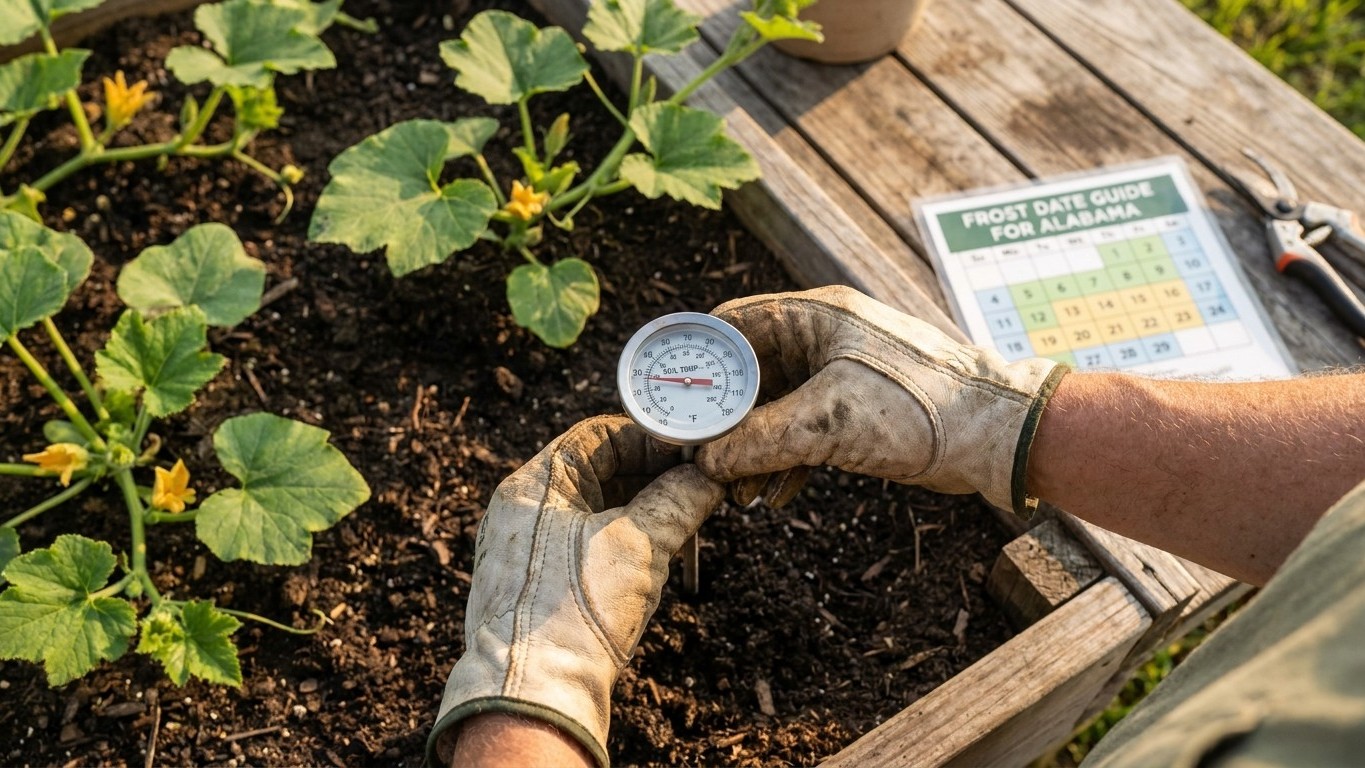
- Check the ground directly. A simple soil thermometer, pushed a couple of inches down at midday, is the only reliable way to know the 65°F line has been crossed. Air temperature on a thermostat or weather app doesn’t substitute for it.
- Use row covers to buy time. Row covers laid over the bed can warm the soil underneath faster than open ground, effectively buying about two weeks on the front end of the season. That’s the difference between sowing in cold, sluggish soil and giving seeds a head start before the true 65°F threshold would otherwise arrive.
- Work backward from the fall side too. Once soil is warm enough to sow, the vine still needs enough weeks to grow, flower, and let that flower finish its 45-to-55-day run before the first fall frost window opens in mid-to-late October. Sowing as soon as the soil legitimately hits 65°F, rather than waiting for a convenient weekend, is what keeps that math from running out of room.
What goes wrong here
- A late flower that never colors. A flower that opens after the safe late-August to mid-September window is fighting the calendar from the start. Even if it sets fruit, there isn’t enough of the 45-to-55-day window left before frost for the rind to color and harden. Remedy: sow as soon as soil hits 65°F rather than the last comfortable weekend, and use a row cover earlier in spring to push that sowing date up by roughly two weeks.
- A fruit caught by frost before it finishes. Because West Virginia’s first fall frost can arrive as early as October 18 in some years, and earlier still at higher elevations, a fruit that’s only 35 or 40 days into its 45-to-55-day development gets frozen while still unfinished. Remedy: track flowering dates on the vine through the season, and if a fruit is clearly behind schedule as October approaches, harvest early rather than gamble on a late-season warm stretch that may not come.
- A vine that dies back before the skin hardens. Vines can collapse from cold, disease, or simple exhaustion before the rind has had the chance to cure to a hard, storable shell. A pumpkin cut from a dead vine with soft skin won’t finish ripening on its own. Remedy: once the vine shows real dieback, cut fruit with the stem attached and move it somewhere it will not freeze, since Utah State University Extension’s guidance on curing and keeping goes no further than that single condition.
Common questions
Can I still plant pumpkins in June in West Virginia?
It depends entirely on which variety and which end of the state. A June sowing leaves a fast, 45-day pumpkin more room than a slow 55-day type, and a valley garden near Charleston has more room than a high-elevation garden that freezes earlier. Once soil is at 65°F, the deciding factor becomes whether the vine can flower early enough to clear that 45-to-55-day window before the first fall frost, which falls between October 18 and November 1.
What happens if a pumpkin flower opens too late?
The fruit that forms from it may set, grow, and even begin to color, but it’s racing the clock against the state’s first fall frost. If frost arrives before the flower’s 45-to-55-day window has run its full course, the fruit is caught unfinished, often green under the rind or soft-skinned, and won’t cure properly even if harvested immediately.
Which pumpkin varieties suit West Virginia’s season?
Utah State University Extension’s guidance doesn’t attach specific day counts or sizes to individual named varieties, so no figures are published here for any of them. Gardeners in this state commonly grow types sold under names such as ‘Connecticut Field,’ ‘Howden,’ ‘Autumn Gold,’ ‘Sugar Pie,’ ‘Jack Be Little,’ ‘Baby Boo,’ ‘Long Island Cheese,’ ‘Cinderella,’ and ‘Atlantic Giant.’ Whichever is chosen, the same 45-to-55-day flowering-to-harvest clock and the same 65°F soil threshold apply.
How do I know my soil has reached 65°F?
A soil thermometer pushed a couple of inches into the bed, checked around midday for a few days running, is the only dependable way to confirm it. Air temperature readings, including the last-frost date itself, don’t reflect what’s happening in the ground, since soil at seed depth warms noticeably slower than the air above it.
Growers dealing with pest pressure once the vines are up should see this site’s dedicated pages on squash bugs and cucumber beetles in West Virginia for what to watch for once the season’s underway.