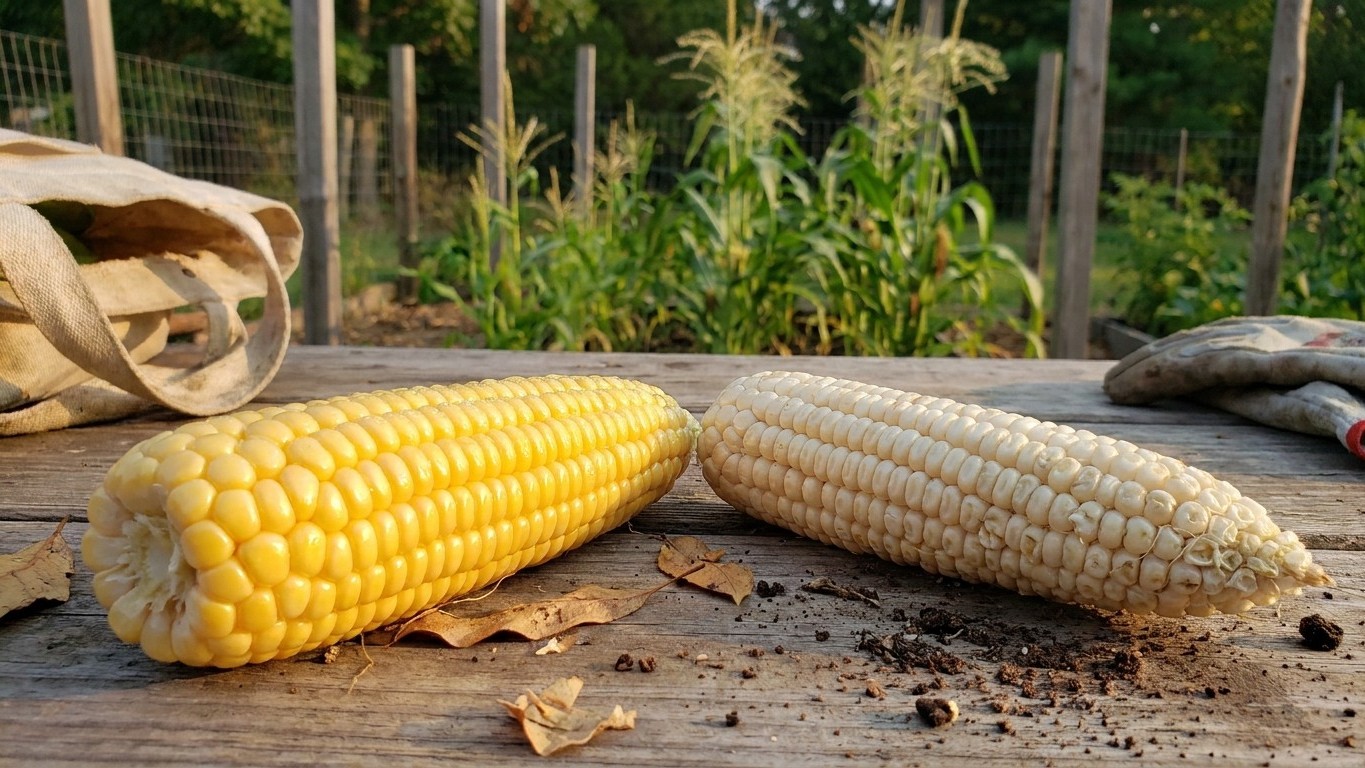

Two ears of corn picked from the same garden bed can taste nothing alike, and the difference usually has nothing to do with soil, water, or which seed packet you bought. It comes down to what was tasseling in the next row over. When standard sweet corn crosses with a sugary-enhanced or supersweet type at the same time, that extra sweetness disappears. Utah State University Extension has documented exactly why.
The short answer
According to Utah State University Extension’s guide to growing sweet corn in the garden, eating quality, specifically sweetness, can be affected “when su, se and sh2 are planted together and tassel at the same time.” If cross pollination happens under those conditions, the extension notes, “the extra sweetness of the se and sh2 types is lost and they taste more like the standard types.” That single sentence explains more garden disappointment than most people realize. A gardener plants a premium supersweet variety expecting candy-like kernels, harvests on schedule, does everything else right, and still ends up with corn that tastes flat and starchy. The seed wasn’t defective. The growing conditions weren’t off. A neighboring planting, or even a different block in the same garden, simply flowered at the wrong moment.
Sweet corn comes in a handful of genetic types, generally shortened to su (standard sugary), se (sugary enhanced), and sh2 (shrunken-2, often called supersweet). Each carries a different gene controlling how much sugar accumulates in the kernel and how fast that sugar converts to starch. The types don’t clash because they’re incompatible plants. They clash because corn is wind-pollinated, and pollen doesn’t check labels before it lands. If a su plant sheds pollen while an se or sh2 plant nearby is silking, that pollen can fertilize the sweeter variety’s kernels, and the offspring kernels shift toward the standard, starchier profile.
Utah State University Extension doesn’t publish a required isolation distance for keeping these types apart, and no other credible figure exists to fill that gap here. What the extension does specify is the condition that triggers the problem: overlapping tassel timing. That’s a more useful piece of information anyway, because distance in a small home garden is often impossible to control, but planting dates are entirely within your control. The rest of this article works from that single, well-documented mechanism.
What actually decides it
How wind pollination works
Corn doesn’t rely on bees or other insects to move pollen from plant to plant. The tassel at the top of each stalk releases pollen into the air, and it drifts down to the silks, the fine threads emerging from developing ears lower on the same or neighboring plants. Utah State University Extension recommends planting corn in blocks rather than single rows specifically “to ensure good pollination and ear development.” A block gives pollen grains a much better chance of reaching silks on all sides, rather than blowing past a lone row of stalks. That’s true regardless of variety. But the same airborne mechanism that fills out an ear properly is exactly what carries pollen between different sweet corn types when their timing overlaps.
The three sugar genes
The su, se, and sh2 designations aren’t marketing labels. They describe distinct genetic pathways controlling sugar content and how quickly that sugar converts to starch after harvest. This matters for flavor loss in two separate ways: cross-pollination during tasseling, and sugar breakdown after picking.
| Type | Gene | Sugar retention after harvest |
|---|---|---|
| su (standard) | Sugary | Loses sugar fastest |
| se (sugary enhanced) | Sugary enhanced | Holds sweetness longer than su |
| sh2 (supersweet) | Shrunken-2 | Holds sweetness longest |
Choosing an sh2 variety, for instance, buys you a longer window between picking and eating before the corn loses its sweetness. But that advantage evaporates if an sh2 planting tassels alongside a su planting and the two cross.
Timing, not distance
Utah State University Extension’s language is precise on this point: the risk arises when different types “tassel at the same time.” Stagger your planting dates for different sugar types so their tasseling windows don’t line up, and the cross-pollination risk drops without needing to measure a single foot of garden space. This is also why gardeners growing only one sugar type across their whole plot never run into this particular problem at all.
How to do it
- Wait until both soil and air temperatures are consistently above 60 F before planting. Utah State University Extension specifies this threshold for best germination and plant growth. Soil warms up well after your last frost date, so don’t plant the moment frost risk passes; wait for the soil itself to catch up.
- Lay out the garden in blocks of three or more rows rather than one long row. Space rows 24 to 30 inches apart, and plant seeds 1 inch deep and 7 to 9 inches apart within the row. For high-density plantings, space seeds in 15 by 15 inch squares instead.
- If you’re growing more than one sugar type (su, se, or sh2), stagger the planting dates between them so their tasseling periods don’t overlap, protecting the sweeter types from cross-pollination.
- Side dress with 1/2 lb of 21-0-0 fertilizer per 100 square feet once plants are near knee high, at the 8 to 10 leaf stage.
- Apply an additional 1/4 lb of 21-0-0 per 100 square feet when the first tassels or silks appear.
- Keep soil near field capacity throughout the season, paying particular attention during tasseling, silking, and ear formation, when water needs are at their most critical.
- Track two separate timelines: overall maturity runs 60 to 90 days from planting depending on variety, while individual ears mature 17 to 24 days after silk emergence. The first tells you whether the crop fits your season; the second tells you which week to start checking ears.
- Check for ripeness using all three signs together: silks that are dry and brown, husks that still look moist and green, and kernels near the tip that are plump and release milky juice when punctured.
- Harvest by grasping the ear and snapping downward while twisting it off the stalk.
- Refrigerate ears unhusked until you’re ready to use them, and plan to eat them within a matter of days rather than storing them for the long haul.
What goes wrong
- Planting one long row instead of a block. A single row leaves pollen with nowhere consistent to land, producing ears with missing kernels and gaps. Rearrange future plantings into blocks of three or more rows, or use the 15 by 15 inch square spacing for smaller spaces.
- Letting different sugar types tassel together. This is the core issue behind flat-tasting supersweet or sugary-enhanced corn. Stagger planting dates between su, se, and sh2 varieties so their tassels don’t shed pollen during the same window.
- Mistaking the last frost date for planting time. Soil takes longer to warm than the air does after frost risk passes. Wait until soil and air temperatures are both reliably above 60 F, even if that means planting later than you’d expect.
- Judging ripeness from a single clue. Brown silks alone, or green husks alone, don’t confirm an ear is ready. Check all three signs together: dry brown silks, husks still moist and green, and milky juice from a punctured kernel near the tip.
- Letting soil dry out during tasseling and silking. Water stress at this stage produces poorly filled ears, since water needs peak during tasseling, silking, and ear formation. Keep soil near field capacity through this window rather than easing off once plants look established.
- Storing corn too long or too warm before eating it. Sweet corn loses sugar from the kernel rapidly at high temperatures, and even under refrigeration it holds up for about five days at most before sweetness declines with each passing day. Refrigerate ears unhusked and use them promptly, especially if they’re a su type, which loses sugar faster than se or sh2 varieties.
Common questions
Can I grow sweet corn and field corn in the same garden without a problem?
Utah State University Extension’s guidance centers on sweet corn types (su, se, sh2) tasseling at the same time as each other. It doesn’t publish an isolation distance for field corn either, so the safest approach follows the same logic: avoid having different corn types tassel simultaneously.
Does cross-pollination change the color or size of the kernels, or just the flavor?
The extension’s documented concern is specifically about eating quality and sweetness. It doesn’t address kernel color or size changes from cross pollination, so don’t assume visual differences will warn you before you bite into a disappointing ear.
How many days should I count before checking for ripe ears?
Use two separate counts. Sweet corn reaches overall maturity 60 to 90 days from planting depending on variety, which tells you if the season allows enough time. Once silks emerge, individual ears mature in 17 to 24 days, which is the window to start checking them.
Why does my supersweet corn taste bland even though I picked it at the right time?
If picked correctly using all three ripeness signs, bland flavor in an se or sh2 variety usually points back to cross-pollination with a standard su type that tasseled during the same period, or to sugar loss from storing the corn too long or at too warm a temperature before eating it.