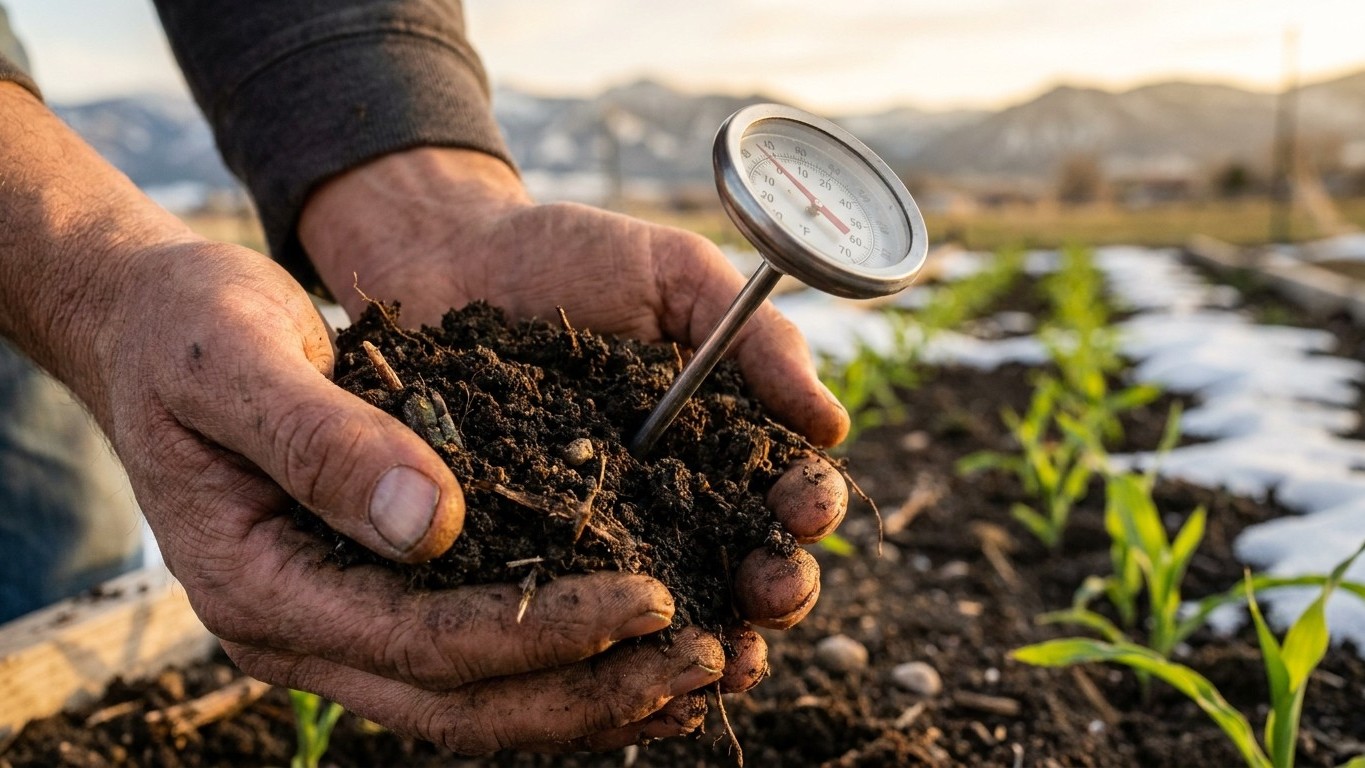

Alberta’s growing season is short for a warm-season crop like corn. Soil here needs to hold steady above 60°F before seed will germinate reliably, and that threshold arrives weeks after the last spring frost, not on the same date. Once soil is warm, sweet corn needs 60 to 90 days to mature before the first fall frost shuts things down. In the Calgary area, that window favors an early variety and puts a slow one at real risk.
The short answer
Start with the frost dates themselves, because they set the outer edges of everything else. The average last spring frost at Calgary Int’l A runs May 21, and the average first fall frost lands September 16, both drawn from the 1981-2010 Canadian Climate Normals. That’s a span of 118 days between the two, which sounds generous for a 60 to 90 day crop. But that 118-day figure is the frost-free window, not the corn-growing window, and the difference matters more than most garden guides let on.
Corn doesn’t start its clock on the last frost date. It starts when soil temperature holds above 60°F, and that mark trails the frost date by a real stretch of weeks, not days. Plant into cold, damp soil expecting the frost date to mean “safe to sow,” and seed will often rot or sit dormant before it even sprouts, University of Wyoming and Utah State University Extension both note this pattern for sweet corn specifically. So the true planting window opens later than May 21, which eats directly into that 118-day buffer; knowing exactly When to Sow Sweet Corn in Alberta makes the difference between a crop that thrives and one that struggles from the start.
Once you subtract the weeks lost waiting for warm soil, the usable growing window for the corn itself shrinks to something closer to three months than four. That’s still workable for a fast-maturing variety, one bred to finish its cycle in roughly 60 days. It’s a much tighter fit for anything pushing toward 90 days, especially once you remember that September 16 is an average, not a guarantee: in roughly half of all years on record, the first fall frost arrives later than that date, but in the other half, it arrives earlier. For a closer look at how these numbers play out season to season, see Will Sweet Corn Ripen in Alberta?
One more number matters here. Calgary averages zero days a year at 90°F or above. That’s not a comment on comfort, it’s a comment on growing degree accumulation. Corn is a heat-loving plant that converts warm days into growth, and a climate with no real heat spikes moves through its stages more slowly than a hot Midwestern summer would. Slower accumulation means the same variety that finishes in, say, 65 days in Iowa may run a bit longer here. That’s the real-world consequence of a mild summer ceiling, and it’s the reason the short answer to whether sweet corn will ripen in Alberta is yes, but only with margin built in on both ends.
Does a late variety fit here?
Seed catalogs sort sweet corn by “days to maturity,” a number counted from the day seed goes into warm ground, not from the last frost date and not from when silks appear. That distinction decides whether a given variety has any business going into an Alberta garden at all.
A 60-day variety
A variety rated near 60 days fits comfortably inside the region’s real growing window. Even accounting for the delay between the last frost and 60°F soil, a fast variety planted as soon as the ground is genuinely warm still has weeks of slack before the average first fall frost on September 16. That slack matters because it absorbs the year-to-year swing in when frost actually shows up, and it gives the crop room to finish even in a summer that runs cooler than average. For gardeners in and around Calgary, a short-season variety is the one that removes most of the guesswork.
A 90-day one
A 90-day variety is a different story, and the honest answer is that it does not reliably fit this territory’s window. Add the delay for soil to reach 60°F onto a 90-day maturity clock, and the harvest date lands right at, or past, the average first fall frost of September 16. Since that date is a midpoint and not a safe cutoff, in half the growing seasons on record the frost would arrive even before that math works out. A single early cold snap, and a 90-day planting can be caught with ears still filling out on the stalk. If a package or catalog lists a variety in that range, treat it as a poor match for this climate rather than an ambitious stretch goal.
What Goes Wrong here
Most sweet corn disappointments in this region trace back to one of three mistakes, and only one of them has anything to do with the climate itself.
- Soil sown too cold. Seed goes in the week after the last frost, on the assumption that frost-free means planting-ready. It doesn’t. Sweet corn seed needs soil consistently above 60°F, and pushing it into cooler ground either rots the seed outright or produces weak, uneven stands. The fix is patience: wait for the soil itself, checked with a simple soil thermometer a few inches down, rather than trusting the calendar date.
- A variety too late for the season. A 90-day or longer variety, chosen because it promised bigger ears or a favorite flavor, simply runs out of warm days before it finishes, especially once soil-warming delay is factored into the true planting date. The fix is choosing maturity length first and flavor second, favoring the shorter end of the range for this territory.
- Sweetness lost because two types tasselled together. This one has nothing to do with weather. Sweet corn comes in several genetic types (commonly labeled su, se, and sh2), and if two different types release pollen at the same time nearby, cross-pollination can turn a supersweet variety starchy and dull. Utah State University Extension is clear that the timing of tasseling, not distance or geography, is what causes the problem. The fix is staggering planting dates so the types don’t tassel in the same window, or growing only one type per season if the garden is small.
Checking this against your own county
Everything above is built on averages from a single reference station, Calgary Int’l A, and Alberta is not one climate. A garden in a sheltered river valley can run measurably warmer than one on an exposed upland flat a short drive away, and a district well north of Calgary can lag those frost dates by real weeks. Before committing a season to sweet corn, it’s worth checking local planting guidance through Alberta Agriculture and Irrigation, which tracks regional conditions more closely than any single provincial average can. Local knowledge is what turns a general climate window into a planting date that actually fits your soil, your slope, and your microclimate.
Common questions
Can I just plant on the last frost date to be safe?
No. The last frost date only tells you when killing cold is unlikely to return, it says nothing about whether the soil is warm enough for seed to germinate. Sweet corn needs soil above 60°F, and that mark typically arrives weeks after the frost date itself, so planting on the frost date alone often means cold, slow-rotting seed.
How do I know when the corn is actually ready to pick?
Look for three signs together, not just one: the silks have turned dry and brown, the husk is still moist and green, and juice from a punctured kernel runs milky rather than clear or thick. Any single sign on its own can mislead you.
Is the days-to-maturity number the same as days to pick after silks appear?
No, and mixing these up is a common error. Days to maturity is counted from planting and tells you whether a variety fits the season at all. A separate, much shorter count from when silk first appears tells you which week within that season to actually harvest. They answer different questions and shouldn’t be merged into one number.
Do I need to keep sweet corn varieties a certain distance apart?
The concern isn’t distance, it’s timing. Cross-pollination between different sweet corn types happens when they tassel and release pollen during the same window. Stagger planting so tasseling doesn’t overlap, and plant in blocks of three or more rows rather than single rows, which helps pollination happen properly within each variety.