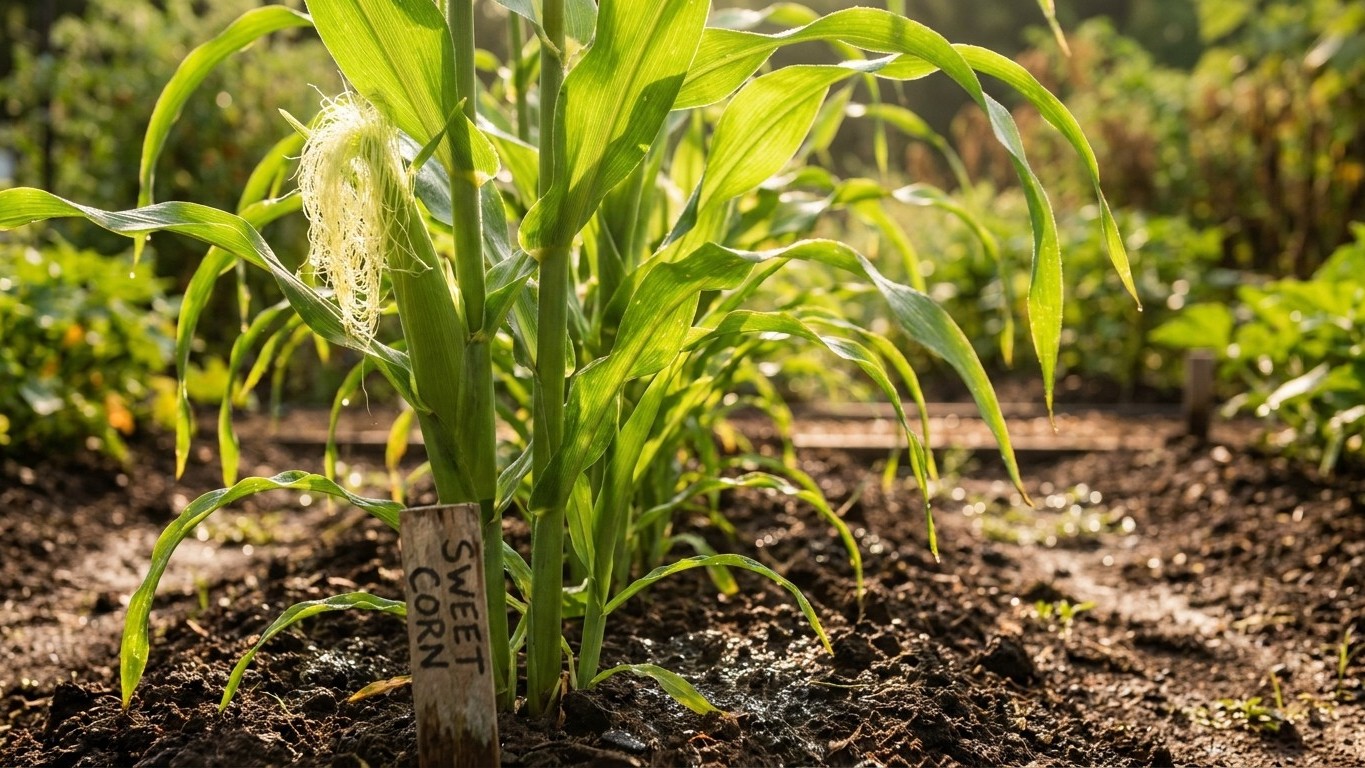

Sweet corn can ripen in Alberta, but only if you pick a fast variety and treat the calendar as tight, not generous. The frost-free window here runs roughly from late May to mid-September, and corn needs warm soil before it will even germinate. That squeezes the real growing season down well below what the calendar dates suggest, which is the part most seed packets never mention.
The short answer
Soil temperature, not air temperature, is what starts the sweet corn clock. According to Utah State University Extension, seed needs soil above 60 F to germinate reliably, and that threshold is reached well after the last spring frost, not on the same day. Environment and Climate Change Canada’s 1981-2010 normals for the Calgary Int’l A station put the average last spring frost at May 21. Soil takes time to catch up to air after that date, so treat May 21 as the earliest possible starting point for the clock, not the day you plant.
The same station’s normals put the average first fall frost at September 16. That gives a theoretical frost-free stretch of about 118 days between the two mean dates. Both figures are averages, which means in any given year the frost can arrive earlier or later than the mean about half the time. Environment and Climate Change Canada does not publish these as a safe range, only as a midpoint, and that distinction matters more here than in milder climates, because there is little room to absorb a late spring or an early fall.
Utah State University Extension lists sweet corn as needing 60 to 90 days from planting to harvest, depending on variety. On paper, a 118-day window comfortably holds a 90-day crop. In practice, the gap between the last frost and the day soil actually clears 60 F eats into that number, and nobody has published exactly how many days that lag runs for this station. That is the honest limit of what can be said here: the window is real, but it is narrower than the frost dates alone suggest.
One more figure from the same climate normals matters just as much as the frost dates: Calgary averages 0.0 days a year at or above 90 F. Sweet corn is a heat-loving crop, and growth toward maturity slows when summer stays cool, even inside a technically long enough window. A variety rated for 60 or 90 days under warmer conditions elsewhere may simply take longer here, which is another reason to treat published day-counts as a floor, not a guarantee.
Does a late variety fit here?
The math changes a lot depending on how many days a variety needs, and Utah State University Extension’s own range, 60 to 90 days, straddles the line between comfortable and risky in this climate.
A 60-day variety
Count forward from whenever soil actually clears 60 F, which lands after May 21, and a 60-day variety still has a wide cushion before the September 16 average first frost. Even allowing several weeks of lag between air warming and soil warming, there’s enough slack left in the 118-day window to absorb a slow start, a cool stretch in midsummer, or a frost that arrives a bit earlier than the mean. This is the category that behaves the way the calendar suggests it should.
A 90-day variety
A 90-day variety spends most of the theoretical 118-day window just reaching maturity, and that’s before accounting for the delay between the last frost and the soil actually hitting 60 F. Once that lag is factored in, there is little to no margin left before the average first fall frost, and since September 16 is a mean date, frost can just as easily land earlier than that in any given year. Add the fact that Calgary averages zero days above 90 F, meaning heat accumulation runs slow, and a 90-day variety is working against the season on two fronts at once. Plainly stated, a full 90-day variety does not reliably fit this window. It may succeed in an unusually warm, unusually late-frost year, but it isn’t a safe bet to plan around.
What goes wrong here
- Soil sown too cold. Planting on the calendar date of the last frost, rather than waiting for the soil itself to clear 60 F, is the most common failure. Seed sits in cold, damp soil, rots before it germinates, or comes up so unevenly that the whole planting struggles the rest of the season. The fix is to test the soil, not the calendar, before planting, and to accept that the real start date always falls after May 21, sometimes by a noticeable stretch.
- A variety too late for the season. Choosing a 90-day variety because it promises bigger ears or better flavor ignores how little margin this climate leaves once soil lag and a cool, low-heat summer (zero days above 90 F on average) are factored in. The remedy is straightforward: favor the shorter end of Utah State University Extension’s 60-to-90-day range, since a 60-day type leaves cushion the 90-day type doesn’t have.
- Sweetness lost to the wrong neighbor, which has nothing to do with climate. Utah State University Extension notes that su, se, and sh2 sweet corn types lose their sweetness if they tassel at the same time as each other. This is a pollination timing problem, not a frost or heat problem, and it happens even in a perfect growing season. The source gives no isolation distance in feet or rows, only the condition itself, so the fix is to plant a single type per block, or to stagger planting dates so the different types don’t tassel together, and to keep plantings in blocks of three or more rows rather than thin single rows, which Utah State University Extension notes helps with pollination generally.
Common questions
Is May 21 a safe date to plant sweet corn in Alberta?
No. It’s the average last spring frost from Environment and Climate Change Canada’s 1981-2010 normals for the Calgary Int’l A station, which means frost arrives later than that date about half the years on record. It also isn’t the day soil reaches 60 F, which comes after the frost date and is what actually matters for planting.
How do I know when soil has reached 60 F?
Utah State University Extension’s guidance centers on soil temperature at planting depth, not a calendar date, so a soil thermometer is the direct way to check rather than relying on frost-date estimates alone.
Can I grow a 90-day sweet corn variety in Alberta at all?
It isn’t reliable. The theoretical window between the average last frost and the average first fall frost is close to 118 days, but soil warm-up lag and the region’s cool summers (zero average days above 90 F) leave little to no safety margin for a full 90-day variety, and the fall frost date itself is only a mean, not a guarantee.
Why did my sweet corn lose its sweetness even though the season was fine?
Utah State University Extension attributes this to pollination timing, not weather. If su, se, or sh2 types tassel at the same time near each other, the sweeter types can be pollinated by the starchier one, dulling the flavor. Planting a single type per block, or staggering tassel timing between types, addresses this directly.