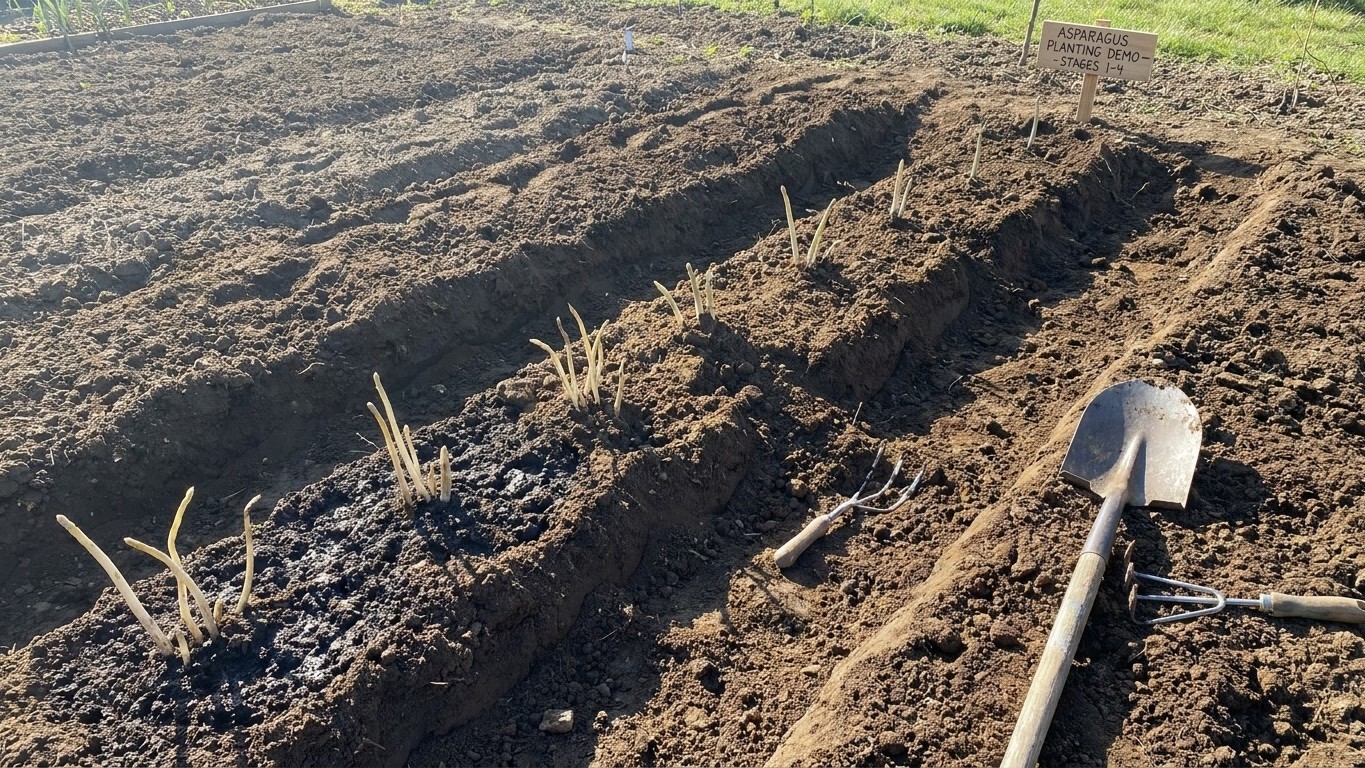

Utah State University Extension’s answer is specific: plant one-year-old crowns in furrows 8 inches deep, spaced 12 inches apart, with rows 4 feet apart. But that 8-inch number is where the trench ends up, not where the crown starts. Cover it with just 2 inches of soil at planting, then fill the rest gradually over the season.
The short answer
According to Utah State University Extension’s guidance on asparagus in the garden, a crown goes into a furrow dug 8 inches deep. Spacing is 12 inches between crowns, with 4 feet left between rows so the fern canopy has room to spread later in the season. That’s the skeleton of the planting job, and it’s the part most people repeat correctly.
The detail that gets lost is what happens right after the crown goes in. Utah State’s instructions don’t call for filling that 8-inch furrow in one pass. They call for covering the crown with 2 inches of soil at planting, then backfilling the rest through cultivation across the year, adding roughly 2 inches of soil every other month. The furrow stays open, or partly open, for months. It closes in stages, not on planting day.
Clemson Extension describes the same idea with slightly different numbers, which is worth knowing because it shows this isn’t a single rigid rule but a shared approach. Clemson’s guidance sets crowns 15 to 18 inches apart and 6 to 8 inches deep, and instructs gardeners to continue pulling soil over the crowns, about 2 inches every two to three weeks, until the trench is filled and the crowns sit 6 to 8 inches deep. Two land-grant extensions, two sets of figures, one shared method: shallow start, gradual fill.
Neither source recommends dumping the full depth of soil on top of a crown the day it’s planted. That single point separates a bed that establishes well from one that struggles. A crown buried at full depth immediately has to push a spear through 8 inches of packed soil before it ever sees daylight. A crown covered lightly and filled in over weeks or months only has to break through 2 inches at a time, over and over, as the fern grows and the roots strengthen.
There’s also a seed option, though it’s a longer road. Utah State’s guidance notes that seed can be planted in January for transplanting in April, which gives a grower a full growing season to raise a seedling before it ever goes into that 8-inch furrow as a young crown. Most home gardeners skip this route and buy one-year-old crowns instead, since it shaves a year or more off the time before the bed produces anything worth cutting.
So the short answer holds together: 8 inches deep, but filled slowly, with Utah State University Extension and Clemson Extension both describing the same gradual approach in their own numbers.
What actually decides it
Why the furrow is filled in stages
An asparagus crown isn’t a bulb sitting quietly underground. It’s a cluster of fleshy roots radiating out from a central bud, and that bud has to send a spear up through the soil above it every time the plant wants to grow. Early in the crown’s life, its root system is small and its stored energy is limited. Asking it to push a spear through a full 8 inches of soil in its first weeks in the ground asks more of it than it can deliver. Filling gradually, 2 inches every other month by Utah State’s schedule, or about 2 inches every two to three weeks by Clemson’s, matches the depth of soil to the strength of the plant as it grows. The trench closes at the same pace the crown gains the capacity to punch through it.
Why the depth figures differ slightly
Utah State’s furrow is 8 inches deep from the start; Clemson’s final depth is 6 to 8 inches. Neither source explains the gap as a regional soil or climate difference, and none should be invented here. What both agree on is the direction: shallow placement, then covering. Treat the depth as a range bounded by these two sources rather than a single fixed inch mark, and treat the spacing the same way. Clemson’s 15 to 18 inches and Utah State’s 12 inches both describe workable spacing; neither is presented as more correct than the other.
Variety and sex, not much else
Four named varieties turn up in the record, but only their reproductive type is published, nothing about flavor, yield, or which one suits which garden. Two are all-male: Jersey Giant and Jersey Knight. Two carry both sexes: UC 157 F1 and Purple Passion.
| Variety | Type |
|---|---|
| Jersey Giant | All-male |
| Jersey Knight | All-male |
| UC 157 F1 | Male and female |
| Purple Passion | Male and female |
No nursery is named here, and no claim about which variety performs better is published in this guidance, so none is made.
Why the harvest rule is a sign, not a date
Once the bed is old enough to cut, the plant tells you when to stop, rather than the calendar. Clemson’s instruction is to stop harvesting when the spears have narrowed to pencil-size and to let the spear grow to full height from that point on. A pencil-thin spear means the crown’s reserves are running low; letting that spear open into fern lets the plant rebuild the energy it just spent, which is what feeds next year’s harvest.
How to do it
- Choose the route: buy one-year-old crowns for a faster start, or plant seed in January for transplanting in April if you’re willing to add a season before crowns go in the ground.
- Dig the furrow. Utah State’s figure is 8 inches deep; Clemson’s is 6 to 8 inches deep. Space crowns 12 inches apart by Utah State’s guidance, or 15 to 18 inches apart by Clemson’s, with rows 4 feet apart either way.
- Set the crowns in the open furrow, spreading the roots out rather than folding them, and leave the trench mostly open at this stage.
- Cover the crown with about 2 inches of soil. Do not fill the furrow the rest of the way yet.
- Backfill gradually as the season goes on. Utah State’s schedule adds about 2 inches of soil every other month; Clemson’s adds about 2 inches every two to three weeks. Either pace ends with the trench filled and the crown sitting at its final depth.
- Keep filling until the trench is closed and the crown rests at 6 to 8 inches deep, following the progress of the fern and spears rather than rushing to close the furrow early.
- Wait. No harvest happens until the third year the bed is established. That patience is what builds the root mass the plant will draw on for every harvest afterward.
- In year three, cut for about 4 weeks. In year four, extend to about 6 weeks. In year five and beyond, extend to about 8 weeks.
- Each season, stop cutting when most spears have narrowed to pencil-size, and let those spears grow out into fern rather than continuing to harvest past that point.
What Goes Wrong
- Filling the furrow all at once. Burying a fresh crown under a full 8 inches of soil on planting day is one of the most common ways a new bed fails to establish. The remedy is the gradual backfill schedule itself: 2 inches at planting, then roughly 2 inches every other month, or every two to three weeks, until the trench closes on its own timetable.
- Harvesting before the third year. Cutting spears from a bed that’s only one or two years old strips energy the crown hasn’t finished building. The remedy is simply not cutting anything until year three, then following the 4-week, 6-week, 8-week progression from there.
- Harvesting past the pencil-size signal. Continuing to cut once spears have thinned to pencil width drains the crown right when it needs to rebuild. The remedy is watching the spears themselves each season and stopping harvest the moment most of them come up thin, letting the rest grow into full fern.
- Crowding the spacing. Setting crowns closer than either sourced range, 12 inches by Utah State’s figure or 15 to 18 inches by Clemson’s, leaves fern with no room to spread and air with no way to move through the bed. The remedy is holding to one of those published spacings rather than tightening it to fit more crowns into a small bed.
- Guessing at soil depth or chilling needs. Neither Utah State University Extension nor Clemson Extension publishes a soil pH target or a winter chilling requirement in this guidance, and inventing one from a hardiness zone is a plausible-sounding shortcut, not a sourced figure. The remedy is sticking to what’s actually published, the furrow depth, the spacing, and the backfill schedule, rather than filling gaps with assumptions.
Common questions
How deep should an asparagus crown actually sit once the bed is established?
Utah State University Extension’s furrow is 8 inches deep. Clemson Extension gives a final depth of 6 to 8 inches. Both describe reaching that depth gradually, not immediately.
Can I fill the trench in one weekend instead of over months?
Neither source describes that approach. Utah State’s schedule adds about 2 inches every other month; Clemson’s adds about 2 inches every two to three weeks, with the trench closing as the season progresses.
When can I cut my first spears?
Not until the third year the bed is established. From there, harvest runs about 4 weeks in year three, about 6 weeks in year four, and about 8 weeks in year five and beyond.
How do I know When to Stop Cutting each season?
Clemson Extension’s rule is to stop when spear diameter has narrowed to pencil-size, then let that spear grow to full height. It’s a signal from the plant, not a date on the calendar.