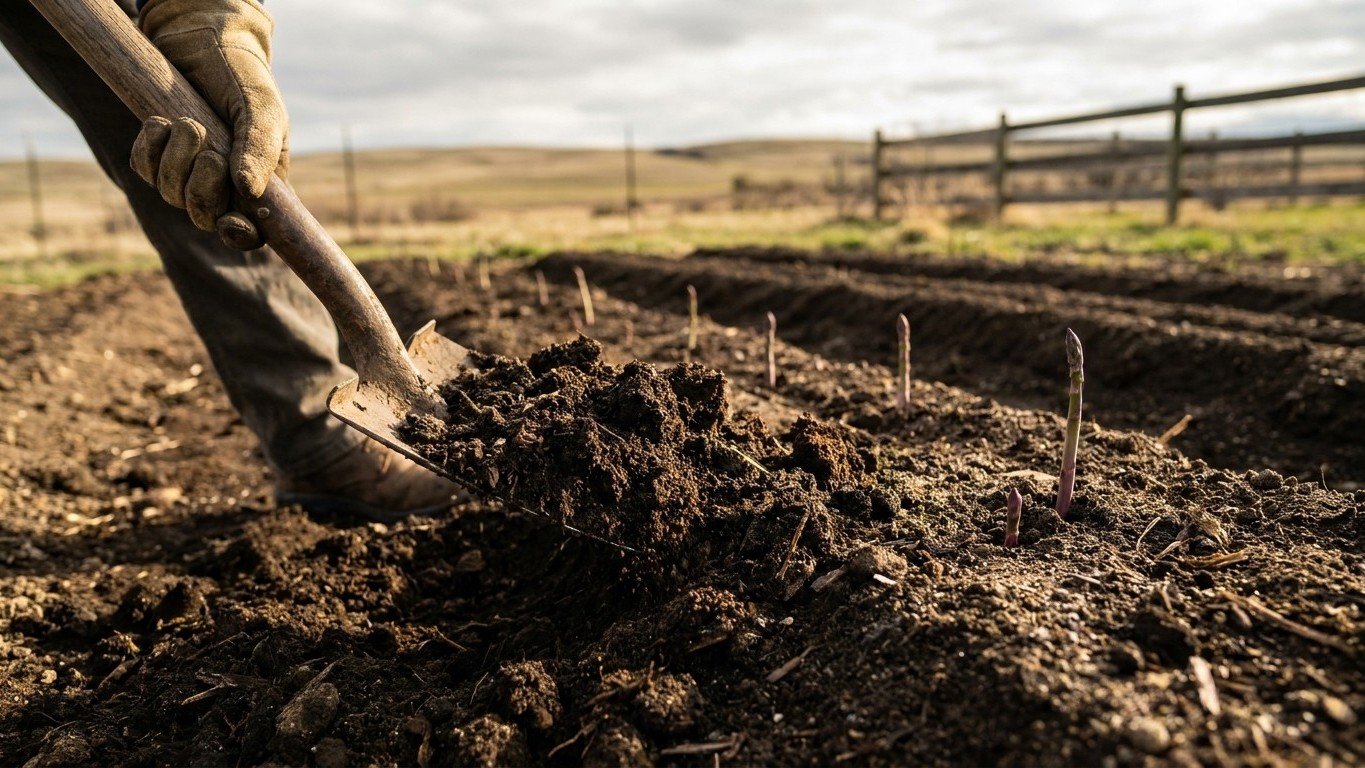

A bed of asparagus outlives most fences, most roofs, and plenty of marriages: once the crowns go in, they’re expected to keep producing for 10 to 15 years. That single fact changes how you pick a spot in Idaho, and it’s worth knowing When to Plant Asparagus Crowns in Idaho before you commit a spot to them. The state’s representative soil, the Threebear series, drains moderately well and runs strongly acid at the surface, workable, but not a soil to plant into without checking your own ground first.
The short answer
Utah State University Extension is blunt about what asparagus needs from the ground: it will grow in most soils, provided they drain. That’s the entire requirement published on soil type. No mention of pH, no mention of a preferred texture, just drainage. Which matters here, because the soil USDA lists as representative of Idaho, the Threebear series, is described as moderately well drained, not excellent, not poor. It’s an Andisol, built from volcanic ash, and that origin gives it an odd combination of traits: it’s light and porous, yet unusually good at holding onto both water and phosphorus. The surface texture runs 35 percent sand, 15 percent clay, 50 percent silt, so it sits closer to a silt loam than anything heavy. Surface pH averages around 5.0, which is strongly acid, though the source on asparagus itself never comments on pH, so no lime recommendation is published here to pass along.
Moderately well drained is the middle of the range, not the bottom. It generally means water moves through in a reasonable time but doesn’t disappear the way it would on pure sand. For a bed that’s going to sit undisturbed for a decade and a half, that’s workable ground, on paper, and the deeper question of Will Idaho Soil Hold an Asparagus Bed for Fifteen Years? depends on more than a statewide average. That “on paper” is doing a lot of work. The Threebear series is what USDA uses to represent the state in a database, built from averaging 24 mapped components, it is not a soil test of any actual backyard. Idaho spans river bottoms, bench land, foothill scrapes, and plenty of ground a builder has filled and compacted. None of that shows up in a statewide representative series.
So the practical move, before a single crown goes into the ground, is a shovel test. Dig a hole about a foot deep, fill it with water, and watch how long it takes to drain. If it’s gone within a few hours, the ground is doing its job. If water is still standing the next morning, that spot will rot asparagus crowns long before the bed reaches year 15. The fix isn’t complicated: raised beds, or working in enough coarse organic matter to open up a heavy patch, solve the drainage problem for good, but that work has to happen before planting, not after the roots are already down eight inches. Nothing about this state’s soil, including the representative series, should be read as a guarantee for one particular yard.
Will the summer here water it for you?
Asparagus has a published watering rhythm, and it doesn’t stay constant. The bed needs 1 to 2 inches of water every other week for the first two years, then eases back to every three weeks once it’s established. Compare that against what the reference station’s climate normals show for summer rainfall here, and the gap is stark: June averages 0.75 inches, July drops to 0.21 inches, and August, the driest month of the growing season, manages just 0.17 inches. Add it up across the three months and the region is working with about 1.1 inches of rain total for the entire summer.
- Weigh the target against the supply. A single every-other-week watering calls for up to 2 inches. July’s entire monthly average doesn’t even cover one of those waterings.
- Expect to supply nearly all of it yourself. With summer rainfall this thin, irrigation isn’t a backup plan here, it’s the plan. A soaker hose or drip line on a schedule matching the every-other-week window for young beds, then every three weeks for established ones, is doing almost the entire job that rain would normally share.
- Don’t let the soil’s water-holding trait fool you into skipping a check. The Andisol common to this state holds moisture well once it’s there, which helps stretch a watering, but it can’t manufacture rain that never fell in August.
- Settle it with a rain gauge on your own plot. Climate normals are averages built from a specific reference station over three decades; a particular yard’s sun exposure, slope, or nearby structures can shift things. A cheap gauge tells you exactly what your bed received this week, which is worth more than any regional average when you’re deciding whether to turn on the hose.
When to put the crowns in
Crowns go into the ground as early spring arrives, planted about 8 inches deep in a furrow, and that furrow doesn’t get filled all at once. The rule is gradual: about 2 inches of soil back into the trench every other month across the year, rather than burying the crown in one pass. That slow backfill lets the emerging shoots keep reaching light while the roots settle in below.
Anchoring “early spring” to an actual window means looking at frost data, and the reference station used for this region’s normals puts the last spring freeze at around April 23 to May 7. That’s a mean date, built from three decades of records, not a promise for any single year, a late cold snap can still show up outside that window, and it’s worth saying plainly that this reference point comes from a low valley station. Most of the state sits higher and colder, with a shorter, later window before it’s safe to plant. Anyone gardening above that valley floor should expect to push planting later, not earlier.
Crowns aren’t the only route in. Asparagus can also be started from seed, which the source lists as the alternative to crowns, a slower path that asks for more patience before the bed reaches the same maturity, but it avoids the cost and limited selection that sometimes comes with buying crowns. Whichever way it starts, the harvest clock doesn’t move: no cutting in year one or two, no matter how tempting the first spears look. Harvest doesn’t begin until year three, and even then it starts light, at about four weeks of cutting, moving to six weeks the following year, then eight weeks once the bed is fully established. The stopping point each season isn’t a date on a calendar either — it’s a visual signal. When most of the spears coming up have gone thinner than a pencil, that’s the cue to stop cutting and let the plant put its energy into foliage for the rest of the season.
Variety choice is one area where the published information stays narrow. Utah State University Extension names four varieties by sex type only, with nothing said about flavor, yield, or a reason to prefer one over another.
| Variety | Sex type |
|---|---|
| Jersey Giant | All-male |
| Jersey Knight | All-male |
| UC 157 F1 | Male/female |
| Purple Passion | Male/female |
All-male varieties tend to get recommended in general gardening circles because they don’t spend energy on seed production, but that reasoning isn’t attributed to the source above, it’s simply not part of what’s published here, so treat variety choice as an open question rather than a settled one.
Checking this against your own county
Everything above describes a state-level picture: a representative soil series, a single reference weather station, and general planting guidance. None of it substitutes for what’s actually happening in a specific yard. The University of Idaho Extension is the named authority to check next, and it runs county-level offices across the state that can answer questions a statewide series simply can’t, from local frost timing at higher elevations to soil test results for a particular property.
Find the office nearest a specific address using the University of Idaho Extension website. A local soil test, run before any crowns go in, will settle the pH and drainage questions this article can only frame in general terms.
Common questions
How long before an asparagus bed actually produces food?
Not until the third year. The first two seasons are entirely about root establishment, no harvest at all, however tall the spears grow. Year three brings the first light harvest, around four weeks of cutting, before easing into longer harvest windows in the years that follow.
Does the state soil mean my yard will drain well enough for asparagus?
Not necessarily. The Threebear series is a representative average built from soil survey data across the state, described as moderately well drained, but an individual yard, especially one on filled or compacted ground, can behave very differently. A simple shovel drainage test on the actual planting site is the only way to know for sure.
How much should I water an established asparagus bed in a dry Idaho summer?
The published guidance calls for 1 to 2 inches every three weeks once a bed is established, down from every other week during the first two years. Given how little rain the summer months typically deliver here, most of that water will need to come from irrigation rather than rainfall.
Is there a winter chilling requirement to worry about before choosing a variety?
That figure isn’t published in the sources behind this article, and it shouldn’t be guessed at or derived from a hardiness zone. If chilling hours matter for a specific variety, that’s a question worth taking directly to a county extension office rather than assuming an answer.