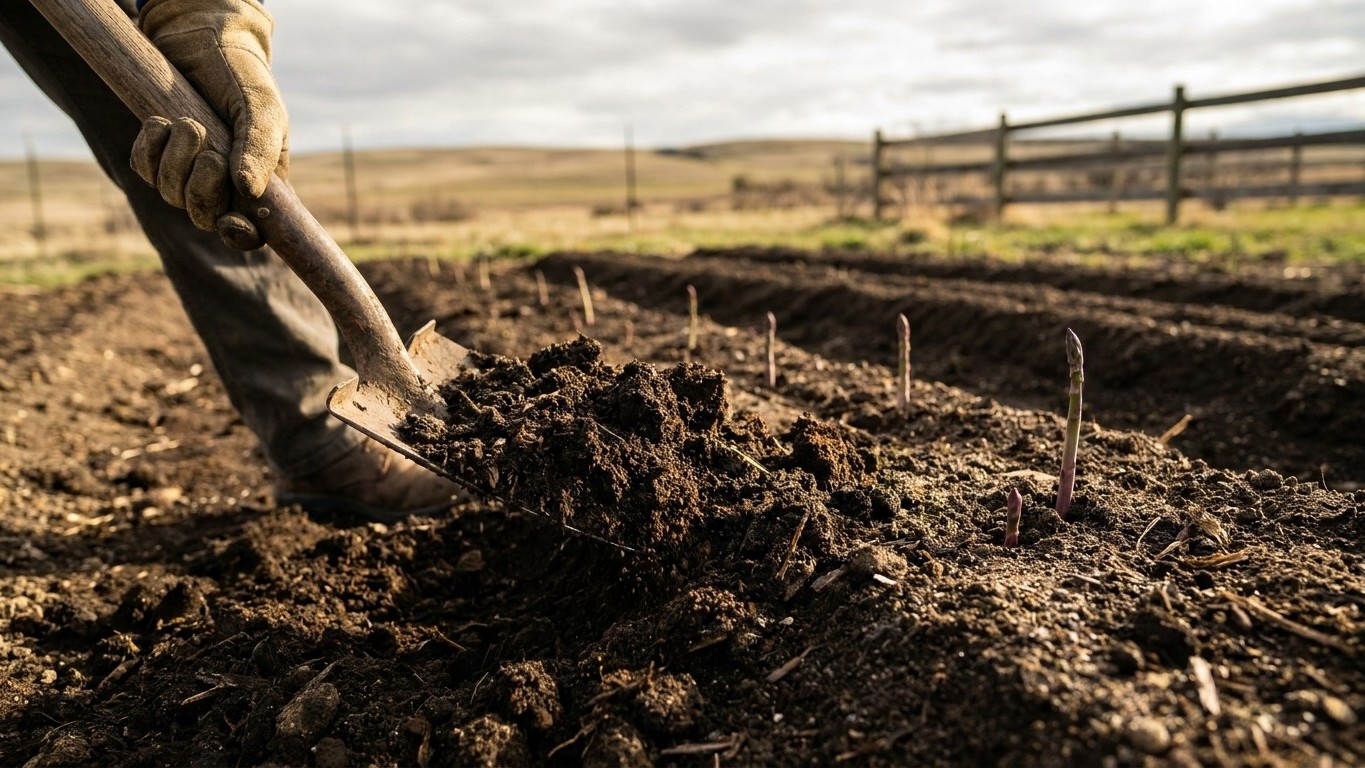

A bed of asparagus planted in Indiana ground will still be sending up spears ten to fifteen years from now, provided the spot drains well. Will Indiana Soil Hold an Asparagus Bed for Fifteen Years? The state’s representative soil, the Miami series, drains moderately well on its own, which covers most plantings. But not every yard sits on that soil, and the fix for a heavier patch is worth working out before the crowns go in the ground, not after.
The short answer
Asparagus is the one crop on this site where the gardener picks a spot and lives with it for a decade and a half. Utah State University Extension puts the bed’s productive life at ten to fifteen years, and the only soil rule it gives is that the ground has to drain. No harvest happens until year three, which makes When to Plant Asparagus Crowns in Indiana worth sorting out before crowns ever touch the soil. When it finally starts, the season runs four weeks that first cutting year, then six weeks, then eight weeks in the years after, and the stopping point every spring isn’t a date on a calendar. It’s a look at the spears: when most of what’s coming up is thinner than a pencil, cutting stops for the season and the plant is left to grow ferns and rebuild its roots.
Indiana’s state soil, the Miami series, is an Alfisol, a forest soil of moderate fertility that holds nutrients reasonably well. USDA NRCS records the surface horizon at roughly 30 percent sand, 20 percent clay and 49 percent silt, with organic matter around 2.0 percent and a surface pH near 6.5. It’s classed as moderately well drained. That drainage class is the number that matters here, and it lands in the workable range for asparagus: not a sand pit that dries out in an afternoon, not a clay pan that stays soggy for a week.
That’s the state’s representative soil, though, queried from mapped survey data, not a reading of any one garden. A back yard on river bottom silt, a lot with fill dirt from construction, or a low spot where water pools after rain can behave nothing like it. If a shovel test after a rain shows standing water an hour later, or the soil balls up sticky instead of crumbling, that spot is a poor match for a fifteen-year planting until it’s built up, typically with a raised bed or several years of added organic matter and a location moved to higher ground.
On variety, the extension source names four by their pollination type only: Jersey Giant and Jersey Knight are all-male hybrids, while UC 157 F1 and Purple Passion are male-and-female. No flavor comparison, no yield figure, and no reason to prefer one over another is published there, so this is as far as that source goes. On pH and on any winter chilling requirement, the source is simply silent, and the state soil’s 6.5 reading is background on the region’s ground, not a stated requirement for the crop.
Will the summer here water it for you?
A newly planted bed wants one to two inches of water every other week through its first two summers. Once established, from year three on, that eases to one to two inches every three weeks. Set against what Indiana’s summers actually deliver, based on the 1991-2020 normals for the Indianapolis reference station, the picture is mixed month to month.
- June brings about 4.95 inches on average, comfortably above what a young bed needs even on the high end of the range.
- July follows with roughly 4.42 inches, still enough most years to cover a first- or second-season planting without much help.
- August is the tight month, averaging only about 3.2 inches, the driest of the three, and it sits right at the edge of what a young bed asks for.
- Add the three months together and Indiana averages about 12.6 inches of rain across June, July and August, against roughly 43.6 inches over the full year, so summer isn’t the wet season here even in a normal year.
- None of this arrives evenly. Rain that falls as a single thunderstorm mostly runs off a compacted surface rather than soaking down to the roots, and how much actually reaches the crowns depends on the same soil that decides drainage: sandy ground lets water through fast and dries out faster, clay holds it longer but sheds a hard rain off the surface.
The practical read: August is the month to watch, especially in a bed’s first two summers, and a rain gauge on the actual plot settles the question a state average can’t. These are long-term normals for one reference station, not a forecast and not a guarantee for any single yard, so a dry August calls for supplemental watering regardless of what the almanac says the state average should be.
When to put the crowns in
Crowns go into the ground in early spring, once the worst of the frost risk has passed. For the Indianapolis area, the 1991-2020 normals put the mean last spring freeze somewhere around April 9 to April 21, a band built from 32F freeze probabilities rather than a single fixed date. That’s a mean, not a promise, and there’s still roughly a 10 percent chance of a 32F event after that published window closes, so anything planted on the early edge of it is worth having a cover ready for, just in case.
Southern Indiana tends to warm up earlier than that Indianapolis window by two weeks or more, and the northern part of the state runs later by a similar margin, so a gardener near the Ohio River is working with a different calendar than one near Lake Michigan even though both are the same state.
The planting method itself is straightforward once the timing is right: crowns go into furrows about 8 inches deep. Rather than filling the trench all at once, the soil goes back in gradually, roughly two inches every other month across the year, letting the emerging shoots grow up through a shallow covering at first and burying the crown fully only as the season goes on.
Seed is the alternative to crowns, and it’s the slower route. Starting from seed pushes the whole timeline back, adding another year before the plant reaches the size a purchased crown already has at planting. The extension source’s detail is built around the crown method, so anyone choosing seed is working from general vegetable-seed-starting practice rather than an asparagus-specific published schedule.
Checking this against your own county
Everything above is a state-level starting point: one reference soil series, one weather station’s normals, one set of frost probabilities. A garden two counties over, or two miles down the road on a different soil map unit, can differ enough to change the drainage call or shift the safe planting date by a week or two.
Purdue University’s Cooperative Extension Service, at extension.purdue.edu, runs a county office in every part of the state, and a call or visit to the local office is the fastest way to get a soil test read for an actual plot and a frost-date answer tuned to that specific county rather than the statewide average used here.
Common questions
How long before an Indiana asparagus bed can be harvested?
Not until year three, according to Utah State University Extension. The first harvest season runs about four weeks, then six weeks the following year, then eight weeks in the years after that, once the bed is fully established.
How do you know when to stop cutting spears each spring?
Not by a date. The rule is a visual one: once most of the spears coming up are thinner than a pencil, cutting stops for the season so the plant can grow its ferns and rebuild the crown for next year.
What soil pH does asparagus need in Indiana?
That figure isn’t published in the extension source used here. Indiana’s representative state soil, the Miami series, runs a surface pH near 6.5, but that describes the state’s mapped soil generally, not a stated requirement for asparagus, and not necessarily the reading in any one garden. A soil test through the local extension office is the way to get an actual number.
Can asparagus be started from seed instead of crowns in Indiana?
Yes, seed is the alternative route, though it adds time before the bed reaches the size a purchased crown starts at, pushing the whole schedule, including that year-three harvest mark, back further.