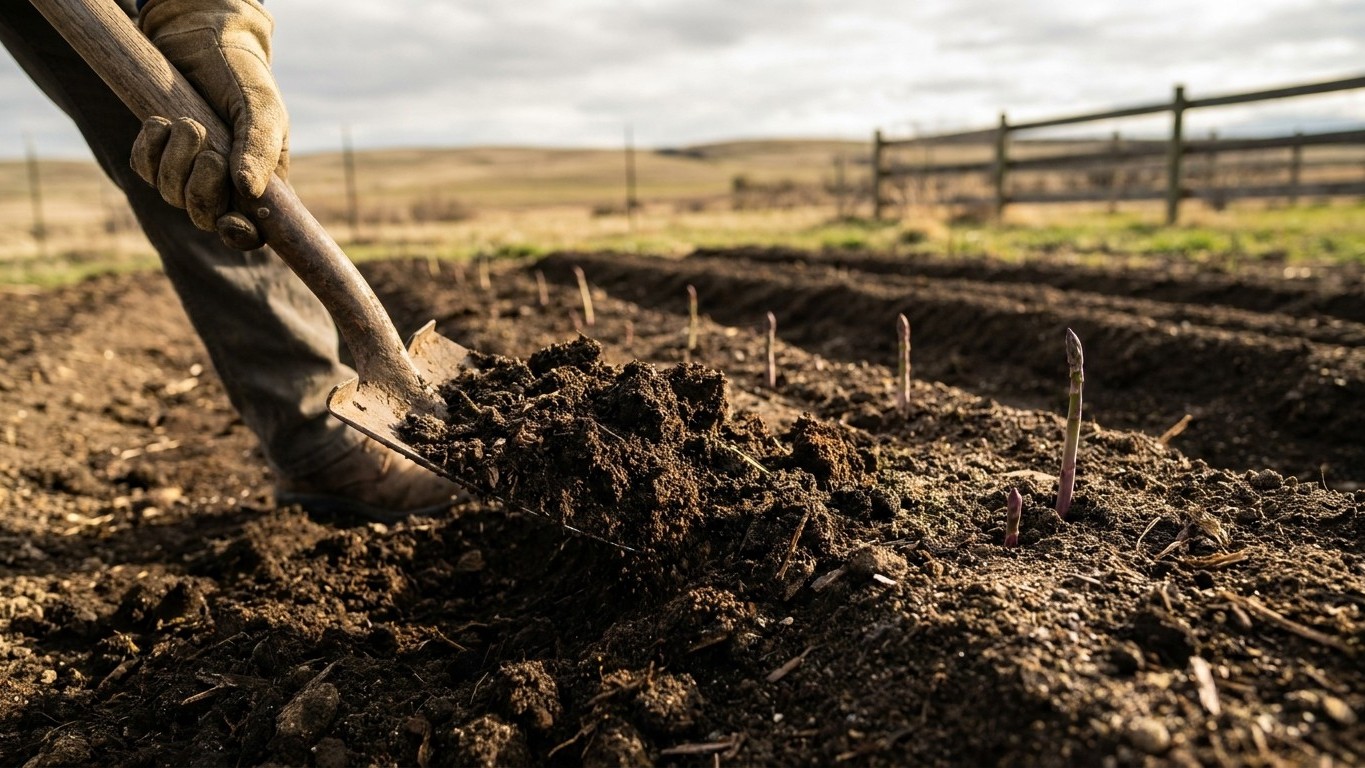

Louisiana’s asparagus answer starts with soil, not enthusiasm. A bed you plant this spring will still be producing spears when today’s seedlings are old shrubs, so the question isn’t whether asparagus grows here, but whether the exact patch of ground you pick can handle a decade-and-a-half without becoming a mistake you’re stuck with.
The short answer
Asparagus goes into the ground as crowns, set into furrows about 8 inches deep. You don’t fill that furrow all at once. The soil goes back in gradually, roughly 2 inches every other month across the first year, as the crown pushes up and the trench fills in behind it. Getting that timing right from the start matters, which is why it’s worth knowing When to Plant Asparagus Crowns in Louisiana. That slow backfill is part of why the bed gets so much time to establish before it ever produces anything you can eat: no harvest at all in year one or two, and the first cutting doesn’t come until year three.
Utah State University Extension, the source behind these figures, is direct about what asparagus asks of the ground beneath it: most soils will do, provided they drain. That single word carries the weight of this whole decision, because a bed you can’t fix after year one is a bed that stays wet, or stays dry, for as long as you own the yard.
What the state’s representative soil looks like
The soil USDA lists as representative of Louisiana is the Ruston series, an Ultisol, the kind of old, heavily weathered ground the Southeast is full of. Its surface is sandy, about 65 percent sand, 11 percent clay, 24 percent silt, with organic matter around 1.8 percent and a surface pH near 5.5. USDA also classifies it as well drained. On paper, that’s good news for a crop planning to stay put for 10 to 15 years: sand sheds water fast, and a bed sitting in standing water is the one failure mode that ruins asparagus outright.
But the Ruston series describes a mapped soil component, not your particular back corner of the yard. Louisiana runs from river-bottom clay to sandy hill country to whatever fill dirt a builder left behind, and none of that shows up in a state-level average. If your ground puddles for hours after a normal rain, that’s the actual test, more than any series name, and it’s worth asking directly: Will Louisiana Soil Hold an Asparagus Bed for Fifteen Years? A raised bed, or working in coarse organic matter before the crowns go in, solves the drainage problem before it becomes a 15-year problem. What the source stays silent on, deliberately left out here, is any pH target or chilling requirement for asparagus itself; neither is published, so neither gets guessed at.
Will the summer here water it for you?
The target for a new asparagus bed is specific: 1 to 2 inches of water every other week for the first two years, then a lighter routine of every three weeks once the crowns are established. Louisiana’s summer doesn’t deliver that evenly, even though the seasonal total looks generous on paper.
- The three-month total. June, July and August bring about 21.3 inches of rain combined, which sounds like more than enough for a bed asking for an inch or two every couple of weeks.
- The driest month still isn’t dry. July, the low point of the three, averages 6.79 inches on its own, more than a young asparagus bed’s entire two-week target in a single month.
- June and August aren’t far behind. June averages 7.62 inches and August 6.91, so the summer doesn’t have a real gap month the way drier states do.
- But rain doesn’t arrive on a schedule. Summer totals like these mostly come as thunderstorms, dumping an inch or more in an hour and running off a sandy surface before it soaks down to the roots, rather than settling in gently over two weeks the way a bed actually wants it.
- Heat cuts the other way too. Days that push into the 90s drive evaporation fast, so a downpour on Monday can leave the top few inches of a sandy bed dry again by Friday.
The practical read: a Louisiana gardener probably won’t need to run a hose on a fixed calendar the way someone in a drier state would, but skipping irrigation entirely because the seasonal average looks big is a mistake. A rain gauge staked next to the bed, checked weekly, tells you more than any statewide number can. If a week goes by without at least an inch registering locally, that’s the cue to add water yourself, regardless of what the three-month total eventually adds up to.
When to put the crowns in
Crowns go into the ground in early spring, timed to land after the risk of a hard freeze has mostly passed but before the ground has warmed up enough to push the plant straight into summer stress. For Louisiana, that window sits around the last spring frost date, which NOAA’s 1991-2020 climate normals place somewhere between January 18 and February 8, depending on where in the state you’re standing.
That date deserves a caveat most planting calendars skip. It’s a mean, not a guarantee, and in south Louisiana it barely applies at all. A 32-degree freeze shows up in only about 86.8 percent of years at the reference station behind that figure, meaning roughly one year in seven brings no freeze whatsoever. The fall side of that same window straddles the New Year, which tells you something important about how this state differs from most of the country: the limiting factor for asparagus here isn’t frost damage in spring. It’s how much summer heat the bed has to sit through afterward. North Louisiana freezes far more reliably than the southern parishes, so a gardener near Shreveport is working with a firmer calendar than one near the coast.
Given all that, “early spring” in Louisiana reads less like a hard date and more like a window that opens once the coldest snaps have mostly passed, which for much of the state arrives earlier than gardeners moving south from colder climates expect. Crowns are the standard route, and they’re what the figures above assume. Seed is the alternative entry point, though it adds a full growing season before the young plant reaches crown-sized roots worth transplanting, a season you skip entirely by starting with purchased crowns instead. For a bed you’re committing to for over a decade, most gardeners find that extra year isn’t worth the wait, and go with crowns from the start.
Checking this against your own county
Everything above is built on state-level and regional figures: a representative soil series, a reference weather station, a statewide frost range. None of it replaces a look at the specific ground you’re about to commit fifteen years to. The LSU AgCenter runs county-level extension offices across Louisiana, and that’s the right next call before crowns go in the ground.
A county agent can tell you whether your parish tends toward the sandy, fast-draining ground the state soil represents, or something heavier that needs a raised bed first. They can also flag local frost timing that runs earlier or later than the statewide range, since a river bottom or a low spot behaves differently than the reference station a few counties over. That’s a five-minute phone call against a fifteen-year decision, which is about as good a trade as gardening offers.
Common questions
Which asparagus variety should I plant in Louisiana?
Utah State University Extension names four commonly available options: Jersey Giant and Jersey Knight, both all-male varieties, and UC 157 F1 and Purple Passion, both male/female. The source doesn’t rank them on flavor or yield, and no nursery is named here as a recommended source, so the choice comes down to what’s locally available rather than a published best pick.
When can I actually harvest my asparagus?
Not before year three, no matter how vigorous the ferny growth looks in years one and two. In year three, harvest runs about 4 weeks; that stretches to roughly 6 weeks the following year, then about 8 weeks once the bed is fully established. The cutoff each season isn’t a date on a calendar. It’s a visual cue: stop cutting once most of the spears coming up are thinner than a pencil, which signals the crown needs to rebuild its energy for next year.
How long will an asparagus bed actually last?
Between 10 and 15 years from the same planting, which is the entire reason soil drainage matters so much upfront. There’s no realistic mid-course correction once the crowns are established and producing.
Does Louisiana’s acidic soil mean I need to adjust pH before planting?
The Ruston series that represents the state runs a surface pH around 5.5, but that’s a description of one mapped soil, not a target or requirement for asparagus specifically. No pH requirement for the crop is published in the source used here, and no chilling requirement either, so a soil test on your own bed is the only way to know where your ground actually sits.