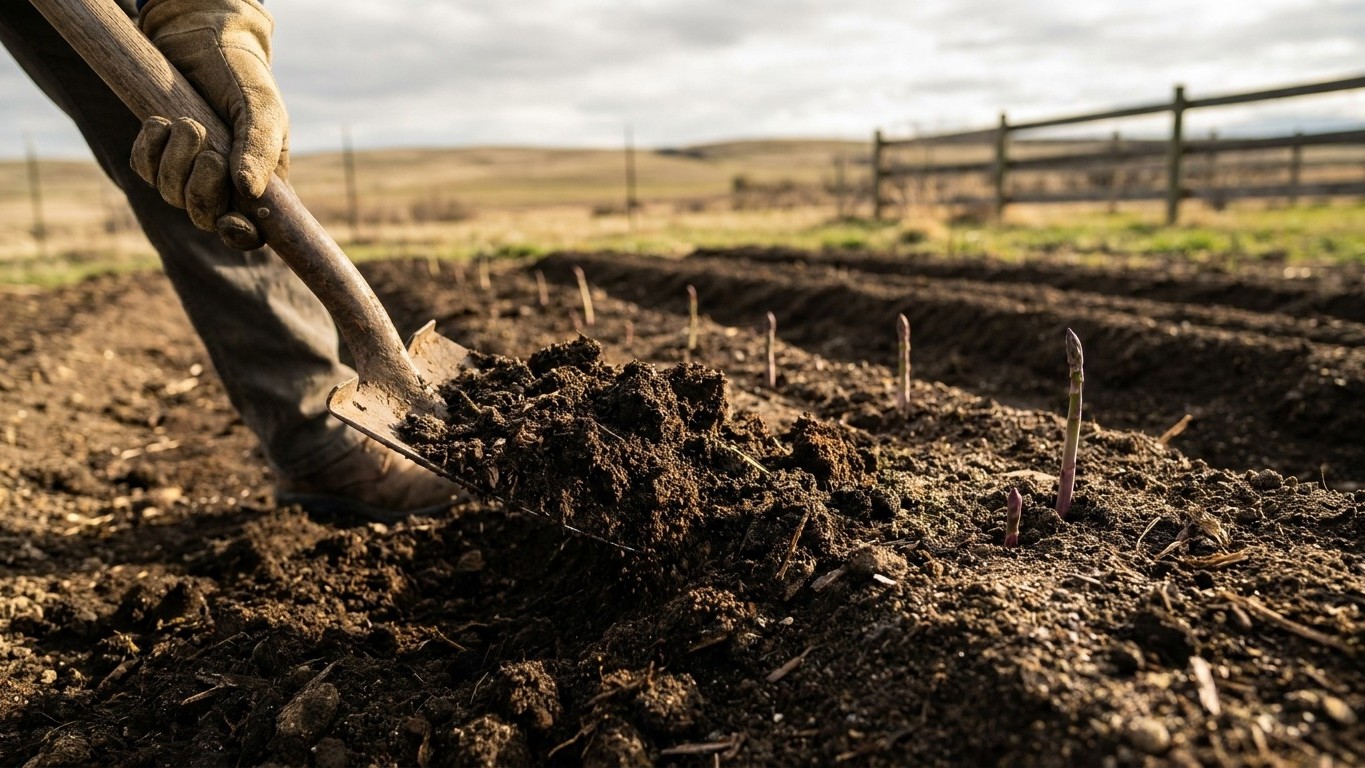

Fifteen years is a long time to leave a vegetable in one spot, and asparagus is the only crop on this site that asks for it. in Newfoundland and Labrador, the bed will outlast the answer depends entirely on what sits under the topsoil, because the plant’s one real requirement is drainage, and the province’s dominant ground does not drain freely on its own.
The short answer
A bed of asparagus crowns, once established, produces for 10 to 15 years without needing to be moved or replanted. That figure comes from Utah State University Extension, and it is the reason the planting decision carries more weight here than almost anything else grown in a home garden. Most soils will support asparagus, the same source notes, provided they are well drained. That single word, drained, is where a Newfoundland and Labrador gardener has to stop and ask Will Newfoundland and Labrador Soil Hold an Asparagus Bed for Fifteen Years? before putting a single crown in.
The dominant soil mapped across the province’s agricultural regions is a Podzol, the acid, leached soil type that forms under conifer cover, where rain has carried the bases out of the surface layer over time. That comes from Agriculture and Agri-Food Canada’s Canadian Soil Information Service, drawn from 459 mapped soil components across the province. The median surface pH sits around 4.3, which counts as strongly acid. The texture runs 56 percent sand, 9 percent clay and 35 percent silt, closer to a loam than anything heavy, with organic matter around 3.3 percent. But the drainage class attached to that dominant profile is imperfectly drained, not well drained.
That is the detail that matters for a fifteen-year commitment. An imperfectly drained soil holds water longer than asparagus crowns tolerate well, especially through a wet spring when the crowns are still shallow and dormant. It does not mean the crop cannot be grown here. It means the decision about where to put the bed has to include a real look at how that particular patch of ground behaves after rain, not an assumption borrowed from a province-wide median. A raised bed, or a mounded row built up eight inches or more above grade, is the standard way to give asparagus crowns the drainage a naturally heavy or slow-draining spot will not provide on its own, and getting the timing right matters just as much as the site; see When to Plant Asparagus Crowns in Newfoundland and Labrador for that piece of the decision.
None of this substitutes for checking the actual plot. The provincial figure is a starting point built from hundreds of mapped soil components across the agricultural regions of Newfoundland and Labrador, not a diagnosis of one backyard. River flats, reclaimed bog ground, and any soil a builder has cut, filled or compacted around a foundation can differ completely from that median. A simple test, dug by hand after a heavy rain, tells a gardener more about their own drainage than any provincial average can.
On variety, the published record is thin. Utah State University Extension names four: Jersey Giant and Jersey Knight, both all-male hybrids, and UC 157 F1 and Purple Passion, both male and female. The source gives their sex and nothing else, no flavor comparison, no yield figure, no reason to choose one over another. That is genuinely all that is documented here, and it is worth resisting the urge to fill in a preference the source does not support.
Will the summer here water it for you?
An established bed’s water needs change with age. Utah State University Extension puts it at 1 to 2 inches every other week for the first two years after planting, then stretches that out to every three weeks once the crowns are settled in. Measured against what a St. John’s summer normally delivers, the numbers land close, but not close enough to skip checking a rain gauge.
- What the bed asks for, years one and two: 1 to 2 inches roughly every fortnight across the growing season, which over a full summer adds up to somewhere in the range of 6 to 13 inches depending on how consistently that schedule is followed.
- What the bed asks for, year three onward: the same 1 to 2 inches, but spaced every three weeks instead of two, a noticeably lighter demand once the root system is established.
- What St. John’s normally delivers: Environment and Climate Change Canada’s 1981-2010 normals put summer rainfall at about 11.4 inches across June, July and August combined, broken down as 3.84 inches in June, 3.61 in July and 3.94 in August.
- Where the gap sits: July is the driest of the three months at 3.61 inches, and it is also the month when a young bed’s every-other-week schedule is most demanding. A normal is an average spread across three decades, not a guarantee that any single July arrives on schedule or in even installments.
- What to add: in a dry stretch, particularly during that first two years, a hose is the backup, not the rainfall total on paper. A rain gauge staked in the actual bed, checked weekly through the growing season, is the only way to know whether the sky is covering the 1 to 2 inches or whether a gardener needs to make up the difference.
These are normals for the St. John’s A reference station, not a forecast for every corner of the province. A coastal garden, an inland one, or anything on a slope that sheds rain faster than it soaks in will see a different real-world number than the station average.
When to put the crowns in
Crowns go into the ground in early spring, set into furrows about 8 inches deep, according to Utah State University Extension. The furrow is not filled in all at once. It gets backfilled gradually across the season, about 2 inches every other month, rather than buried in a single pass at planting time.
For Newfoundland and Labrador, the only frost anchor published here comes from Environment and Climate Change Canada’s 1981-2010 normals for the ST JOHN’S A station, which puts the average last spring frost around May 30. That word around matters. A mean date is the midpoint of a range, not a promise. In roughly one year out of two, the last frost at that station falls later than May 30, which means a gardener planting exactly on that date is planting into a coin flip. Early spring, in practice, means waiting until the soil is workable and the worst of the cold has passed, rather than fixing a single calendar day. And a provincial figure drawn from one coastal station will run behind schedule in northern or upland districts, where the ground stays cold longer into the season.
Once the crowns are in, the schedule that follows is fixed and worth knowing before the first spear ever shows. There is no harvest at all in the first two growing seasons. Harvesting begins in year three, and even then it is limited to about 4 weeks of cutting. That window lengthens to about 6 weeks the following year, and about 8 weeks in the years after that. The cue to stop each season is not a date on a calendar but the spears themselves: when most of them come up thinner than a pencil, cutting stops for the year, whatever week it happens to be.
Seed is the other route, and it is the slower one. Starting from seed instead of setting out crowns adds an extra growing season before the plants reach the size and maturity that a purchased crown already has at planting time. The source used throughout this article does not detail seed-specific timing or handling beyond noting that crowns are the standard planting method, so that gap is worth being upfront about rather than filling in with an unpublished figure.
Checking this against your own county
A provincial soil median and a single reference station’s frost date are a starting point, not a verdict on one particular yard. Local drainage, local frost pockets and local soil test results settle the real question for any specific piece of ground.
The Newfoundland and Labrador Department of Fisheries, Forestry and Agriculture is the place to take that question next. Its site, at gov.nl.ca/ffa, is the provincial contact point for agricultural and gardening questions specific to local districts, soil conditions and growing seasons that vary from the coastal averages cited here. A phone call or a soil sample sent through that office will tell a gardener more about their own eight feet of garden bed than any province-wide figure ever will.
Common questions
Can asparagus grow in acidic soil like Newfoundland and Labrador’s Podzols?
The published guidance used here does not give a pH requirement for asparagus, so no specific number can be attached to it. What is documented is a drainage requirement, and the province’s dominant soil is mapped as imperfectly drained, which is the more immediate issue to address before worrying about acidity.
How long before an asparagus bed produces anything?
Nothing is harvested in the first two years after crowns go in. Cutting starts in year three, for about 4 weeks, then extends to about 6 weeks the next year and about 8 weeks in the years that follow.
Does the crown planting date have to be exactly May 30?
No. May 30 is the average last spring frost at the ST JOHN’S A station over the 1981-2010 period, and an average means frost arrives later than that in about half of all years. Early spring planting should follow the actual condition of the soil and the season, not a fixed calendar date.
What happens if a garden’s soil does not drain well?
Since asparagus stays in the same spot for 10 to 15 years, poor drainage is not something to work around season by season the way it might be with an annual vegetable. Building a raised or mounded bed before planting is the standard way to give the crowns the drainage the source specifies, rather than hoping a naturally slow-draining spot improves on its own.