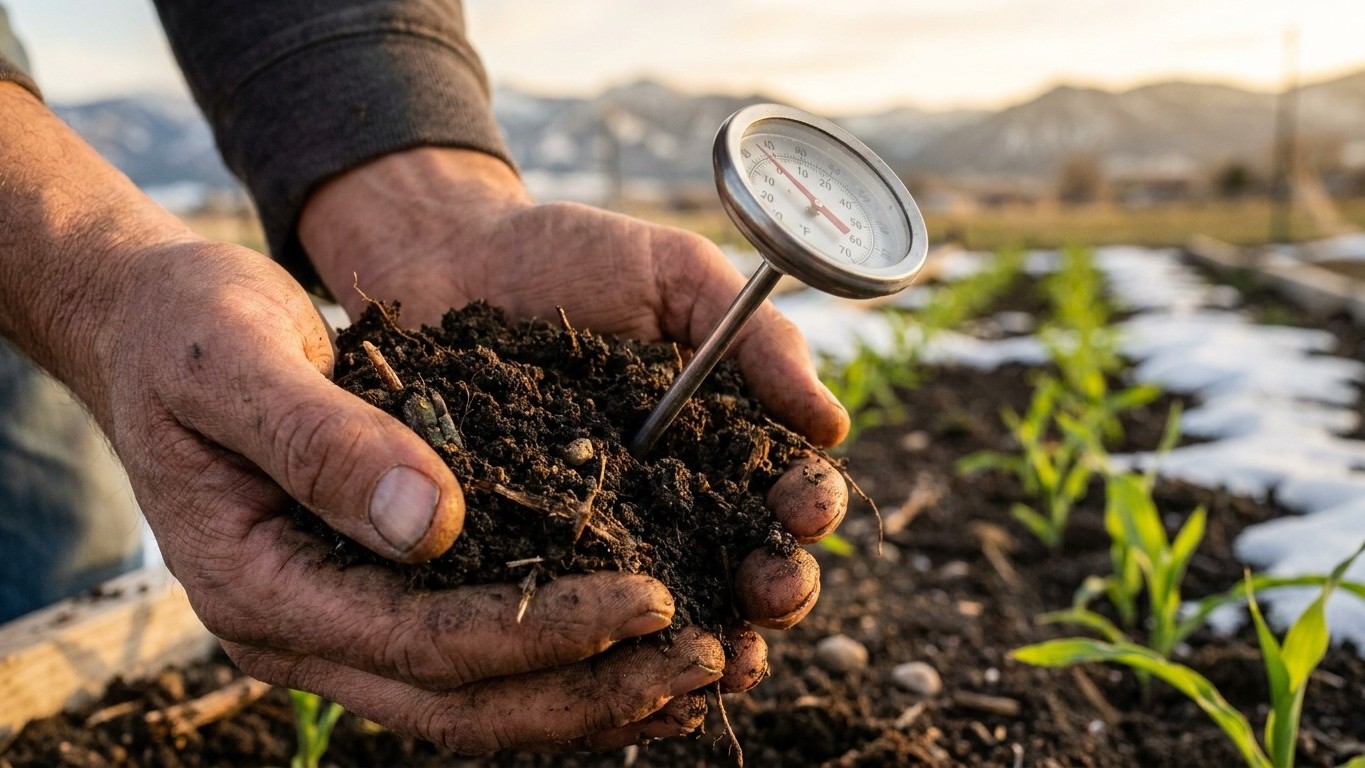

Will Sweet Corn Ripen in Newfoundland and Labrador? Sweet corn can mature here, but only with an early variety and only if the soil warms enough before planting. This province works on a maritime clock: cool summers, zero days a year hitting 90 F, and a frost-free window that looks generous on paper but shrinks fast once soil temperature enters the equation. The honest answer is: a fast variety, planted carefully, has a real shot. A late one does not.
The short answer
Corn seed does not care what the calendar says about frost. It cares about soil temperature, and sweet corn needs that soil above 60 F before it will germinate reliably. That threshold arrives well after the average last spring frost, not on the same day, and in a maritime province like this one the gap between “frost is over” and “soil is actually warm” can run into weeks. The average last spring frost at the St. John’s reference station falls around May 30, but treating May 30 as planting day would be a mistake. The ground here, sitting next to cold ocean water for months, warms slowly. A grower who plants the week after the frost date is very likely planting into soil still too cold for sweet corn to germinate well.
So the practical planting window opens later, likely well into June, once the soil itself has caught up. That is not a date this data set publishes, and no one should pretend otherwise. For a closer look at timing this properly, see When to Sow Sweet Corn in Newfoundland and Labrador. What can be said with confidence is that the window is shorter than it looks, because it is bounded on the other end too: the average first fall frost lands around October 17. Between the mean last spring frost and the mean first fall frost sits roughly 140 days, but subtract the weeks it takes soil to hit 60 F and the corn’s actual usable season drops closer to 100 to 120 days, depending on how far into June planting realistically starts.
That still leaves room for the 60 to 90 day maturity window sweet corn needs, according to Utah State University Extension, at least for varieties on the shorter end. The problem is heat, not just days. Zero days a year reach 90 F at the reference station. Corn does not just need a frost-free stretch, it needs accumulated warmth to push through pollination and ear fill, and a summer with no hot days at all delivers those growing degree days slowly. A 60-day count on a calendar in Iowa and a 60-day count on a calendar in Newfoundland are not the same 60 days. Here, they stretch longer in practice, because the heat that speeds things along in warmer states simply is not showing up.
None of this rules corn out. It rules out complacency. Choosing the fastest maturing type available, warming the soil before sowing, and tracking the actual weather rather than the mean dates are what decide whether ears fill before the October frost closes the season.
Does a late variety fit here?
A 60-day variety
Start with soil that has finally cleared 60 F, call that mid-to-late June in a typical year here, though this data does not give an exact date for that crossover. A 60-day variety planted at that point tassels and fills through the warmest stretch of summer and should be ready to pick sometime in August. That leaves a wide buffer before the average October 17 frost, likely six to eight weeks of slack even accounting for a slow-to-warm summer. This is the maturity class that makes sense for this province: it asks the least of a climate that has zero days above 90 F, and it gives the grower room to replant if a first sowing fails in cold soil.
Picking time itself runs on a separate clock from planting maturity. Once silks appear, ears are typically ready in roughly 17 to 24 days, a completely different count from the 60 to 90 day figure that decides whether the crop fits the season at all. The two numbers answer different questions and should never be collapsed into one. When that picking window arrives, look for three signs together, not just one: silks gone dry and brown, husks still moist and green, and juice that runs milky, not clear or starchy, when a kernel is punctured. All three together, not any single sign alone, mean the ear is ready.
A 90-day variety
Run the same math with a 90-day type and the margin disappears. Planting in mid-to-late June, adding 90 days lands harvest around mid-to-late September, which sounds fine against an October 17 mean frost date, until the heat problem is factored back in. A 90-day maturity rating assumes a certain pace of accumulated warmth that this climate, with no days a year above 90 F, does not reliably supply. In a cool summer, that 90-day variety can run noticeably behind its rated maturity, pushing ripening past the average frost date rather than ahead of it. Combine that with soil that was already slow to warm and a planting date pushed later than hoped, and the buffer a 60-day variety enjoys simply is not there for a 90-day one.
The plain conclusion: a 90-day sweet corn variety does not fit reliably in this territory. It might succeed in an unusually warm, unusually early year, but it is betting against the climate’s normal pattern rather than working with it.
What goes wrong here
- Soil sown too cold. Planting at or right after the average frost date, rather than waiting for soil to actually clear 60 F, is the most common failure in a province this cold. Seed sits, rots, or germinates unevenly. The remedy is patient: check soil temperature directly rather than trusting the frost date, and wait until it holds above 60 F before sowing.
- A variety too late for the season. Choosing a 90-day type because it promises bigger ears or better flavor ignores what a cool, hot-day-free summer does to that maturity rating. The remedy is to favor the fastest maturing type available and accept that as the tradeoff for growing corn this far north.
- Sweetness lost to the wrong neighbor. This one has nothing to do with climate. Sweet corn types (su, se and sh2) lose their characteristic sweetness when they tassel at the same time as each other, because cross-pollination between types changes the sugar content of the kernels. Utah State University Extension gives no isolation distance for this, and none should be invented here. The remedy is timing: stagger plantings or choose a single type so that different sweet corn types are not tasseling in the same window, and plant in blocks of three or more rows rather than a single thin row, which also improves pollination overall.
Checking this against your own county
Every figure above comes from a single reference station and averages spanning three decades. Newfoundland and Labrador is not one climate. Coastal districts, inland valleys, and the Labrador side of the province can sit weeks apart in when soil actually warms and when the first fall frost arrives, and a mean date is, by definition, beaten by a later frost in roughly half of all years.
Before committing a season’s seed budget to sweet corn, check current conditions and local guidance against the Newfoundland and Labrador Department of Fisheries, Forestry and Agriculture. Provincial agriculture staff can speak to conditions in a specific district in a way that a single climate station forty years of averages cannot, and they are the right first call before betting a garden bed on a 90-day variety this data suggests should be avoided.
Common questions
Can sweet corn ripen at all in Newfoundland and Labrador?
Yes, with a fast-maturing variety planted once soil has cleared 60 F. A 90-day type is unlikely to reliably mature given the cool, hot-day-free summers typical here.
Is the last frost date the right time to plant sweet corn?
No. Soil needs to reach 60 F, which happens well after the average May 30 last frost date in this maritime climate. Planting at the frost date risks seed sitting in soil too cold to germinate.
Why did my sweet corn lose its sweetness?
The most likely cause is two different sweet corn types tasseling at the same time nearby, which cross-pollinates the ears and changes the sugar content of the kernels. Stagger plantings or grow a single type to avoid this.
How do I know when an ear is actually ready to pick?
Look for three signs together: dry, brown silks, husks that are still moist and green, and juice that runs milky when a kernel is punctured. One sign alone is not enough; all three together confirm ripeness.