
Pennsylvania can grow asparagus well, provided the spot drains. The state’s representative soil, the Hazleton series, is classified well drained, which clears the one hurdle Utah State University Extension sets for the crop. When to Plant Asparagus Crowns in Pennsylvania matters too: get crowns in the ground in early spring, wait until the third year to harvest, and the bed will keep producing for ten to fifteen years. The soil test matters more than the state average, which raises the real question: Will Pennsylvania Soil Hold an Asparagus Bed for Fifteen Years?
The short answer
Start with what the Hazleton series actually is: an Inceptisol, meaning a young soil that hasn’t had time to build the layered horizons older soils show. Its surface runs loam to silt, about 46 percent sand, 42 percent silt, and 12 percent clay, with organic matter around 3.0 percent. USDA NRCS lists it as well drained, which is the only soil condition Utah State’s asparagus guidance cares about. No pH threshold, no mention of chilling hours, nothing about fertility rankings. Just: does the water move through, or does it sit.
That single question carries more weight here than it would for a tomato bed or a row of carrots. Those crops get replanted every year, so a mediocre spot is a mediocre spot for one season and then you move on. Asparagus doesn’t work that way. A crown planted this spring is still expected to be sending up spears a decade and a half from now. Pick a low corner of the yard that stays soggy after a storm, and you’re not dealing with a bad year, you’re dealing with a bad decade.
What the state soil does and doesn’t tell you
The Hazleton series is what USDA NRCS names as representative of Pennsylvania, drawn from surveys of 389 mapped components. It is not a prediction for any one backyard. The state runs from river bottoms in the southeast to steep hill country in the north and the Alleghenies, and any lot a builder graded or filled sits on ground that has nothing to do with a natural soil series. A silty loam like Hazleton, well drained by nature, tells you what the regional tendency looks like. It doesn’t tell you what’s under the lawn where you’re standing.
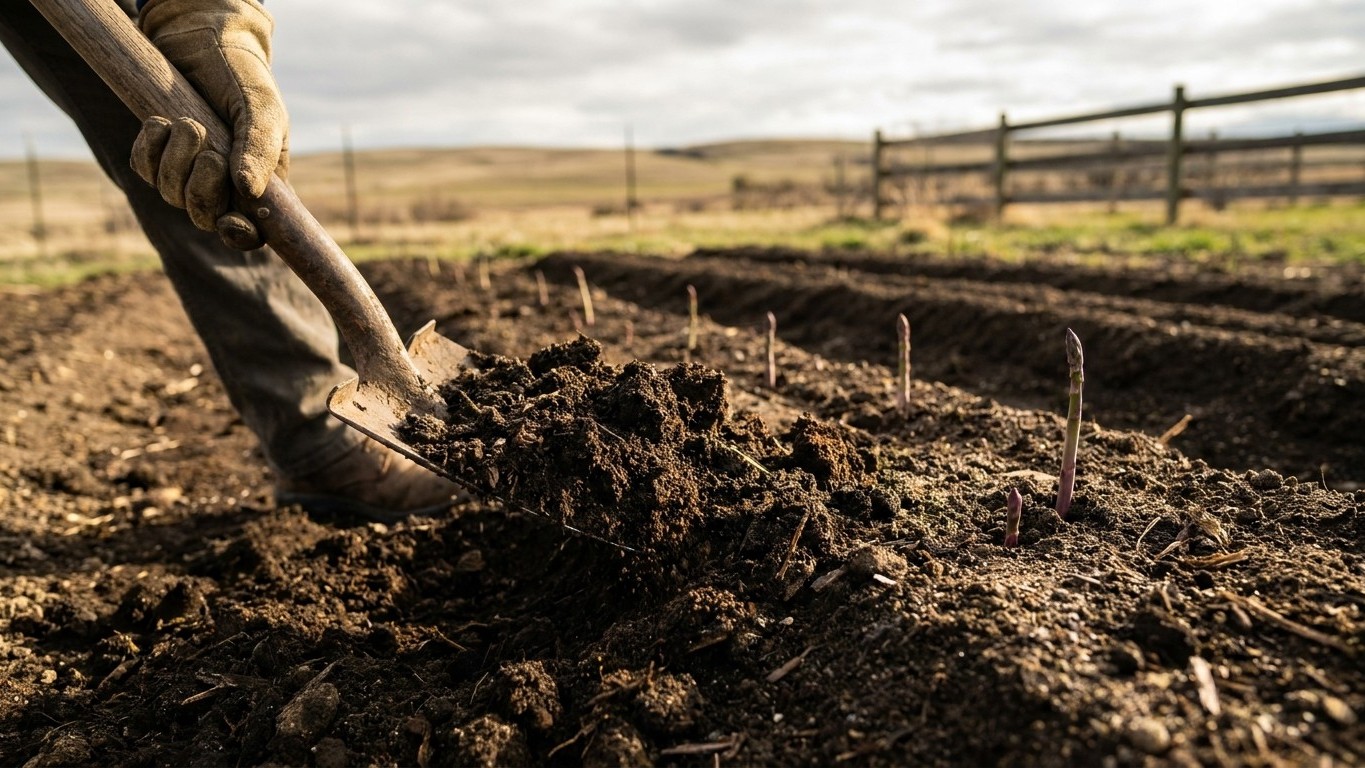
If a dig test after rain shows standing water more than an hour or two later, the fix isn’t to abandon asparagus. It’s to raise the bed, working organic matter into a mounded row eight to twelve inches above grade, or to shift the planting to higher ground on the same property. A raised bed sidesteps the drainage question entirely, which matters more here than almost anywhere else on this site, precisely because the decision won’t be revisited for fifteen years.
Will the summer here water it for you?
Utah State’s figures are specific: 1 to 2 inches of water every other week for the first two years while the crown system establishes, then a lighter schedule of every three weeks once the bed matures. Pennsylvania’s summer rainfall, measured at the reference station behind the state’s climate normals, runs about 12.7 inches across June, July, and August combined, with June the driest of the three at 4.04 inches, July at 4.38, and August at 4.29. On paper the totals look close to what a mature bed needs. In practice, rain doesn’t fall on the every-other-week schedule the plant wants, and a single thunderstorm that dumps an inch in twenty minutes mostly runs off a clay-heavy soil instead of soaking in.
- Track the establishment years separately. In the first two seasons after planting, the bed needs 1 to 2 inches every other week regardless of what the sky delivers. June’s normal of 4.04 inches over four weeks falls short of what two establishment-year cycles would call for, so plan on supplemental watering through June most seasons.
- Watch July and August with a rain gauge, not a memory. Both months average a bit over 4 inches, close to two cycles of the 1-to-2-inch target, but normals are 1991-2020 averages, not this year’s forecast. A dry stretch mid-summer is common even in a normal year.
- Ease off once the bed matures. After the second year, the every-three-week schedule is far more forgiving, and Pennsylvania’s summer rainfall usually covers most of that need on its own, especially on the finer-textured, better-moisture-holding end of the state’s soils.
- Let the soil, not the calendar, make the final call. A sandy surface drains a rainstorm within a day and needs the gauge checked more often; a clay-heavy one holds moisture longer and can go without supplemental water even when a normal month looks dry on paper.
When to put the crowns in
Crowns go into the ground in early spring, set into furrows about 8 inches deep. Pennsylvania’s last spring frost, measured at the same reference station used for the rainfall normals, runs around March 29 to April 6 for the 30-to-70-percent freeze probability band. That’s an average drawn from three decades of data, not a guarantee for any one spring, and Philadelphia sits at the mild end of the state. The northern tier and the Alleghenies typically run two to four weeks later, so a gardener in those regions should expect to plant later than the statewide window suggests.
The furrow itself isn’t filled in all at once. Utah State’s method backfills it gradually across the first year, adding about two inches of soil roughly every other month as the young shoots grow, rather than covering the crown completely on planting day. That staged filling protects the emerging growth while still giving the root system room to establish in loose soil.
Seed is the alternative route, though it adds a year to an already long timeline before the bed produces anything. Most home gardeners skip it in favor of crowns for exactly that reason: a crown is already a year or more into its root development, while seed starts from nothing.
On variety, the available guidance names four options by breeding type alone: Jersey Giant and Jersey Knight are all-male varieties, while UC 157 F1 and Purple Passion are male/female crosses. Utah State’s Extension guidance doesn’t rank them on flavor or yield, and no nursery is named as a source here. The choice comes down to what’s locally available, not a published performance difference.
Whatever variety goes in, the harvest clock doesn’t start moving until the third year. The first harvest that year runs about 4 weeks, then extends to about 6 weeks the following year, then to about 8 weeks after that. The stopping point each season isn’t a date on the calendar. It’s a visual cue: once most of the spears coming up are thinner than a pencil, harvest stops for the year so the plant can put energy into building next year’s crown reserves.
Checking this against your own county
None of this replaces a soil test on the actual planting site. The Hazleton series describes what USDA NRCS maps as representative of Pennsylvania broadly; it says nothing about the drainage, pH, or texture of one particular yard in Erie County versus one in Chester County. Penn State Extension, the land-grant extension service for the state, runs county offices that can walk a gardener through a soil test and confirm whether a specific spot drains well enough for a planting meant to last fifteen years.
Frost dates work the same way. The statewide window given here is an average from one reference station, and local extension staff typically know how much later a given county’s frost risk runs compared to the milder southeast corner of the state. Before crowns go in the ground, a call to Penn State Extension is the fastest way to square general figures against the conditions of one particular property.
Common questions
Does Pennsylvania’s acidic soil hurt asparagus?
The published guidance for this crop is silent on soil pH, so no acidity threshold is available to compare against the state’s representative surface reading. A local soil test, not the state average, is the way to check pH on a specific site.
How long before asparagus can be harvested after planting?
No harvest happens in the first two years. Harvest begins in the third year, running about 4 weeks that year, then about 6 weeks the following year, then about 8 weeks in subsequent seasons, always stopping once most spears thin out to less than pencil width.
Can asparagus grow in heavy clay soil in Pennsylvania?
Utah State Extension’s only stated requirement is that the soil drains; it doesn’t rule out clay specifically. Where a site holds standing water after rain, raising the bed several inches above grade with added organic matter is the practical workaround rather than picking a different crop.
Is there a winter chilling requirement for asparagus in this region?
That figure isn’t published in the available guidance. No chilling-hour number should be assumed from the state’s hardiness zone; treat it as information not currently available rather than filling the gap with a guess.