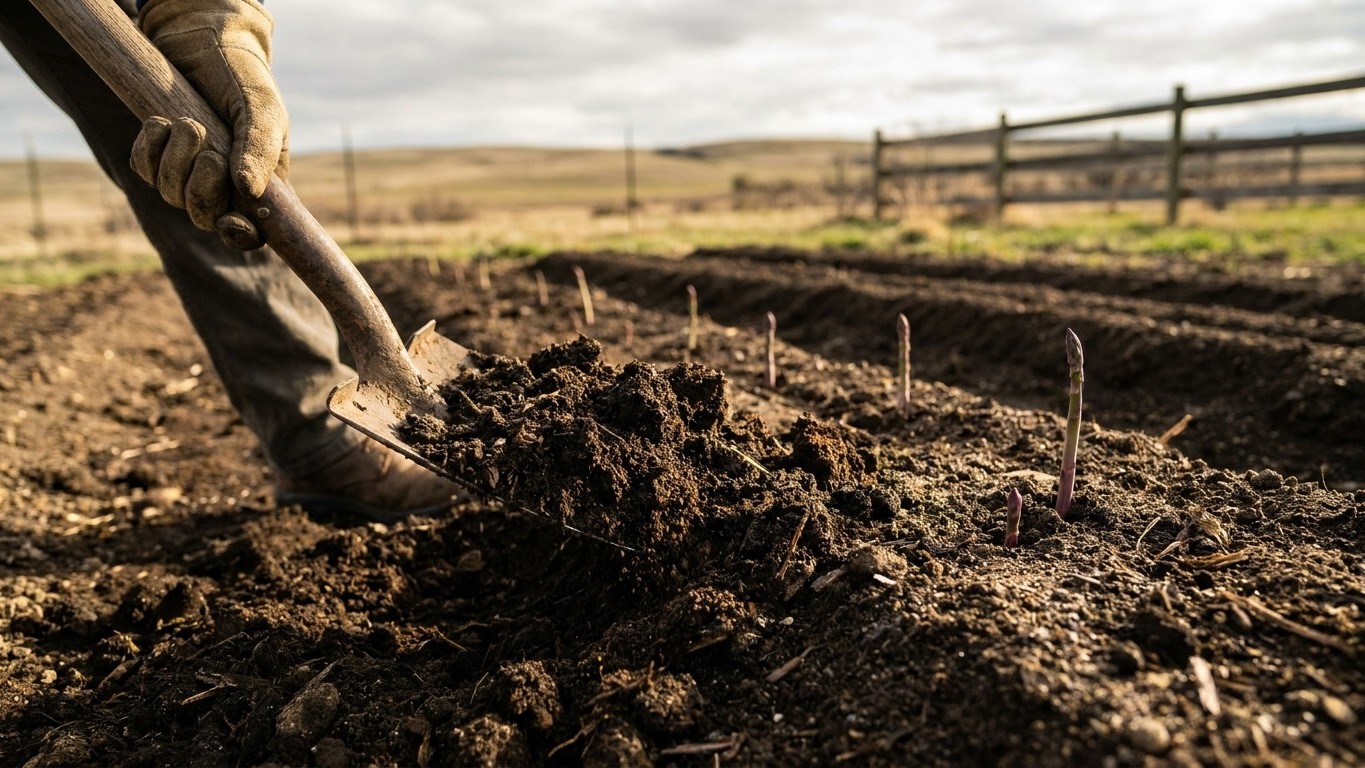

Yes, a spot for asparagus in Quebec can hold the same bed for ten to fifteen years, but the soil has to drain. The province’s dominant ground, an acid Podzol, sheds water well by nature. When to Plant Asparagus Crowns in Quebec is around early May; skip the fork for three seasons, and the same twenty feet of garden feeds you every June for the rest of the decade.
The short answer
Asparagus is the one plant on this site where the decision outlives the gardener’s patience. A bed planted this spring is still producing spears when the kids who watched it go in are in high school. Utah State University Extension puts the commercial life of a bed at ten to fifteen years, with the first cut delayed until the third year after planting, then rising in stages: about four weeks of harvest in year three, six weeks in year four, and eight weeks from year five onward. The source names no calendar date to stop; instead it gives a rule tied to the plant itself, quit cutting once most of the spears coming up are thinner than a pencil, because that is the plant telling you it needs to rebuild its root reserves for next year. Will Quebec Soil Hold an Asparagus Bed for Fifteen Years?
The one soil condition the source insists on is drainage. Everything else, it says plainly, most soils will handle. That single requirement matters more here than almost anywhere else on this site, because a heavy, slow soil is a nuisance you can amend every spring in an annual vegetable bed, but it is a mistake you live with for a decade and a half once asparagus crowns are in the ground.
Quebec’s most common mapped surface soil is a Podzol, the acid, leached profile that forms under conifer cover once rain has carried the bases out of the topsoil. Agriculture and Agri-Food Canada’s soil survey puts it at 36 percent of the mapped surface, ahead of Gleysolic ground, with a median surface pH near 5.5, a loam-to-silt texture (51 percent sand, 34 percent silt, 15 percent clay), organic matter near 6.2 percent, and a drainage class of well drained. That drainage class is the good news for asparagus specifically: on paper, the province’s typical ground clears water the way the crop wants.
That figure is a starting point, not a verdict on any one yard. The survey describes the median of 248 mapped agricultural components across the province, and it does not cover the far north. A river-bottom lot, a patch of muskeg, or ground a builder filled and compacted can behave nothing like that median, holding water in a way no provincial average will warn you about. If a test hole dug a foot or two down fills with water and stays that way for more than a few hours after a rain, the practical fix is to raise the bed, mounding the row six to eight inches above grade or building a framed raised bed, so the crowns sit above whatever the native soil can’t carry off.
Will the summer here water it for you?
The bed’s own water budget is specific: 1 to 2 inches every other week for the first two seasons while the crowns are still building a root system, then a lighter 1 to 2 inches every three weeks once the planting is established. Set against what Environment and Climate Change Canada’s 1981-2010 normals record for the Montreal/Pierre Elliott Trudeau station, about 10.6 inches of rain across June, July and August, the math works out roughly like this:
- Weekly average from the sky: 10.6 inches over a summer of roughly thirteen weeks averages out to a little over half an inch a week, which sits near the low end of what a first- or second-year bed needs and generally covers what a mature bed needs.
- The driest month is the riskiest one: June, the establishment month for a newly planted bed, is also the driest at 3.42 inches, versus 3.52 for July and 3.71 for August, so the weeks right after planting are exactly when rainfall is thinnest.
- Averages hide the gaps: normals describe a long-run mean, not any single summer. Rain that falls as one heavy thunderstorm mostly runs off a well-drained Podzol rather than soaking into the root zone, so a week can show up as “average” on the ledger while the bed itself stays dry.
- What that means for a hose: a first- or second-year bed should be checked with a rain gauge every week through June in particular, and topped up to the 1-to-2-inch target whenever the gauge falls short, rather than assumed to be covered because the season averages out fine.
- Established beds need less oversight: once a planting is past its second year and only needs 1 to 2 inches every three weeks, the province’s typical summer rainfall usually clears that bar on its own, and supplemental watering becomes an occasional insurance policy during a dry stretch rather than a routine.
None of this replaces a rain gauge stuck in the actual bed. A station reading is a regional average; a slope, a wall, or a city microclimate can shift it in either direction, and the only number that settles the question for a given yard is the one measured on that yard.
When to put the crowns in
Crowns go into the ground in early spring, set in furrows about 8 inches deep. Environment and Climate Change Canada’s 1981-2010 normals put the average last spring frost at the MONTREAL/ST-HUBERT A station around May 6, and “around” matters here: a mean date is a midpoint, not a guarantee, and in roughly one year out of two the last frost actually lands later than that. Treat early May as the center of a planting window rather than a green light, and hold off if a hard frost is still forecast.
The furrow itself isn’t filled in one motion. The soil goes back over the crowns gradually across the season, about two inches every other month, rather than being backfilled flush on planting day, which lets the developing shoots keep pushing up through loose soil as the crown settles in.
The source names four varieties by one trait only, their sex, and says nothing else about flavor, yield, or which performs better in a given climate:
| Variety | Sex |
|---|---|
| Jersey Giant | All-male |
| Jersey Knight | All-male |
| UC 157 F1 | Male/female |
| Purple Passion | Male/female |
All-male varieties put their energy into spears instead of seed production, which is generally why gardeners lean toward them, but that reasoning isn’t stated in the source itself, so treat it as background rather than a published recommendation.
Seed is the alternative route the source points to, though it gives no seeding calendar of its own. Starting from seed means growing a seedling to crown size before it ever goes into a permanent furrow, which effectively adds a year onto the front end of the whole timeline before the three-year no-harvest clock even starts ticking. For a bed meant to still be producing spears a decade and a half from now, most home gardeners find that crowns, not seed, are the faster way to the first real harvest.
Neither the planting depth guidance nor anything else in the source touches on winter chilling requirements or a target soil pH for asparagus. Those numbers simply aren’t published here, and reaching for a hardiness-zone-based chilling figure would be a guess dressed up as data. Better to plant by the frost window given and confirm drainage before committing a spot for fifteen years, rather than chase a chilling number nobody has actually measured for this crop.
Checking this against your own county
A provincial soil survey and a single Montreal-area weather station describe the region in broad strokes, not the particular back corner of a particular yard. Before committing a fifteen-year bed to a spot, it’s worth running the local frost dates, soil drainage, and any variety guidance past Quebec’s own agriculture ministry, Le ministère de l’Agriculture, des Pêcheries et de l’Alimentation du Québec (MAPAQ), which tracks conditions at the regional level in a way a single climate station or a province-wide soil average can’t.
A local office or an extension contact can also confirm whether a given county’s frost window runs later than the Montreal-area normal cited here, since upland and northern districts routinely lag behind a southern reference station by weeks. That gap is exactly the kind of detail a provincial figure can’t resolve on its own.
Common questions
Can I harvest any spears in the first two years?
No. The source is explicit that harvest doesn’t begin until year three, with no exception described for a partial or trial cut in years one or two.
How long does harvest season last once it starts?
It grows in stages: about four weeks in year three, six weeks in year four, and eight weeks from year five onward, according to Utah State University Extension.
How do I know when to stop cutting each season?
Watch the spears rather than the calendar. The rule given is to stop harvesting once most of the spears coming up are thinner than a pencil, a sign the plant needs to shift energy back into rebuilding its roots for the following year.
What if my soil doesn’t drain well?
The source’s only real soil requirement for asparagus is drainage. If a test hole stays wet for hours after rain, raising the bed six to eight inches above grade, or building a framed raised bed, is the practical way to give the crowns the drained root zone they need for a planting meant to last a decade or more.