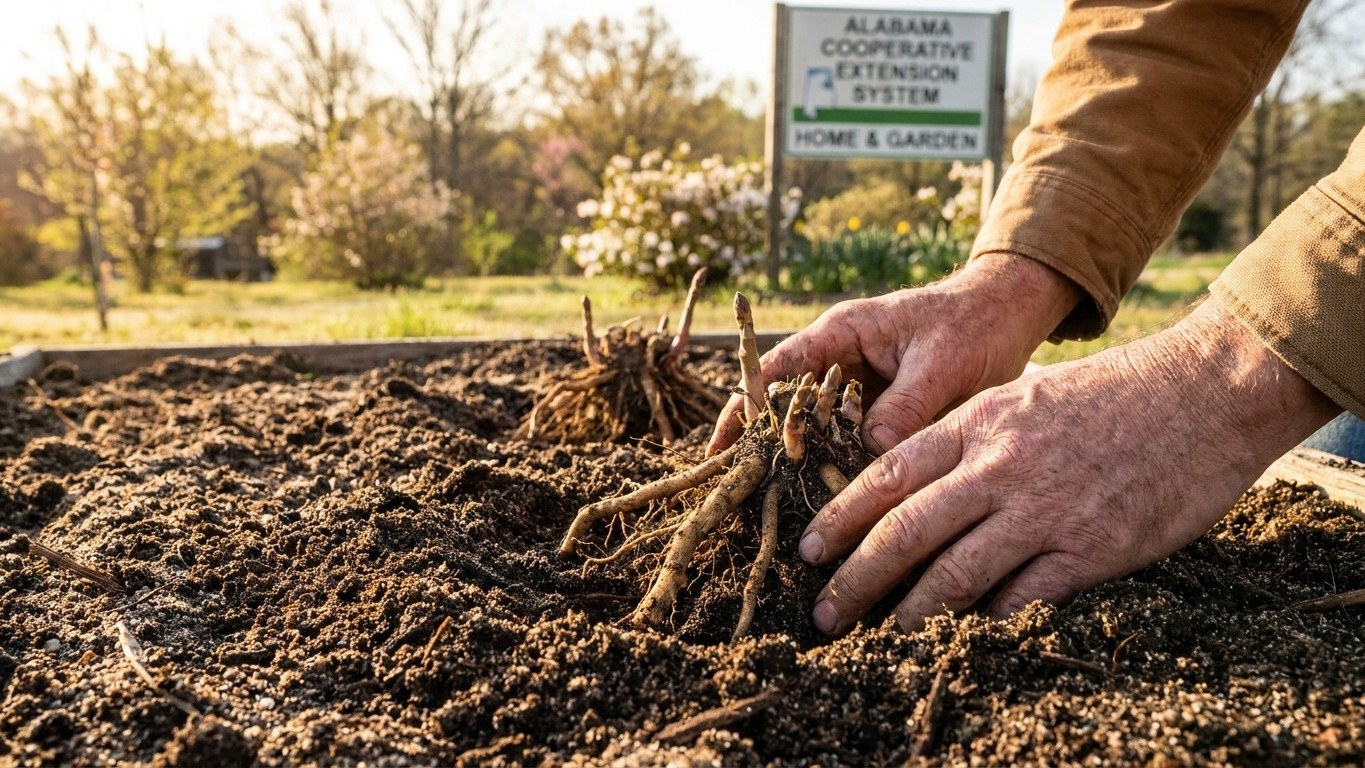

Alabama gardeners get one real planting window for asparagus crowns: early spring, timed to the last frost. Since a bed planted now will still be producing spears a decade and a half from now, the exact week matters far less than what’s underneath the crowns. That soil question is where this answer actually gets interesting.
The short answer
Asparagus is unlike almost anything else grown in a home garden. Once those crowns go into the ground, they stay put for 10 to 15 years, according to Utah State University Extension. There’s no rotating this bed to a sunnier corner next season or moving it because the drainage turned out wrong. The plant asks for exactly one thing from the soil: that it drains. Everything else, according to the same source, most soils can handle.
Alabama’s official state soil offers a useful reference point here. The Bama series, an Ultisol named the state soil by Alabama law in 1997 under the USDA NRCS State Soils program, is described in USDA NRCS soil survey data as well drained. It’s sandy stuff, roughly 67 percent sand, 14 percent clay and 19 percent silt in the surface horizon, with organic matter around 0.8 percent and a surface pH near 5.3, strongly acid. Sandy, well-drained ground like that is close to ideal for a crop that will rot in standing water. If your yard happens to sit on soil built like the Bama series, drainage is likely one less thing to worry about.
But the Bama series describes a state, not a backyard. Alabama holds hundreds of mapped soil series, and river bottoms, clay-heavy hill country, and any lot a builder graded and compacted can behave nothing like the sandy, well-drained profile above. A patch of dense clay that puddles for a day after rain is a different proposition entirely for a bed meant to outlast a mortgage’s first refinance. The fix, if a test spot holds water, isn’t complicated: raised beds, or working generous organic matter into a wide trench before planting, both let a heavier soil shed water the way this crop needs.
The practical planting method backs this up. Crowns go into furrows roughly 8 inches deep, and rather than filling that trench in one pass, gardeners backfill it gradually across the season, adding about 2 inches of soil every other month. That slow backfill gives roots time to establish while keeping the crown from sitting too deep, too soon, in ground that hasn’t proven itself dry.
None of this is a substitute for checking the actual dirt in the actual bed. A soil test through a county extension office will say more about one specific yard than any state-level series ever could.
Will the summer here water it for you?
Once established, an asparagus bed asks for 1 to 2 inches of water every other week for its first two years, then eases to about every three weeks after that, per Utah State University Extension. Alabama’s summer rainfall, drawn from NOAA NCEI 1991-2020 climate normals at the reference station used throughout these figures, comes in at roughly 12.1 inches across June, July and August combined. That sounds like it might cover the requirement on its own. It doesn’t, not reliably, and here’s the sequence that explains why.
- The monthly numbers aren’t flat. June averages 4.06 inches, July climbs to 4.49 inches, and August drops to 3.55 inches, the driest of the three, per the same NOAA normals.
- Averaged out, that’s close to an inch a week across the summer, which on paper roughly matches the every-other-week, 1-to-2-inch target for a young bed.
- Rain doesn’t arrive on a schedule. Summer totals in the Southeast typically come as thunderstorms, not steady soaking rain, meaning a bed can go two dry weeks and then get 2 inches in an afternoon that partly runs off instead of sinking in.
- Sandy ground drains fast in both directions. If the bed sits on soil built like the sandy Bama series, that quick summer downpour moves through the root zone and past it within a day, leaving less stored moisture for the following week than the same rain would leave in heavier ground.
- August is the gap month. At 3.55 inches, it’s the thinnest of the three summer months, right when a two-year-old bed is still asking for that every-other-week 1-to-2 inches.
- The working answer is a rain gauge, not an almanac. These are 30-year normals for one reference station, not a forecast and not a guarantee for any specific yard. A gauge on the actual bed, checked weekly through summer, tells a gardener whether nature covered that week or a hose needs to make up the difference.
The honest takeaway: Alabama’s summer rainfall gets a new bed most of the way there most years, but on sandy, fast-draining ground it rarely gets there every single week, and August is the month most likely to come up short.
When to put the crowns in
Crowns go into the ground in early spring, timed around the last frost rather than a fixed date on the calendar. NOAA NCEI 1991-2020 climate normals put the window for the last spring freeze at the 32°F threshold at around March 19 to April 3, based on freeze probabilities at the reference station used throughout this data. That’s a mean, built from three decades of records, not a promise for any single spring. Suburban and rural gardens away from that airport station often see their last frost arrive later, sometimes by a week or two, and gardens at higher elevation later still. The practical move is to treat that date range as a starting point and confirm timing against a specific county’s typical frost pattern before crowns go into the trench.
Aiming for the tail end of that window, rather than the earliest days of it, gives newly set crowns a better shot at avoiding a late cold snap that catches tender new growth. Since the bed is going to occupy that ground for a decade or more, a week or two of patience in spring costs nothing measurable against that timeline.
Growing from seed is the main alternative to planting crowns, and it’s worth knowing before committing to one method. Starting asparagus from seed pushes the whole timeline back, since seedlings need a season of growth before they’re substantial enough to set out as what amounts to a homegrown crown. Most home gardeners choose crowns specifically because they skip that extra year and shorten the wait to first harvest, but seed remains an option where crowns of a particular type aren’t available.
On variety, Utah State University Extension names four asparagus varieties by sex alone: Jersey Giant and Jersey Knight are all-male, while UC 157 F1 and Purple Passion are male/female. The source doesn’t rank them by flavor, yield, or suitability for any particular soil or region, so no variety recommendation is published here, and none should be assumed.
Common questions
How soon can I harvest spears after planting crowns?
Not in the first two years. Utah State University Extension is clear that harvest doesn’t begin until the third year after planting, and even then it’s limited: about 4 weeks of cutting the first harvest year, extending to roughly 6 weeks the following year, then up to about 8 weeks once the bed is fully established.
How do I know when to stop cutting each season?
Stop when most of the spears coming up are thinner than a pencil. That’s the signal the crown’s stored energy for the season is running low, not a specific week on the calendar. Cutting past that point weakens the bed’s performance the following year.
Do I fill the planting trench all at once?
No. The furrow, dug about 8 inches deep for the crowns, gets backfilled gradually rather than in a single pass, adding roughly 2 inches of soil every other month across the year as the young shoots grow.
Does Alabama’s acidic soil mean I need to adjust pH before planting?
The surface pH of the state’s representative soil runs around 5.3, strongly acid, but that figure describes a mapped soil series, not any individual garden, and Utah State University Extension’s asparagus guidance doesn’t specify a target soil pH for the crop. A soil test on the actual bed is the only way to know what, if anything, needs adjusting there.