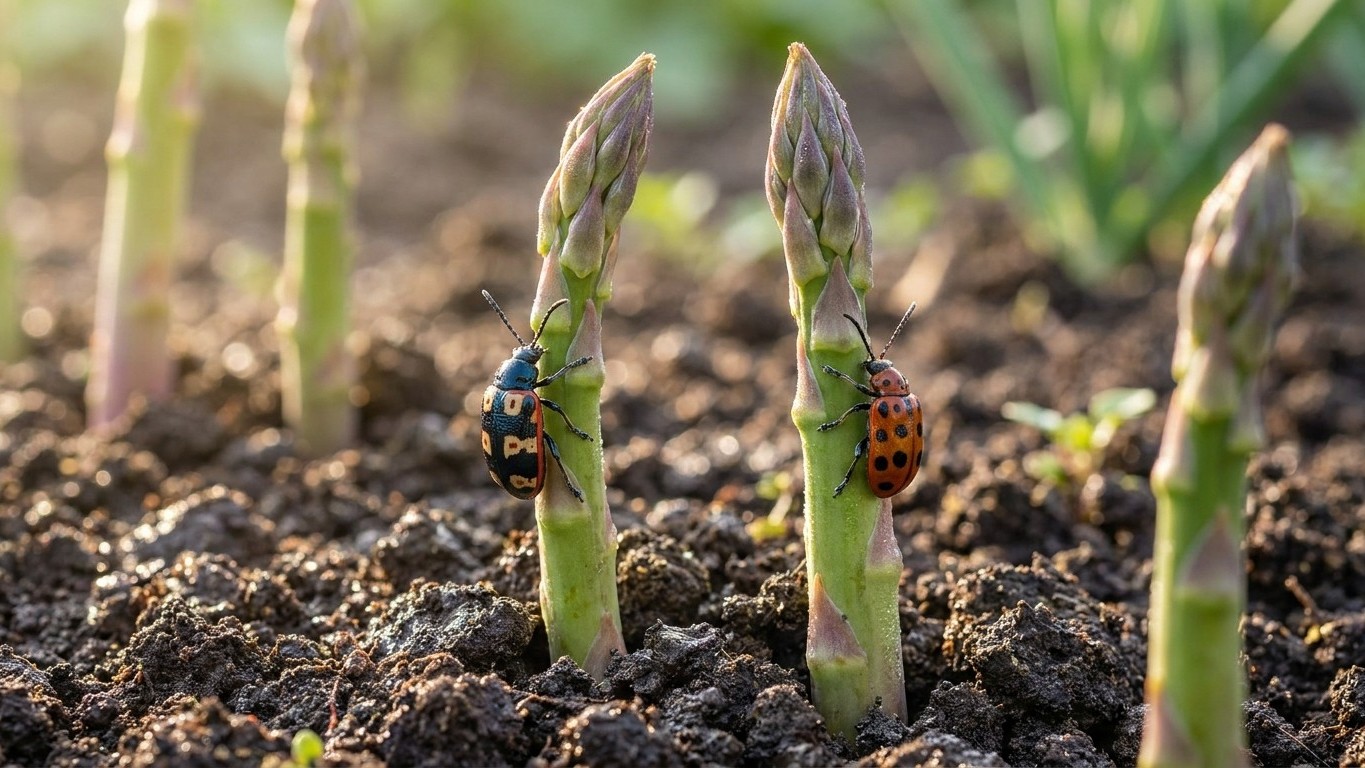

In Alabama gardens, only four of the state’s documented vegetable pests show up on asparagus with any regularity: aphids, spider mites, Leaffooted bugs, and stink bugs. All four are generalist feeders that move onto asparagus ferns once their preferred hosts nearby have been picked over or dried out. The rest of the insects the state tracks on vegetable crops are tied to other plants and have little reason to touch an asparagus bed at all.
Which pests attack asparagus in Alabama

The Alabama Cooperative Extension System documents ten insect pests across the state’s home vegetable garden crops: Aphids, Corn earworm (tomato fruitworm), Cowpea curculio, Imported cabbageworm, Leaffooted bug, Mexican bean beetle, Spider mites, Spotted cucumber beetle, Squash vine borer, and Stink bugs. That’s the full list for this territory, and it isn’t padded with anything beyond it.
Not all ten belong on an asparagus page. Corn earworm targets developing corn ears and tomato fruit, structures asparagus never produces during its harvested spear stage, so it has nothing to feed on here. Cowpea curculio is a pod feeder built for cowpeas and southern peas, not a fern or a spear. Imported cabbageworm sticks to cabbage-family leaves, a chemistry asparagus doesn’t share. Mexican bean beetle feeds almost exclusively on bean foliage. Spotted cucumber beetle and squash vine borer are both built around cucurbit vines, squash, cucumber, melon, and neither one is drawn to an asparagus row planted well away from a squash patch.
That leaves four species with a real reason to show up: aphids and spider mites, both sap feeders with a wide host range that includes the feathery mature fern; and leaffooted bugs and stink bugs, generalist true bugs that will pierce tender stems and any berries a female plant sets later in the season. Treating those four as the ones worth watching, and setting the other six aside, keeps a gardener from spraying for a beetle that was never going to visit the bed in the first place.
When each one shows up, and what it does first
Spears push through the soil as the ground warms following the region’s last spring frost window, listed for the reference station as March 19 to April 3. That window is the anchor for Everything that follows, since every one of the four pests tracks the fern’s growth stage rather than a fixed date on the calendar.
Aphids are usually the first sign of trouble. They cluster on the new spear tips and inside the tightly folded scales before the fern opens, small, soft-bodied, often pale green, and easy to miss until a sticky honeydew film builds up and starts drawing ants. Leaffooted bugs and stink bugs come in once the fern has filled out enough to give them cover and, later, once female plants set berries. Their feeding shows up as sunken, discolored patches where a stem has been pierced, sometimes with the stem weakening or bending at that spot.
Spider mites tend to build later, once the fern is mature and the weather turns hot and dry. Their buildup lines up with the driest stretch of the Alabama summer, August, which averages just 3.55 inches of rain compared with 4.06 in June and 4.49 in July. Dusty, moisture-stressed foliage is exactly what favors a mite outbreak, and the first sign is a fine stippling or bronze cast across the ferny growth, sometimes with faint webbing between the needles if a hand lens or a shake over white paper is used to check.
Telling the damage apart from everything else
Asparagus grows in a bed for ten to fifteen years once established, which means a misdiagnosis doesn’t just cost one season, it compounds. A few symptoms mimic insect feeding closely enough to send a gardener reaching for a treatment that won’t fix anything.
| Symptom | Looks like | What tells them apart |
|---|---|---|
| Stippled, bronzed fern needles | Spider mites or plain drought stress | Mites leave fine webbing and tiny moving specks visible with a hand lens; drought stress alone shows neither |
| Sticky, curled new growth at spear tips | Aphids | Look for the soft-bodied clusters themselves, honeydew film, and cast skins; nothing else in the bed produces that combination |
| Sunken or discolored spots on stems | Leaffooted bug or stink bug feeding versus wind or hail damage | Insect feeding clusters near the puncture point and the bugs themselves are often visible early in the morning; mechanical damage tends to be scattered and random |
| Whole-bed yellowing and stunted growth | Nutrient deficiency versus pest damage | Insect damage tracks visible feeding sites; a deficiency spreads evenly across the bed regardless of where any insect has been seen |
If yellowing spreads evenly across the entire bed instead of concentrating near visible insect activity, the more likely explanation is the soil, not a pest. Alabama’s representative state soil, the Bama series, runs strongly acid at a surface pH near 5.3 and carries only about 0.8 percent organic matter, conditions that can lock up nutrients on their own without any insect involved. A soil test through the local extension office settles that question far faster than guessing.
What actually works here, and what is a waste of time
A lightweight physical barrier over the bed as spears first emerge, timed to the frost-free window, blocks early aphid and true-bug activity before it starts, and it costs nothing beyond the cover itself. Clearing old fern debris at the end of the season removes the overwintering shelter that leaffooted bugs and stink bugs use, which matters more in a short growing season than any single treatment applied mid-summer.
Since asparagus isn’t harvested at all until the third year after planting, protecting the fern’s ability to keep photosynthesizing matters more in those early seasons than protecting spear yield. A bed that tolerates some early aphid or mite feeding on the fern, without losing the fern altogether, is in better shape by year three than one stressed by an unnecessary treatment applied too early or too often.
What doesn’t work: waiting until damage is heavy and obvious before checking the bed, since by then a spider mite population in particular has usually already exploded past the point where simple sanitation helps. Reaching for a leftover product bought for another vegetable is another common mistake. Nothing about squash vine borer or corn earworm controls has any bearing on asparagus, and using them wastes money without touching the actual problem. Any treatment decision belongs with the local extension office, which knows what’s labeled for this crop in this state.
Where to check this for your own county
Everything above comes from statewide records, and Alabama isn’t one garden. The Alabama Cooperative Extension System maintains county offices precisely because pest pressure, soil, and rainfall all vary from one part of the state to another. The Bama series soil cited here is the state’s official representative soil, not a description of any one backyard; river bottoms, hill country, and any lot a builder has graded will differ from it completely.
What’s documented at the state level tells a gardener what’s plausible, not what’s actually in a given bed. A county office can confirm whether aphids or spider mites have been reported nearby recently, run a soil test that puts an actual pH and nutrient number on a specific plot, and recommend anything currently labeled for asparagus in Alabama.
Call or visit the county extension office before treating anything, bring a sample of the damage if possible, and let a local agent confirm what’s actually causing it. That single call settles more than any general list ever will.
Common questions
Do asparagus beetles occur in Alabama? The Alabama Cooperative Extension System’s list for this territory doesn’t include asparagus beetle among its documented vegetable pests, so it isn’t covered here; a county office can speak to local sightings.
Can aphids kill an established asparagus planting? Not typically. They weaken the fern and can attract sooty mold through their honeydew, but a mature bed generally tolerates aphid pressure without dying from it.
When is the first safe harvest after planting? Not until the third year after the crowns go in. Cutting spears earlier than that weakens the crown before it’s had time to establish.
Does the state’s acidic soil make pest pressure worse? That link isn’t published in the available data for this territory. Soil acidity affects nutrient uptake and general plant vigor, which is worth checking with a soil test, but no source here ties it directly to insect activity.