
Sweet corn in Alberta needs two green lights, not one: soil warm enough to germinate, and enough frost-free days left to finish. Soil crossing 60°F comes well after the last spring frost, not on the same date, and that gap is what actually sets your planting window. With a mean last frost around May 21 and a mean first fall frost around September 16 at the Calgary reference station, the season is real but tight, and it punishes a variety picked for looks rather than days-to-maturity.
The short answer
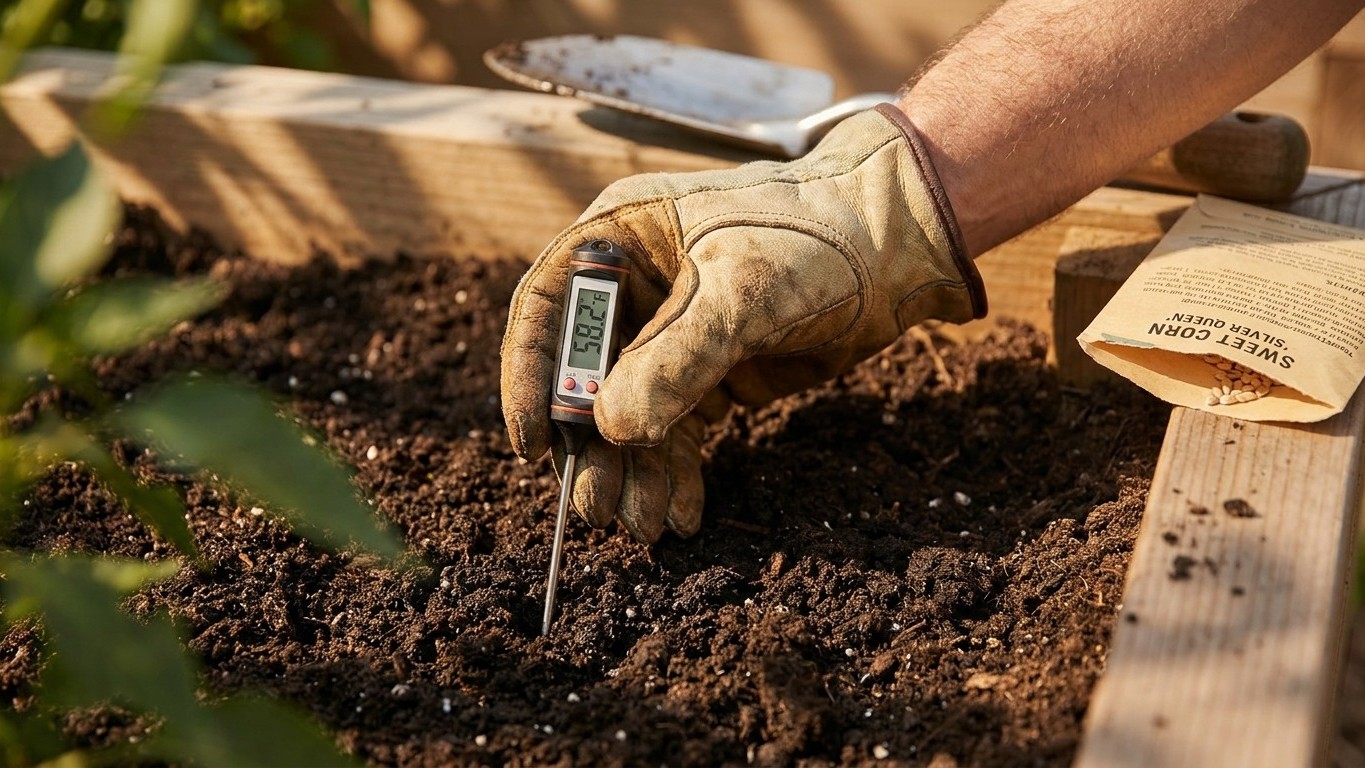
Air temperature and soil temperature don’t move together in spring. The ground holds winter’s cold long after the last frost has passed, so a calendar that says “frost is over” doesn’t mean the soil has caught up. Sweet corn seed rots or simply sits without germinating in cold soil, so the planting decision has to wait for the dirt itself to cross 60°F, checked with a soil thermometer pushed a couple of inches down, rather than for a date on a chart.
That lag matters more in Alberta than it would in a milder region, because the frost-free stretch here isn’t long to begin with. Using the mean dates from Environment and Climate Change Canada, the average window between the last spring frost (May 21) and the first fall frost (September 16) runs about 118 days. That sounds generous next to the 60 to 90 days sweet corn needs from planting to harvest, but the soil-temperature lag eats into it from the front end, and the frost dates themselves are averages, not guarantees.
That last point deserves a plain warning. A mean frost date is the midpoint of a spread, not a safe line: in one year out of two, frost arrives later than May 21 in spring or earlier than September 16 in fall. The Calgary International Airport station is also just one reference point for a large province, and gardens in northern districts or at higher elevation typically run weeks behind it. Anyone gardening outside the Calgary area should treat these dates as a starting estimate, not a guarantee for their own yard.
There’s a second factor that shrinks the practical window further: heat. Sweet corn is a warm-season crop that races through its growth stages fastest when summer days push into real heat. At the Calgary reference station, the average number of days reaching 90°F in a year is 0.0. That’s not the average summer temperature, it’s a measure of heat load, and a season with essentially no 90°F days accumulates growing degree-days more slowly than a hot prairie or a southern garden. A variety’s stated “days to maturity” was measured somewhere with more heat than this, so the real count in an Alberta garden tends to run longer than the seed packet number.
Put together, the practical answer is this: wait for soil above 60°F before you plant, expect that date to land meaningfully after May 21, and choose a variety whose days-to-maturity leaves real margin before September 16, because that fall date is only a coin-flip guarantee and the season’s low heat load stretches the clock anyway.
Does a late variety fit here?
A 60-day variety
A fast, early-maturing type built around 60 days from planting is the one that comfortably fits this climate. Push the planting date to whenever the soil genuinely crosses 60°F rather than the calendar date of the last frost, and a 60-day clock still lands with weeks to spare before the mean first fall frost of September 16. That buffer matters precisely because September 16 is a mean date, not a promise, and because the near-absence of 90°F days here means the plant’s actual pace will run a bit slower than the label suggests. A short-season type gives you room to absorb both of those uncertainties without losing the crop to cold before it ripens.
A 90-day variety
A slower, 90-day type is a much harder fit. Add the soil-temperature lag to the front of the season, then add 90 days, and the projected finish line sits right on top of, or past, the mean first fall frost. Because that frost date is itself only a 50/50 marker, a 90-day variety planted in an Alberta garden has a real chance of getting caught by frost before the ears mature, especially in a cooler district or a year that turns wet and slow to warm. The low heat accumulation implied by zero average days above 90°F compounds the risk, since it tends to stretch a “90-day” variety closer to 100 days in practice. Plainly: a 90-day sweet corn does not reliably fit this territory’s window, and gardeners who want that kind of maturity should treat it as a gamble rather than a plan.
What goes wrong here
- Soil sown too cold. Planting the day frost supposedly ends, rather than waiting for the soil itself, leaves seed sitting in cold, often damp ground where it rots or germinates weeks late, if at all. The fix is simple and unglamorous: push a soil thermometer a couple of inches into the row before planting, and hold off until it reads consistently above 60°F, even if that means waiting well past the average frost date.
- A variety too late for the season. Choosing a 90-day type because it promised bigger ears or better flavor ignores that Alberta’s frost-free window, combined with its very low heat load, doesn’t reliably carry that clock to the finish. The remedy is to match the variety to the season rather than the other way around: favor shorter days-to-maturity types and treat anything advertised near 90 days as unsuitable for a first planting here.
- Sweetness lost to a nearby planting, with nothing to do with the weather. Sweet corn comes in different genetic types (commonly labeled su, se, and sh2), and their sweetness and texture degrade if two types tassel and shed pollen at the same time nearby. This is a timing and layout problem, not a climate one: stagger planting dates between different types so their tasseling windows don’t overlap, and grow each type in its own block of three or more rows rather than a single thin row, which helps each block pollinate itself rather than drift pollen from a neighboring block of a different type.
Common questions
Can I plant sweet corn right after the last frost in Alberta?
Not reliably. The last frost date only tells you the air has likely stopped freezing; it says nothing about the soil, which typically stays too cold to germinate corn seed for some time afterward. Test the soil directly with a thermometer and wait for a reading consistently above 60°F rather than planting on the frost date alone.
Is a 90-day sweet corn variety ever worth trying in Alberta?
It’s a genuine risk given the mean first fall frost of September 16 and the region’s very low heat accumulation (an average of 0.0 days reaching 90°F). A 90-day type can end up racing an early frost with little margin, so gardeners who want to experiment with one should treat it as a trial planting, not the main crop, and lean on shorter-season varieties for reliable harvests.
Why did my sweet corn taste starchy instead of sweet?
The most common non-weather cause is cross-pollination between different sweet corn types tasseling at the same time nearby. If a standard-sweet type and a supersweet type shed pollen in the same window, the kernels on both can turn out starchy or tough. Stagger planting dates so tasseling doesn’t coincide, and grow each type in its own solid block rather than a single row.
Does the mean frost date mean it’s safe to plant by then?
No. A mean date from Environment and Climate Change Canada’s climate normals is a midpoint, not a safety line: by definition, frost arrives later than the mean last-frost date in roughly half of all years, and the first fall frost arrives earlier than its mean date about as often. Treat both dates, May 21 and September 16, as estimates to plan around, and build in extra margin, especially outside the Calgary area where the reference station’s readings don’t apply.