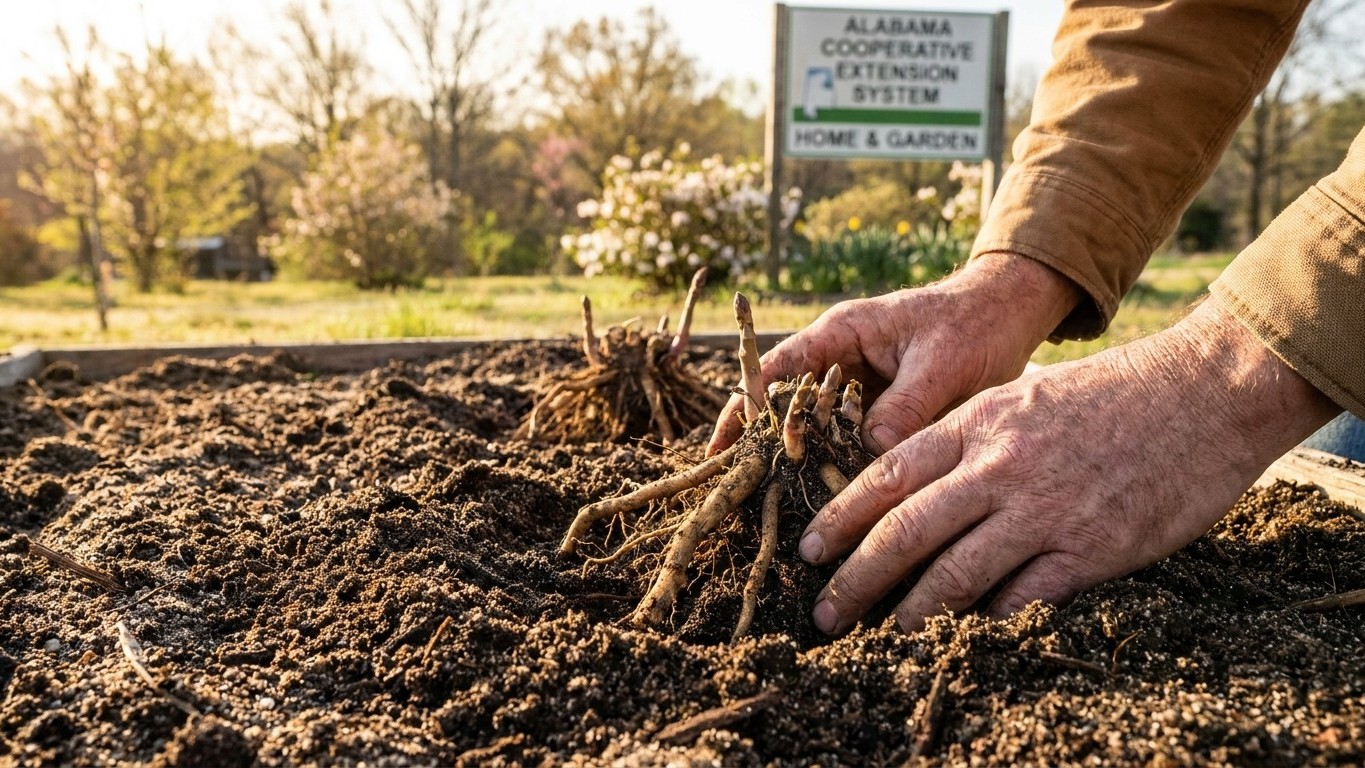

Plant Asparagus Crowns in early spring, once the soil can be worked. Arizona’s low desert almost never sees a hard freeze, so the calendar here isn’t dictated by frost risk the way it is in colder states. It’s dictated by getting crowns into the ground before summer heat takes over. And because this bed will occupy the same patch of yard for 10 to 15 years, where you plant matters as much as when.
The short answer
Once an Asparagus Bed goes in, it stays put for 10 to 15 years, according to Utah State University Extension. That’s the span to picture before breaking ground: this isn’t a raised planter you rearrange next season. It’s a decade-plus decision about one patch of the yard. So before frost dates or planting months matter at all, the ground itself has to answer one question correctly.
Utah State University Extension is blunt about what asparagus asks of soil: most types will work, “provided they are well drained.” That’s the entire published requirement. No pH target, no amendment recipe. Just drainage.
Arizona’s representative state soil, the Casa Grande series, is an Aridisol, the dry-climate soil type common across the Southwest. USDA NRCS Soil Data Access lists its surface layer as sandy, 64 percent sand, 14 percent clay, 22 percent silt, with organic matter around 0.8 percent and a surface pH near 8.5, alkaline. Sandy texture like that drains well, and USDA classes the series as well drained overall. On paper, that’s good news for a crop whose one hard rule is drainage.
But a state soil series is a starting point, not a diagnosis of any single backyard. Casa Grande is what USDA lists as representative of Arizona; it says nothing about the compacted fill dirt behind a newer subdivision, the caliche layer a builder’s grader exposed, or the heavier clay pocket in one particular low spot in a yard. The published pH and organic-matter figures describe the surface horizon of this mapped series specifically, not a worked garden bed, and they should never stand in for a reading off your own property.
The practical test is simpler than a lab report. Dig a hole roughly a foot deep, fill it with water, and watch how fast it disappears. If water is still standing after several hours, the spot drains too slowly for a bed meant to last well over a decade. The fix isn’t complicated: build the bed above grade, or work organic matter into the top layer before the crowns ever go in. What doesn’t work is planting anyway and hoping. A crop that occupies the same ground for 10 to 15 years doesn’t give you many chances to correct a drainage mistake once the crowns are established.
Will the summer here water it for you?
Utah State University Extension’s watering guidance for asparagus is specific: 1 to 2 inches every other week for the first two years while the bed establishes, then a lighter schedule of every three weeks once it’s mature. Arizona’s summer rainfall doesn’t come close to covering either number, and the shortfall isn’t small.
- What the bed asks for early on. In year one and two, the goal is 1 to 2 inches of water roughly every 14 days. Over a full summer, that adds up to several inches delivered on a fairly strict schedule, not whenever rain happens to show up.
- What the sky actually delivers. NOAA’s 1991-2020 climate normals for the reference station put total summer rainfall, June through August combined, at about 1.9 inches. Spread across three months, that’s a fraction of what a newly planted bed needs in any single two-week stretch, let alone the whole season.
- The month that gives almost nothing. June is the driest month of the year here, averaging just 0.02 inches. July and August pick up slightly, at 0.91 and 0.93 inches respectively, as the summer monsoon arrives, but even those wetter months fall well short of a 1-to-2-inch biweekly target on their own.
- What has to come from a hose instead. For a bed in its first two summers, irrigation has to supply nearly the entire 1-to-2-inch, every-other-week amount by hand or drip line, since June offers next to nothing and even the wetter monsoon months don’t reliably hit the mark on their own schedule. Once the bed matures and the requirement eases to every three weeks, the math is still lopsided: total summer rainfall of 1.9 inches is spread unevenly and arrives as thunderstorms that often run off rather than soak into sandy soil, so a rain gauge on the actual property, not a regional average, is what should decide whether to skip a watering.
When to put the crowns in
Crowns go in in early spring, once soil temperature and workability allow digging an 8-inch furrow, per Utah State University Extension’s planting method. In most of the country that timing is built around a spring frost date. Arizona’s low desert is a different situation entirely, and it’s worth saying so plainly rather than forcing a frost-based calendar onto a place where frost barely applies.
NOAA’s 1991-2020 normals and daily records for the reference station show no freeze in most years here at all. A rare cold snap can bring the temperature down to 32F, but that happened in only 6 of 30 recorded springs, and when it did occur it landed somewhere between late December and mid-January, well before the early-spring planting window most gardeners are thinking about. freeze risk isn’t really the variable driving the calendar in this part of Arizona. Summer heat is the bigger constraint, since it arrives fast and hard once the season turns. The practical goal is getting crowns established while conditions are still mild, not dodging a frost date that, most years, never shows up around here at all.
Crowns are the standard route, planted directly into that 8-inch furrow. Utah State University Extension names four varieties by sex alone: Jersey Giant and Jersey Knight are all-male, while UC 157 F1 and Purple Passion are male-and-female. No flavor, yield, or performance difference is published for any of them, so the choice comes down to sex type rather than a claimed advantage.
Seed is the alternative route for gardeners who don’t start with crowns, though it adds time before the bed reaches the same maturity a crown planting starts with. Either way, the furrow itself isn’t filled in all at once. It gets backfilled gradually, about 2 inches every other month across the year, as the emerging shoots grow tall enough to tolerate being covered a little deeper each time.
Common questions
How long before an asparagus bed in Arizona can be harvested?
Not until year three, per Utah State University Extension. That first harvest year is limited to about 4 weeks of cutting, extending to roughly 6 weeks the following year and about 8 weeks after that. The stopping point each season isn’t a date on the calendar, it’s a condition: cutting stops once most emerging spears have gone thinner than a pencil, which signals the plant needs to put energy back into the crown rather than into more spears.
Does asparagus need a specific soil pH or winter chilling in Arizona?
Neither figure is published in the source used for this guide. Utah State University Extension’s requirement is drainage, not a pH target, and it says nothing about a chilling requirement for the crop. Arizona’s representative state soil surface runs alkaline, around pH 8.5, but that describes the mapped Casa Grande series, not a confirmed reading for any individual garden, so it shouldn’t be treated as a personal soil number.
Can asparagus be started from seed instead of crowns in Arizona?
Yes, seed is the alternative to planting crowns directly. It’s a slower route to a mature, harvestable bed than starting with crowns, since crowns are already a year or more into development by the time they’re planted in the furrow.
How is the planting furrow filled in after the crowns go in?
Gradually, not all at once. Utah State University Extension’s method backfills the 8-inch furrow in stages, adding about 2 inches of soil every other month over the course of the year as shoots emerge and grow, rather than covering the crowns completely at planting time.