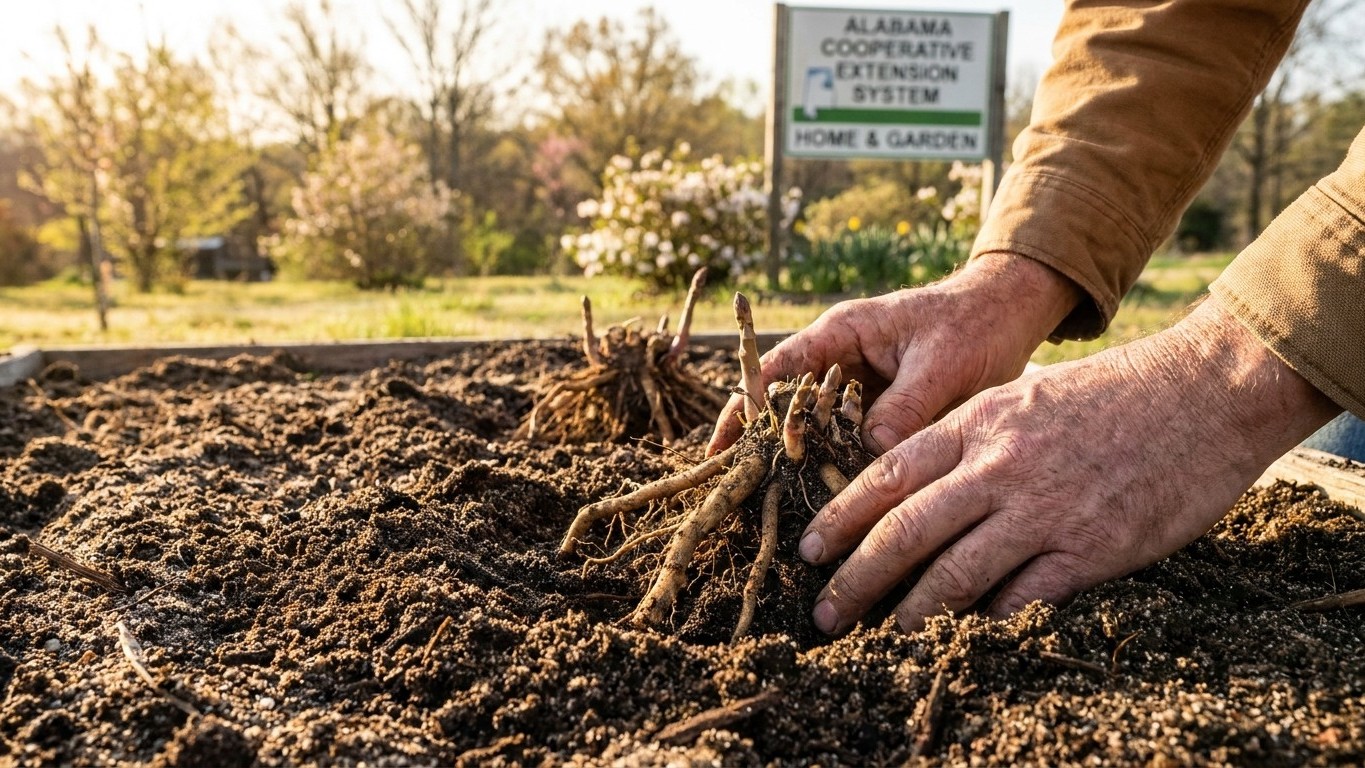

In most of California, asparagus crowns go into the ground in early spring, but the real question isn’t the calendar so much as what’s underneath it. This is a plant that will occupy the same patch of dirt for a decade or more, so the soil under those crowns, and how much water the sky is willing to supply, matter more than the exact week you dig the trench.
The short answer
Start with the fact that changes everything else: an Asparagus Bed, once planted, produces for 10 to 15 years, according to Utah State University Extension. That’s not a bed you rework next season if it turns out damp or compacted. It’s a decision you live with. The source is specific on one requirement and only one: the ground has to drain. Most soils will do, the extension notes, provided that condition is met.
California’s official state soil, the San Joaquin series, gives a useful baseline for what the region’s ground tends to do, though it’s worth being clear up front that this is a representative soil sample, not a verdict on any one backyard. The San Joaquin series is an Alfisol, a forest-derived soil of moderate fertility that holds nutrients reasonably well. Its surface runs slightly acid, with a pH around 6.1, and the texture leans loam to silt: about 51 percent sand, 18 percent clay, and 32 percent silt, with organic matter around 0.8 percent. USDA NRCS classifies it as moderately well drained.
Moderately well drained is the middle of the road. It’s not the free-draining sandy loam that asparagus growers dream about, but it’s not the heavy, standing-water clay that rots crowns either. For a gardener working ground that resembles this profile, the practical takeaway is that drainage is probably adequate but not generous, so a wet winter or a low spot in the yard could tip things the wrong way over a 10-to-15-year span.
If a soil test or simple observation shows water pooling for more than a few hours after rain, the fix isn’t complicated: build the bed up. A raised bed or a mounded row lifts the crowns above the saturation line without changing the underlying ground. That single adjustment addresses the only soil condition the source cares about, and it’s a lot cheaper to make before planting than to regret after year three, when the first harvest finally arrives.
None of this replaces an actual soil test on the actual plot. The San Joaquin series describes a mapped surface horizon across dozens of sampled locations, not the dirt behind any particular house. A yard built on river-bottom fill, hill country, or a lot a builder scraped and regraded can differ completely from the state’s representative soil. Treat the state figures as a starting point for what the region’s ground tends to do, not a diagnosis.
Will the summer here water it for you?
An established asparagus bed asks for 1 to 2 inches of water every other week during its first two years, then eases to about every three weeks once it’s mature. California’s summer sky, for its part, is not going to be much help. Reference climate normals from a California weather station show June, July, and August delivering roughly 0.1 inches combined, with August coming in at 0.0. Here’s what that gap looks like in practice:
- June: normal rainfall of about 0.08 inches, functionally none, meaning the bed’s every-other-week watering has to be supplied entirely by hose or drip line.
- July: normal rainfall drops further to about 0.04 inches. Peak heat is also arriving in most of the state, which pulls moisture out of the soil faster on top of the rain shortfall.
- August: the driest month of the year at the reference station, with a normal of 0.0 inches. Whatever the bed needs this month, the gardener is providing 100 percent of it.
- Total summer contribution: about 0.1 inches across the three months, against a yearly normal of 12.2 inches. Nearly all of California’s annual rain falls outside summer, which is exactly the season an asparagus bed is thirstiest.
- The practical adjustment: treat the 1-to-2-inch, every-other-week (or every-three-week) figure as the full irrigation target, not a supplement to expected rain. In a California summer, the sky isn’t going to cover any meaningful share of it.
Those figures come from 1991-2020 climate normals at a single reference station, so they describe what the region can usually expect, not a guarantee for any one summer or any one yard. A coastal fog belt behaves differently than an inland valley a few miles away. A rain gauge on the actual property, tracked over a season, is the only way to know for certain how much of that 1-to-2-inch target is arriving on its own.
When to put the crowns in
Crowns go into 8-inch furrows in early spring, once the coldest stretch of the year has passed. For a large share of California, that timing is straightforward because frost barely enters the picture. Climate normals for a California reference station show no freeze occurring in an average year at all, zero days at or below 32°F across three decades of daily records, with a frost-free season effectively running the full calendar. Coastal and Southern California, garden around heat, drought, and water restrictions, not around a spring frost date.
That does not describe the whole state. Northern California, the Central Valley, and the Sierra foothills and higher elevations do freeze in a normal year, and their planting windows shift later than the frost-free coastal and southern zones. No specific frost date for those inland and mountain regions is published in the source used here, so rather than invent one, the honest guidance is to plant once the ground has thawed and worked easily and the sharpest cold snaps of late winter have passed, treating any local frost guidance a gardener already has for their own area as the tiebreaker.
Wherever the timing lands, the furrow itself isn’t filled in all at once. Crowns are set into their 8-inch trench and the soil is backfilled gradually across the year, adding roughly two inches every other month rather than covering the crowns completely on planting day. That staged backfill lets the emerging shoots push through loose soil instead of forcing their way up through a deep, packed trench.
Gardeners who would rather not source crowns have a seed alternative. Asparagus can be started from seed and grown on for a season before the young plants, now essentially homegrown crowns, get moved to their permanent bed. It’s a slower route to that first real harvest, but it sidesteps the need to buy crowns at all, and the same early-spring, post-cold-snap timing applies once those seedlings are ready to move.
Whichever way the bed starts, the clock on harvest doesn’t move. No spears get cut in year one or year two regardless of planting date; the plant needs that time to build the root system that will feed a decade of spring harvests. That patience, more than the exact week the crowns go in, is what actually determines whether the bed performs.
Common questions
Can asparagus grow in a raised bed if the yard soil is heavy clay?
Yes, and given the 10-to-15-year lifespan of a bed, a raised or mounded bed is a straightforward way to guarantee the drainage the plant needs without depending on the native soil to cooperate over that long a span.
How long until the first harvest?
None in year one or year two. Utah State University Extension is specific that harvest doesn’t begin until year three, and even then it starts light, around four weeks of cutting, before extending to six weeks and then eight weeks in later years as the crowns mature.
How do I know when to stop cutting spears each season?
Stop once most of the spears coming up are thinner than a pencil. That’s the signal the plant needs to stop producing harvestable shoots and put its energy into building next year’s crown instead, and it’s a condition to watch for rather than a fixed date on the calendar.
Does the source recommend a particular variety for California conditions?
Utah State University Extension names varieties only by their pollination type, all-male types such as Jersey Giant and Jersey Knight, and male-female types such as UC 157 F1 and Purple Passion, without publishing a flavor, yield, or regional recommendation for any of them. Anyone shopping for crowns is choosing among named varieties without a published performance ranking to lean on.