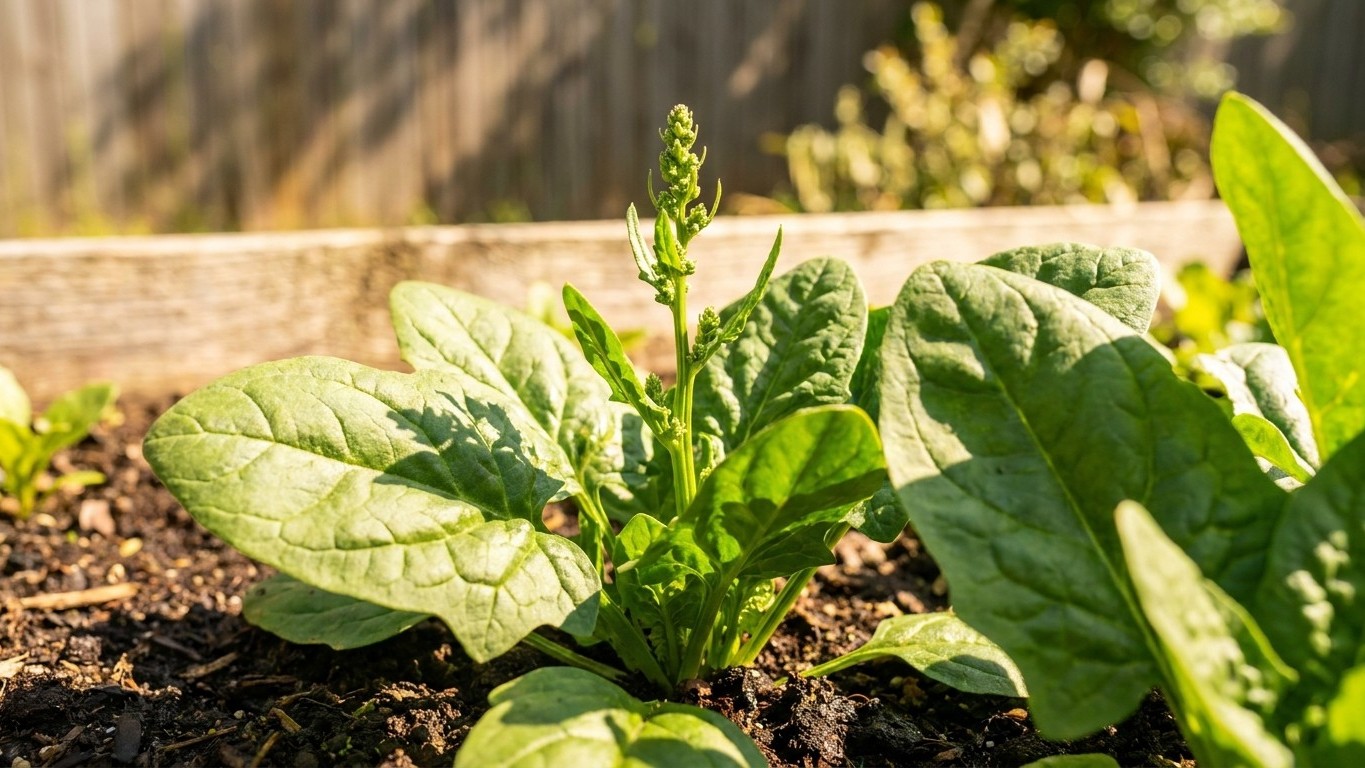

Yes, spinach will bolt early in Iowa, and it isn’t really the state’s muggy summers that force the issue. The trigger is daylight itself: once Iowa’s early-summer days stretch past a certain length, spinach starts flowering no matter how the thermometer behaves. Layer in the more than 18 days a year that climb past 90 F, and the plant is pushed from two directions at once. The spring window is real, but narrow, and the fall crop depends on soil temperature, not frost, to even get started.
The short answer
On the longest day of the year, Iowa sees 15 hours and 1 minute of daylight. That number matters more than most gardeners expect, because spinach flowers, or “bolts,” in response to long days as well as warm temperatures. Fifteen hours and one minute is deep into long-day territory. A spinach plant sitting in a garden bed near Des Moines in late June doesn’t get a pass just because the season has stayed mild. The day length alone is enough to flip the plant from making leaves to making seed stalks.
That’s a different story than onions, where long summer days are the whole point, building the bulb rather than ending the harvest. Spinach runs the opposite script. A cool, cloudy Iowa summer does not buy extra weeks of harvest, because the clock that matters is the sun’s position, not the mercury. This is worth repeating because it trips up a lot of people who assume a mild season means an easy crop. It doesn’t, not for spinach.
Heat then piles on top of that daylight pressure. Iowa averages 18.4 days a year at 90 F or hotter, and spinach grows best only where temperatures stay below 75 F. Once the plant is stressed by heat on top of long days, it doesn’t just bolt faster, it also turns bitter, since 75 F marks both a growth ceiling and a flavor threshold. So the honest answer is that both forces are working against a summer spinach crop here, but day length is the one that arrives first and can’t be managed around. Shade, irrigation, and mulch might buy a little time against heat. Nothing buys time against the calendar.
That’s why Iowa spinach growing splits into two short seasons rather than one long one: a spring run that ends when the days lengthen too far, and a fall run that has to dodge both warm soil and the season’s first hard frost. Neither window is generous, and both reward planting on time rather than planting by feel.
How long the spring window really is
Figuring out how many usable spring weeks Iowa actually offers means stacking a few numbers together rather than trusting a single date on a seed packet.
- Iowa’s last spring frost, based on NOAA NCEI 1991-2020 climate normals for the reference station, falls between April 12 and April 24. Spinach is typically sown 2 to 3 weeks before that date, which pushes the earliest practical sowing into late March, roughly March 22 to April 3.
- Iowa State Extension’s county-level data, drawn from a longer 1950-2021 record, tends to run about 4 days later in spring than the airport station figures above. That means gardeners working from county averages should treat late March as optimistic and plan closer to the first days of April.
- Once seedlings are up, growth stays productive as long as temperatures don’t climb past 75 F. Iowa’s spring air temperatures generally stay under that mark through April and into much of May, giving the crop several weeks of favorable growing conditions before heat becomes a factor.
- Day length is climbing the entire time, and by the June solstice Iowa reaches 15 hours and 1 minute of daylight. Long before that peak, the days have already grown long enough to start pushing spinach toward flowering, so the harvest window effectively closes well ahead of the solstice itself, not on it.
- Adding it up: a sowing in late March to early April, a favorable growing stretch of roughly six to eight weeks before heat and lengthening days combine, and a practical harvest cutoff somewhere in late May to early June. That leaves Iowa gardeners with a usable spring spinach season of about two months, not the full run of spring.
That’s tighter than a lot of garden plans assume, and it’s why staggered sowings every week or two in that late-March-to-April stretch tend to outperform a single big planting date.
The autumn crop, and when the soil lets you sow
Fall spinach in Iowa isn’t blocked by cold weather showing up too soon. It’s blocked by the ground staying too warm for too long, which is a less intuitive obstacle for gardeners used to thinking about frost dates first.
Soil still too warm to germinate
Utah State University Extension notes that spinach seed germination drops sharply once soil temperatures climb above 80 F. Iowa’s summer heat load, reflected in that average of 18.4 days a year at 90 F or higher air temperature, means soil at typical sowing depth often stays above that 80 F mark well into late summer. Sowing spinach seed into soil that hot usually means poor or spotty germination, no matter how carefully the seed is watered in. Gardeners have to wait for the soil itself to cool, which in a state with Iowa’s heat pattern typically doesn’t happen until sometime in September, not in the first weeks of August when the fall math would otherwise suggest sowing.
The frost that ends the season
Iowa’s first fall frost, again from the NOAA NCEI 1991-2020 normals, arrives between October 14 and October 25. Iowa State Extension’s longer county record runs about 10 days earlier in fall than that airport figure, so gardeners working from county data should treat mid-October as the safer, earlier target rather than the optimistic end of the range. Utah State University Extension’s guidance for a fall crop is to sow 50 to 75 days before the date you want to harvest. Working back from a harvest goal of around October 10, that puts the ideal sowing window somewhere between late July and late August.
The catch is obvious once both obstacles are lined up side by side. The 50-to-75-day math wants seed in the ground in late July or August, but Iowa’s soil is often still running hotter than the 80 F germination ceiling through that same stretch. That squeezes the realistic fall window down to something closer to September sowings with a harvest that either arrives later than ideal or gets cut short by frost. Fall spinach is doable in Iowa, but it’s a narrower, more weather-dependent gamble than the spring crop, and timing it well matters more than it does for most other fall vegetables.
The source names four spinach varieties commonly grown for these seasonal windows: Bloomsdale, Melody, Teton, and Olympia. No days-to-maturity figures or performance comparisons for any of these four are published in the extension guidance behind this article, so choosing between them comes down to local seed availability rather than a documented edge for Iowa conditions specifically.
Common questions
Can spinach survive an Iowa summer if I keep it watered?
Watering helps with heat stress but doesn’t change day length, and day length alone is enough to push spinach toward bolting by early summer in Iowa. Expect the plant to flower on schedule even in a well-watered bed once the days get long enough.
Will shade cloth stop spinach from bolting?
Shade cloth can lower soil and air temperature slightly, which helps with the heat side of the equation, but it does nothing to shorten the actual hours of daylight the plant experiences. Since bolting is triggered by both day length and warmth, shade alone won’t hold off flowering once the days have gotten long enough.
Which spinach variety grows best in Iowa?
Bloomsdale, Melody, Teton, and Olympia are the varieties named in current extension guidance, but no comparative data on their performance in Iowa conditions is published. Availability at local garden centers is a more practical deciding factor than any documented yield or bolt-resistance advantage.
Is fall spinach more reliable than spring spinach in Iowa?
Not necessarily. Spring sowing has a clearer, more predictable window tied to frost dates. Fall sowing has to wait for soil to cool below 80 F, which in Iowa often pushes planting later than the ideal 50-to-75-day countdown from frost would prefer, making the fall crop more dependent on how the season’s heat plays out.