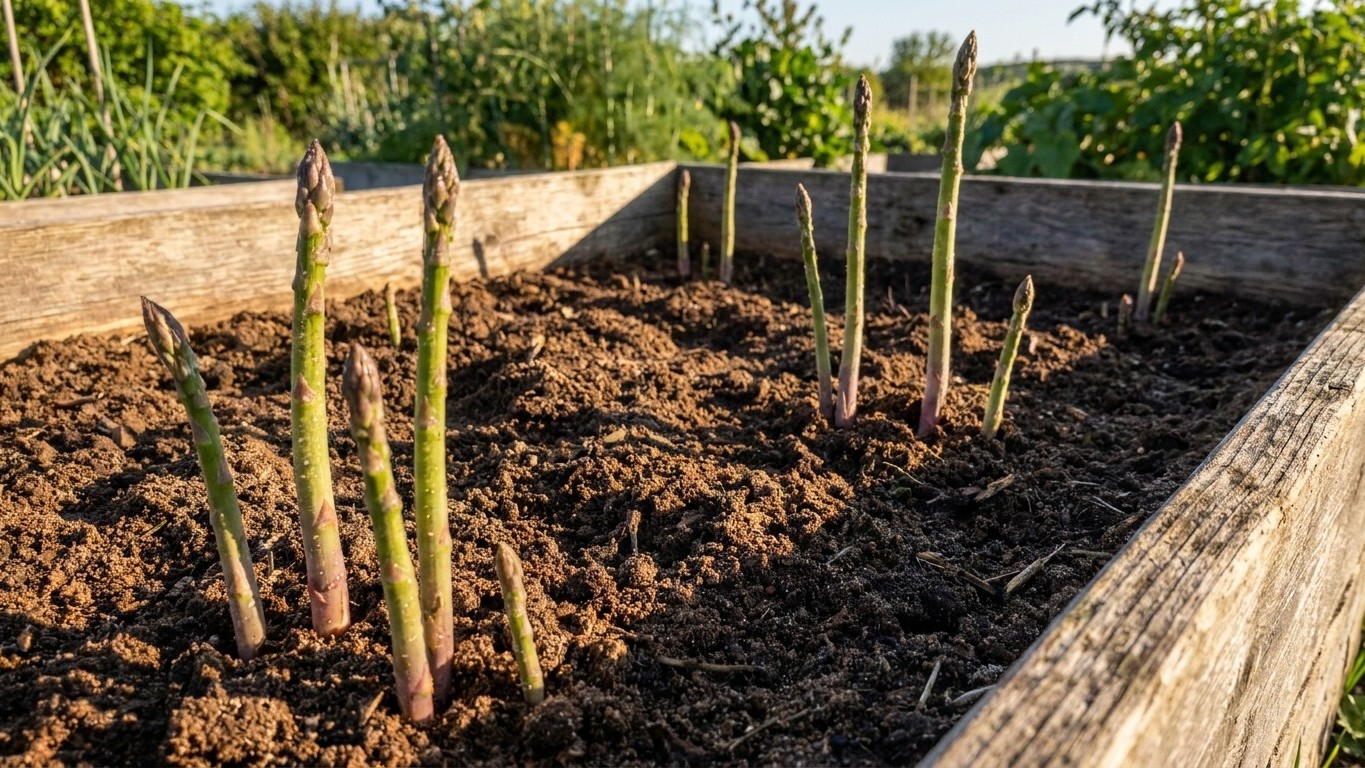

Yes, in most cases. The soil that represents Maine, the Chesuncook series, is described as moderately well drained, and drainage is the one soil requirement Utah State University Extension attaches to a fifteen-year asparagus bed. But “represents” is doing a lot of work in that sentence, and what decides the outcome in your own yard is not a state soil profile, it’s a shovel test in the actual bed you’re about to commit to for over a decade.
The short answer
Maine’s official state soil, named by state law in 1999 under the USDA NRCS State Soils programme, is the Chesuncook series. It’s a Spodosol, the kind of sandy, acid, strongly leached ground that typically forms under conifer stands across the northern part of the state. USDA NRCS Soil Data Access puts the surface horizon at roughly 35 percent sand, 12 percent clay and 53 percent silt, a texture that leans toward silt loam. The recorded drainage class for the series is moderately well drained, which is the range where an Asparagus Bed generally succeeds, since the crop’s only stated soil requirement is that water moves through it rather than sitting on it.
That drainage class matters more here than it would for almost anything else grown in a home garden. Utah State University Extension notes that asparagus is planted once, as crowns, and then left to produce for 10 to 15 years. There’s no annual do-over. A tomato bed that turns out to be too heavy gets amended, rotated, or abandoned the following spring. an Asparagus Bed that turns out to sit wet through April is a problem you live with for a decade and a half, because the crowns don’t transplant well once established and the root system spreads wide and deep in the first two seasons.
The surface horizon data for Chesuncook also lists an organic matter figure around 53 percent and a surface pH near 5.1, strongly acid. Those two numbers need a flag before anyone plants around them. An organic matter reading that high describes a natural forest floor layer, the litter and duff under conifers, not a worked garden bed. Nobody’s cultivated asparagus row will carry anywhere near that much organic matter once it’s been dug, tilled and planted, so treat that figure as a description of undisturbed ground, not a promise about your soil. The pH figure carries the same caution: it’s the state soil’s number, not yours. A garden a mile away, especially one on river-bottom silt, hill-country ledge, or fill from a house lot, can read completely differently.
What this means in practice is straightforward. If a soil test on the actual bed site shows standing water after a hard rain, or the ground stays soggy into May, don’t fight it with a Chesuncook-shaped bed. Build a raised bed, 10 to 12 inches high, and fill it with a well-drained mix. If the site drains within a few hours of a soaking rain and the ground is workable by hand a day or two after, the underlying tendency of Maine’s representative soil, sandy, leached, moderately well drained, is on your side, and there’s no reason a bed planted this spring shouldn’t still be producing spears well past its tenth year.
Will the summer here water it for you?
Utah State University Extension gives a two-stage watering rule: 1 to 2 inches every other week for the first two years while the crowns establish, then a lighter 1 to 2 inches every three weeks once the planting matures. NOAA’s 1991-2020 climate normals for the reference station put Maine’s summer rainfall at about 11.2 inches across June, July and August, broken down as June 4.15 inches, July 3.43 inches and August 3.57 inches, with July the driest month of the three.
- Years one and two, June: the every-other-week rule asks for roughly 2 to 4 inches over the month. June’s normal of 4.15 inches sits at or above that range, so a soaking rain-driven June often needs little supplemental watering, assuming it falls in usable amounts rather than one runoff-heavy downpour.
- Years one and two, July: the same math calls for 2 to 4 inches, and July’s normal of 3.43 inches lands inside that band but toward the low end, right in the month NOAA records as Maine’s driest. This is the stretch most likely to need a hose.
- Years one and two, August: August’s 3.57-inch normal again sits within the needed 2 to 4 inches, but late-summer heat can push evaporation up even when the rain total looks adequate on paper.
- Year three onward: the every-three-weeks rule works out to roughly 1.3 to 2.7 inches a month, well below what any of the three summer months normally deliver. An established bed on well-drained ground often needs no supplemental watering at all in a normal Maine summer.
Those normals describe the reference station over 1991-2020, not the exact conditions on your property in any given July. Rain that arrives as a single thunderstorm mostly sheds off the surface rather than soaking down to the root zone, and a sandy Chesuncook-type surface drains faster than a heavier clay one holds. The only way to know what a specific bed needs is a rain gauge on that plot, tracked against the every-other-week and every-three-week targets, especially during the first two establishment years when the young crowns have no deep root reserve to draw on.
When to put the crowns in
Utah State University Extension’s method is to set crowns into 8-inch furrows in early spring, then backfill the furrow gradually across the season, adding about 2 inches of soil every other month rather than filling it in all at once. In Maine, “early spring” lines up with the stretch just around and after the last spring frost. NOAA’s 1991-2020 normals put that date, based on the 30 to 70 percent freeze-probability band for 32°F, somewhere around April 22 to May 1 for the coastal reference station. That’s an average window, not a guarantee, and it describes the milder, coastal end of the state; inland and northern Maine typically run later into spring and earlier into fall, so a gardener working further from the coast should expect to push planting back accordingly.
Crowns are the standard route because they skip a full year of growth compared to starting from seed. Seed is the alternative when crowns aren’t available, but it means raising seedlings and giving them time to develop before they go into the permanent bed, which pushes the first light harvest even further out than the three-year wait crowns already require. Neither the timing nor the exact indoor-starting schedule for seed is detailed in the Utah State University Extension source, so gardeners choosing that route are working from general nursery guidance rather than the same figures cited here for crowns.
Whichever way the bed starts, the harvest clock doesn’t move. There’s no cutting in year one or year two, full stop. Year three brings the first harvest, typically about four weeks of cutting. That window lengthens in year four to roughly six weeks, and by year five to about eight weeks, the mature harvest length the bed will carry for the rest of its productive life. The rule for when to stop cutting each season isn’t a date on a calendar; it’s a visual signal, the point where most of the spears coming up have gone thinner than a pencil, telling the plant it’s time to be left alone to grow ferns and rebuild the root reserves for next year.
Common questions
Do I need to test my own soil before planting an Asparagus Bed?
Yes. The Chesuncook series describes Maine’s representative soil, not your yard’s. A soil test on the exact bed site tells you the texture, drainage and pH you’re actually working with, which matters far more here than for a crop you replant every year.
What if my planned bed site doesn’t drain well?
Utah State University Extension’s stated requirement is drainage; texture and fertility matter less. If water stands or the ground stays soggy for days after rain, a raised bed 10 to 12 inches deep, filled with well-drained soil, sidesteps the problem before the fifteen-year clock starts.
Which asparagus variety is best for Maine?
Utah State University Extension names four without ranking them: the all-male varieties Jersey Giant and Jersey Knight, and the male/female varieties UC 157 F1 and Purple Passion. No flavor, yield or regional preference is published for any of them, so the choice comes down to availability rather than a documented advantage.
Can I harvest anything in the first two years?
No. The source is explicit that no spears are cut in year one or year two. The first harvest, about four weeks, comes in year three, and the harvest window only reaches its full eight-week length by year five.