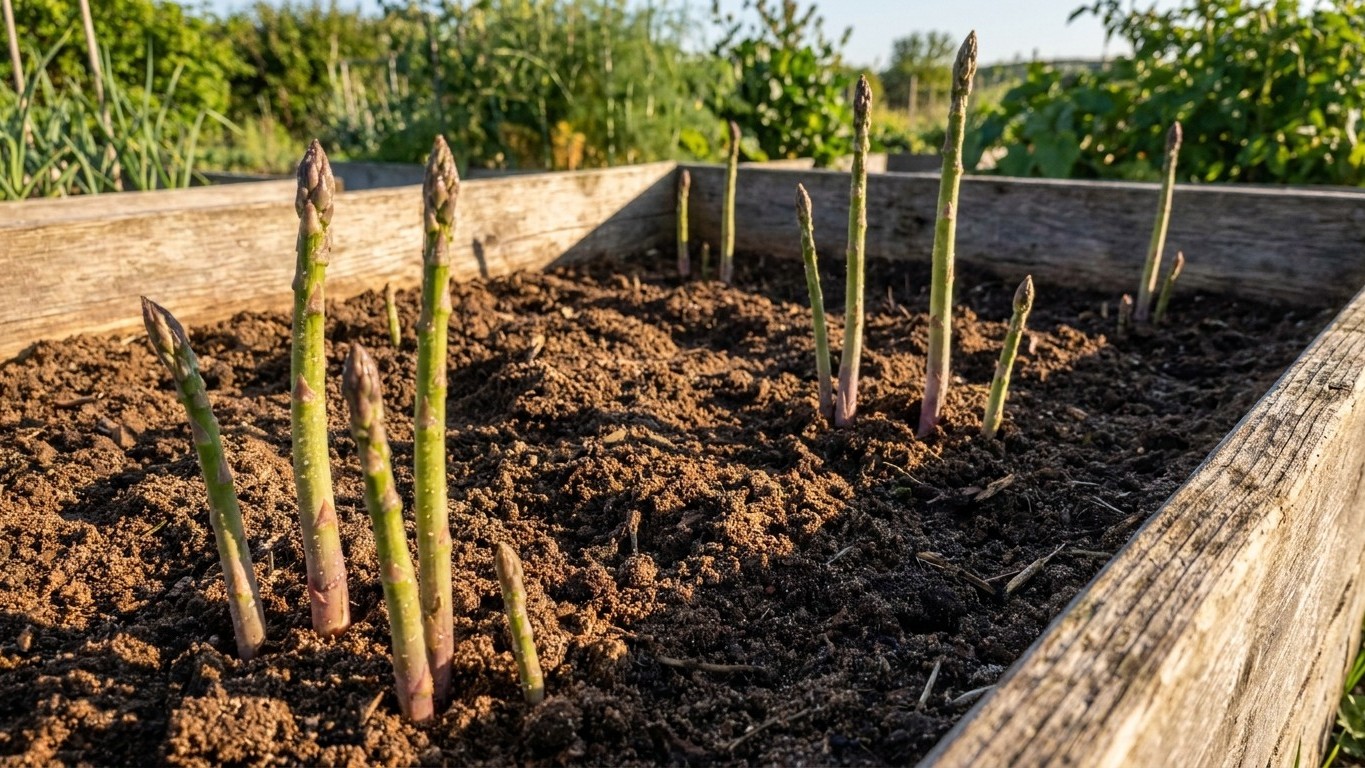

Mississippi’s state soil, the Natchez series, is officially well drained, which happens to be the only soil requirement an Asparagus Bed has according to Utah State University Extension. That’s good news for a crop that stays in one spot for 10 to 15 years. But “well drained” describes a representative soil sample, not the ground behind your house. Before you commit a corner of the yard for over a decade, the drainage question needs answering on your own dirt, not on a state average.
The short answer
Ten to fifteen years is a long commitment for a vegetable bed, and Utah State University Extension is specific about what a spot needs to earn that commitment: soil that drains. Almost nothing else about the planting site matters as much. Asparagus roots sit below ground through winter freezes, spring floods, and summer downpours, and a crown that spends weeks sitting in standing water will rot long before it produces a harvestable spear.
Mississippi’s designated state soil, the Natchez series, checks that box. It’s classified as an Inceptisol, a young soil type that hasn’t developed the strong, distinct layers older soils show. The surface runs slightly acid, at a pH near 6.2, and texturally it leans toward loam to silt: about 5 percent sand, 13 percent clay, and a dominant 82 percent silt, with organic matter around 1.8 percent. USDA’s Soil Survey Geographic Database lists it as well drained, based on measurements averaged across 31 mapped components of the series. That combination, mostly silt with modest clay, tends to hold moisture without staying waterlogged, which is roughly the middle ground asparagus tolerates well.
Here’s the caution that matters more than any of those numbers: the Natchez series is the soil that represents Mississippi in USDA’s records, not the soil under every garden in the state. River bottoms drain differently than hill country. A yard where a builder scraped topsoil and pushed in fill dirt may behave nothing like the mapped series, regardless of what county it sits in. If your ground is heavy clay that puddles for a day or more after rain, don’t plant crowns directly into it. Build a raised bed at least 10 to 12 inches deep and fill it with a loam mix, or work in enough coarse organic matter over a full season to change how the existing ground handles water. A simple test costs you nothing but time: dig a hole about a foot deep, fill it with water, and see how long it takes to drain. Standing water after several hours is your answer, and it’s a “no” regardless of what the state soil map says.
Utah State University Extension also names four asparagus varieties, though only by their sex, not by flavor, yield, or region. Jersey Giant and Jersey Knight are all-male hybrids; UC 157 F1 and Purple Passion are male and female. All-male types tend to put energy into spear production rather than seed, which is a practical reason many home growers lean that direction, though the source draws no conclusions about which performs best in any specific soil or climate.
| Variety | Sex type |
|---|---|
| Jersey Giant | All-male |
| Jersey Knight | All-male |
| UC 157 F1 | Male and female |
| Purple Passion | Male and female |
Will the summer here water it for you?
an Asparagus Bed has a moving target for water. Newly planted crowns need 1 to 2 inches every other week for their first two years while roots establish. Once the bed matures, that eases to 1 to 2 inches every three weeks. Whether Mississippi’s summer rain covers that on its own depends on timing as much as total volume.
- What the young bed needs: roughly 1 to 2 inches biweekly across a summer means the bed wants somewhere between 6 and 12 inches of water over a typical 13-week June-through-August stretch, delivered fairly evenly.
- What summer actually delivers: NOAA’s 1991-2020 climate normals put summer rainfall at about 14.1 inches across June, July, and August combined, out of 57.4 inches for the year. Broken down by month, June averages 4.43 inches, July 5.02 inches, and August 4.69 inches.
- The gap that matters isn’t the total, it’s the pattern. June is the driest of the three summer months, and Southern rain in that period often arrives as a single thunderstorm that dumps an inch in twenty minutes and runs off rather than soaking into the root zone. A young bed on the fast-draining end of the Natchez profile could see a dry stretch of ten days or more even in a month that averages over 4 inches.
- For the established bed, the every-three-weeks target is a lighter lift, and the summer totals here comfortably cover it in most years, assuming rainfall isn’t unusually concentrated into one or two storm events.
- The practical takeaway: plan to supplement during the first two summers, especially through June, and keep a rain gauge on the actual bed rather than trusting the monthly average. NOAA’s figures come from a single reference station and describe a 30-year normal, not this year’s weather on your property.
When to put the crowns in
Crowns go into the ground in early spring, timed around the last expected frost so tender new growth isn’t cut down the week it emerges. For the reference station NOAA tracks in this region, the 32°F freeze probability window for the last spring frost runs from around March 6 to around March 22. That’s a mean derived from 1991-2020 data, not a guarantee for any specific year, and it describes conditions at an airport-based weather station. Suburban and rural gardens, especially those with more tree cover or at slightly higher elevation, often see their own last frost run a week or two later, so treat the window as a starting point and watch your local forecast before digging.
Utah State University Extension describes planting crowns in furrows about 8 inches deep. The furrow isn’t filled in all at once. As the young shoots grow taller across the season, soil gets pulled back in gradually, about 2 inches every other month, until the trench is level with the surrounding bed by the end of the year. That slow backfilling protects the emerging crown while still letting it stretch upward into the light.
Seed is the alternative to crowns, and it’s a slower route. Seed-started asparagus needs an extra year of growth before it reaches the size a purchased crown already has at planting, which pushes the harvest timeline out further. Whichever start method you choose, the harvest rule doesn’t change: nothing gets cut the first two years. Year three allows a harvest window of about 4 weeks. Year four extends that to about 6 weeks. From year five on, the harvest runs about 8 weeks. The stopping point in any season isn’t a date on the calendar, it’s the spears themselves: once most of what’s coming up is thinner than a pencil, that’s the plant’s food-production tissue trying to rebuild, and cutting should stop for the year regardless of how many weeks have passed.
Common questions
Does the state soil’s pH mean I don’t need to test my own?
No. The 6.2 figure is the surface pH recorded for the Natchez series’ mapped components, not a number for any individual garden. A cultivated bed with added compost, lime, or years of fertilizer history can sit well outside that range. A basic home soil test is the only way to know what your bed is actually starting from.
Which of the four named varieties is best for Mississippi?
Utah State University Extension doesn’t rank them. It names Jersey Giant and Jersey Knight as all-male hybrids and UC 157 F1 and Purple Passion as male-and-female types, without comparing flavor, yield, or regional suitability. Choosing between them comes down to whether you want an all-male bed, which tends to avoid volunteer seedlings, or don’t mind a mixed planting.
Is Mississippi’s summer heat too much for an established bed?
That’s not addressed in the sourced material here, which covers watering needs and planting mechanics, not heat tolerance or a chilling requirement. Hardiness zone alone doesn’t translate into a specific chilling number, and none is published for this crop in these facts.
What if my soil drains fine in spring but stays wet in summer downpours?
That’s exactly the kind of seasonal variation a one-time soil map can’t capture. Watch the bed after a heavy summer storm specifically, since that’s the condition most likely to rot crowns. If water lingers for more than a few hours after a downpour, raising the bed is worth the effort before you’re several years into a planting you can’t easily move.