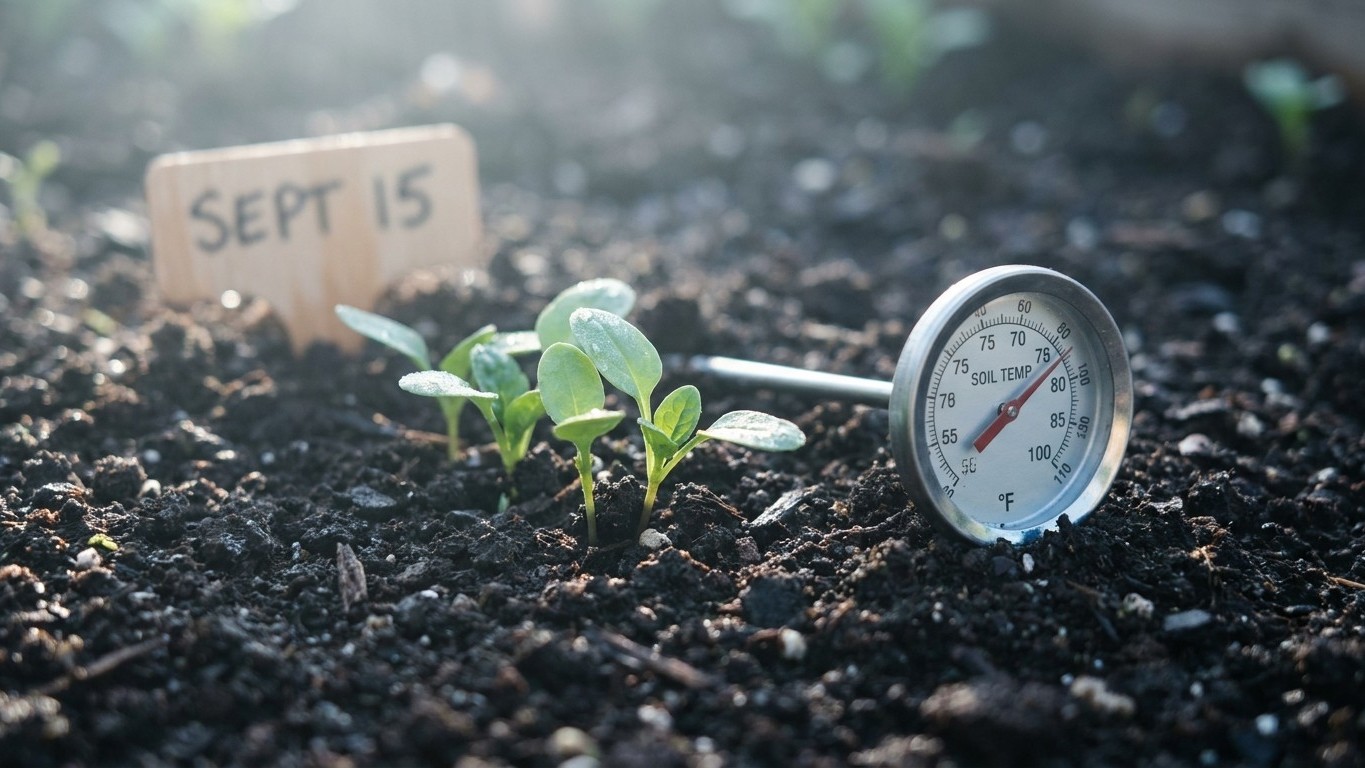

Autumn Spinach in Mississippi goes into the ground once the soil cools below 80°F, typically mid-September through early October, so the crop has 50 to 75 days to mature before the first fall frost arrives between November 7 and 22 at the Jackson reference station. Spring sowing is a much tighter window, squeezed by fast-arriving heat rather than cold.
The short answer
At the Jackson reference station, the longest day of the year brings 14 hours and 7 minutes of daylight. That number matters more than most gardeners think, because spinach bolts under two triggers at once: long days and warm temperatures. A cool summer would not rescue the crop here even if Mississippi had one, because day length alone is enough to push spinach toward flowering once the calendar tips past the solstice. But Mississippi does not offer a cool summer as a fallback. The state logs an average of 71.1 days a year at 90°F or hotter, a heat load that arrives early and lingers late.
So which is the real limit, day length or heat? In Mississippi, the honest answer is both, but heat wins the argument first. Spinach grows best where temperatures stay under 75°F, and that ceiling gets crossed well before the summer solstice pushes day length to its peak. By the time the days are long enough to matter on their own, the thermometer has already ended the conversation. That is why spring spinach in this state has such a short shelf life, and why the autumn planting exists at all: it lets the crop mature during the stretch of the year when neither heat nor day length has caught up yet.
This is also where spinach and onions part ways completely, even though they share the same climate data. Long days build the bulb in an onion. Long days destroy a spinach crop by sending it to seed. Anyone reading both crops off this site’s weather numbers should keep that distinction sharp, because the same 14-hour, 7-minute daylight figure means opposite things depending on which plant is in the ground.
Practically, that leaves Mississippi gardeners with two narrow windows a year for spinach: an early spring planting that races the arrival of 75°F afternoons, and a fall planting that has to wait out summer soil heat before seed will even germinate. Neither window is generous. Both reward planting close to the calculated edges rather than guessing.
How long the spring window really is
Working out the spring window means starting from the last frost date and running the clock forward until heat shuts the crop down. Here is how that plays out using the Jackson reference numbers.
- Start with the last spring frost. The 1991-2020 climate normals put it between March 6 and March 22 at the Jackson station. Spinach seed goes in 2 to 3 weeks before that date, which lands sowing somewhere in the middle to late part of February.
- Mark the point where growth quality falls off. Spinach stops growing well once temperatures climb above 75°F. Mississippi springs warm quickly, and with an annual average of 71.1 days a year reaching 90°F, the state does not linger in the 60s and low 70s for long once spring gets underway.
- Count the usable stretch. From a mid-to-late February sowing to the point spring afternoons start pushing past that 75°F ceiling, most Mississippi gardens get somewhere in the neighborhood of eight to ten weeks of good spinach growth before quality and flavor start to slip.
- Treat that window as firm, not flexible. Because the ceiling is a heat threshold rather than a fixed calendar date, a warm spring can close the window early. A gardener who sows late in that February-to-March range is trading away days at the tail end of the crop, not gaining a delay-proof cushion.
The short version: spring spinach in Mississippi is a sprint, not a season. It is worth growing, but nobody should expect it to carry a garden much past the point spring turns into early summer.
The autumn crop, and when the soil lets you sow
Fall spinach avoids the spring problem, but it trades one obstacle for two others. The first is invisible until you check a soil thermometer. The second is the frost that eventually ends the season outright.
Soil too warm to germinate
Spinach seed germinates poorly once soil temperature climbs above 80°F, according to Utah State University Extension. That threshold, not the calendar, is what actually opens the autumn window in a hot state like Mississippi. With 71.1 days a year averaging 90°F or higher, soil in Mississippi holds summer heat well into what other regions would already call fall. Sowing too early means seed sitting in warm, inhospitable soil and simply failing to come up. The practical fix is patience: wait until soil temperatures have visibly dropped, which for most of the state means mid-September at the earliest, sometimes later in a hot year.
The frost that ends the season
The other end of the calculation is the first fall frost, which the same 1991-2020 climate normals put between November 7 and November 22 at the Jackson station. Utah State University Extension recommends sowing fall spinach 50 to 75 days before the target harvest date, and no more specific days-to-maturity figure is published for the crop. Counting back from a harvest date in early-to-mid November puts the theoretical sowing window somewhere between late August and early October, depending on which end of the frost range and which end of that 50-to-75-day range is used.
Lay that theoretical window over the soil-temperature problem and the practical answer narrows fast. Late August is usually still too warm below the surface for reliable germination in Mississippi, even though the frost math would technically allow it. That pushes the real sowing window toward mid-September through early October, once soil has cooled enough for seed to sprout but while there is still enough time left before frost to reach a usable harvest.
Utah State University Extension names four spinach varieties, Bloomsdale, Melody, Teton, and Olympia, without publishing maturity data or growth characteristics for any of them. That means variety choice in Mississippi comes down to seed availability and personal preference rather than any documented difference in how fast each one handles the state’s soil-warmth and frost constraints. Gardeners should still check their own county conditions rather than relying only on the Jackson airport figures, since suburban and rural sites often see the first fall frost arrive earlier and the last spring frost linger later than the reference station shows, sometimes by a week or two, and more at higher elevation.
Common questions
Can I sow spinach in Mississippi during the middle of summer?
No. Summer soil in Mississippi routinely holds temperatures well above the 80°F germination ceiling, and the long, hot days during that stretch are exactly the conditions that push spinach toward bolting rather than leaf growth.
Does a mild fall push the sowing date later?
It can, but the limiting factor is soil temperature, not air temperature or the calendar. If soil is still reading above 80°F in late September, waiting a bit longer usually produces better germination than sowing on a fixed date.
Is the first frost date the same everywhere in Mississippi?
No. The November 7 to November 22 range comes from the Jackson airport weather station. Suburban and rural gardens elsewhere in the state often see frost arrive earlier in the fall and linger later in spring, so local records are worth checking before locking in a sowing date.
Why does spinach bolt even in a cool year?
Because day length, not just heat, triggers flowering in spinach. Once the days grow long enough, the plant can bolt regardless of how mild the temperatures happen to be that particular season, which is why the autumn planting matters as much as getting spring sowing timed correctly.