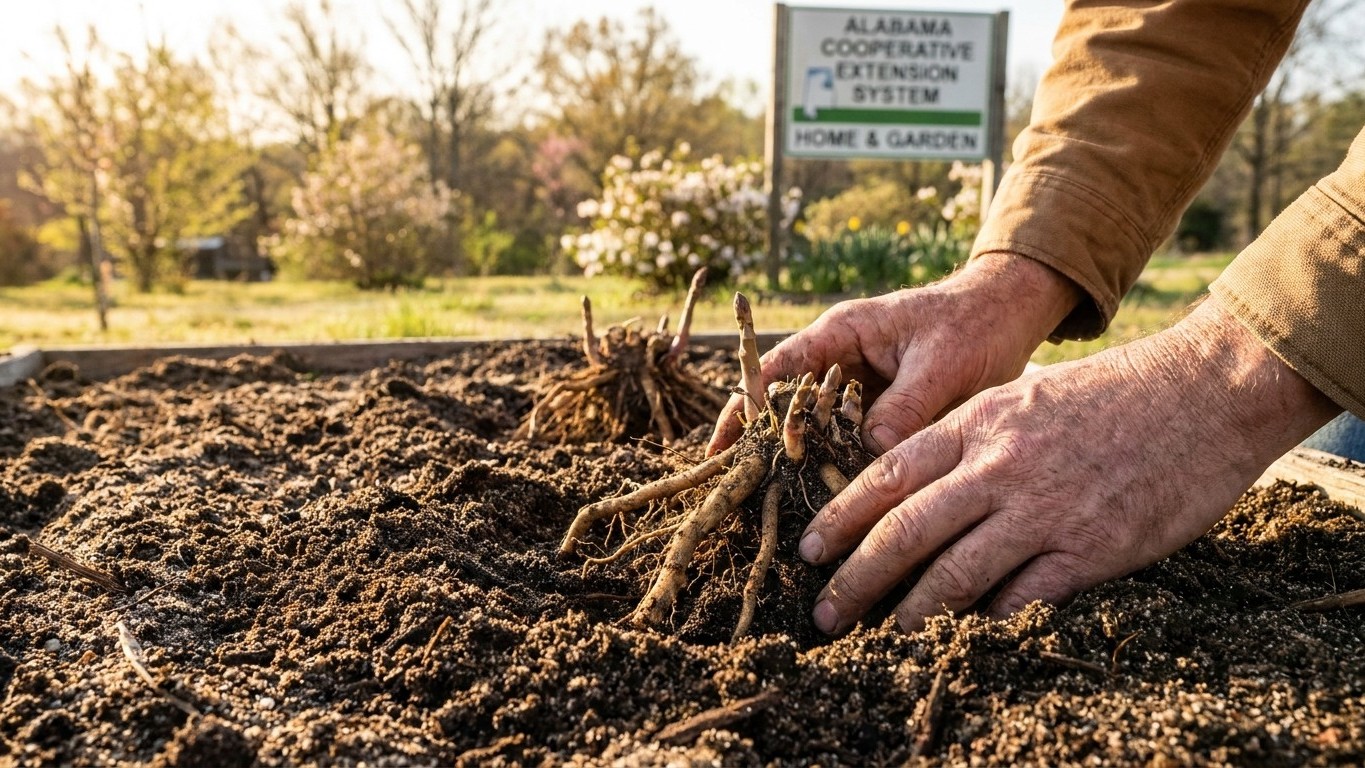

In Montana, Plant Asparagus Crowns in early spring, right around the region’s last frost window of April 29 to May 10. That timing lets the roots settle into cool ground before summer heat arrives, and it lines up with the 8-inch furrows this crop needs before its long run begins. This is a plant that will occupy the same patch of dirt for 10 to 15 years, so the week you choose matters far less than the ground you choose.
The short answer
Montana’s official state soil is the Scobey series, a Mollisol, the deep, dark prairie soil that built the reputation of the Corn Belt long before it carried a state title. On paper it looks like good news for a long-term bed: surface pH runs about 7.0, close enough to neutral that most vegetables tolerate it without complaint, and the texture splits fairly evenly between sand, clay and silt (35 percent sand, 31 percent clay, 34 percent silt), with organic matter around 2.0 percent. USDA lists it as well drained. That last word is the one that matters most for asparagus, because drainage is the only soil condition the crop actually demands.
Asparagus crowns go into 8-inch furrows and then stay put. There’s no digging them up in year four because the spot turned out to be wrong. The plant isn’t harvested at all until year three, and once it starts producing it keeps going for 10 to 15 years. Compare that to a tomato bed you can rework every spring, and the stakes look different. A soil that’s merely inconvenient for lettuce is a fifteen-year sentence for asparagus if it holds water around the crown through a wet spring.
The Scobey series itself, being well drained with a fairly balanced texture, would suit a long-term asparagus bed reasonably well if your garden actually sits on it. But that’s the catch: Scobey is the soil chosen to represent Montana on a map, not a soil test of any particular backyard. The state spans river bottoms, benchland, mountain valleys and any number of lots a builder has scraped and refilled, and none of those necessarily resemble the state soil at all. A yard with heavier clay, a compacted subsoil, or a spot where water visibly stands after a spring rain is a different story entirely, regardless of what the official soil series says.
What to do if your ground doesn’t drain
If water pools in your planting area for more than a few hours after rain, don’t plant asparagus there as-is. Build a raised bed, or mound the row 6 to 8 inches above grade, so the crowns sit above the saturation line. Working several inches of coarse sand or compost into a heavy patch can help, but a raised bed is the more reliable fix over a 10 to 15 year timeframe. None of this replaces an actual soil test on your own property, which is the only way to know your real drainage and pH rather than borrowing a state average that may not describe your yard at all.
Will the summer here water it for you?
Established asparagus beds want 1 to 2 inches of water every other week for their first two years, then about every three weeks once the roots are deep and settled. Montana’s summer rainfall doesn’t come close to covering that on its own, and the shortfall is worth spelling out month by month.
- June: the reference station averages 2.22 inches for the month, the wettest of the three summer months. Spread over roughly four weeks, that’s close to half an inch a week, well under the roughly 1 inch a week a young bed wants during its first two seasons.
- July: rainfall drops to 1.22 inches, cutting the natural supply nearly in half from June. This is typically when supplemental watering becomes non-negotiable rather than optional, especially for crowns planted that same spring or the year before.
- August: the driest month of the three, at just 0.87 inches. Across the full growing season, June through August adds up to about 4.3 inches total, against a target that, for a first- or second-year bed, would call for something closer to 8 to 12 inches of applied and natural moisture combined over the same stretch.
- Established beds (year three and beyond): once the watering interval stretches to every three weeks, the math gets a little easier, but Montana’s summer total of roughly 4.3 inches over three months still falls short of an every-three-week, 1 to 2 inch schedule stretched across twelve summer weeks. Expect to supply the difference with a hose or drip line most summers.
- Reading your own plot: these are 1991-2020 normals for one reference station, not a forecast and not a measurement of your yard. A rain shadow, a slope, or simply living in a different valley changes the numbers. A rain gauge on your own property is what actually tells you whether to turn on the hose this week or skip it.
The practical upshot: treat Montana’s summer rain as a partial answer, not a full one. Sandy ground drains what little rain falls even faster, while heavier clay holds it a bit longer, which is one more reason a soil test matters before you decide how often to drag out the hose.
When to put the crowns in
Crowns go into the ground in early spring, timed around the region’s last frost rather than a fixed calendar date. For the reference station’s area, the last spring frost falls somewhere between April 29 and May 10. That’s a mean, an average built from years of data, not a guarantee for any single spring. Treat it as the center of a window rather than a firm start date, and remember that mountain valleys elsewhere in Montana can see frost in months this reference station never would.
Planting crowns around that window, rather than well before it, avoids exposing new growth to a hard freeze while the plant is still establishing its root system. Once the furrow is dug to about 8 inches and the crown is set in, the trench doesn’t get filled in all at once. Soil is added back gradually, about 2 inches every other month across the first year, rather than backfilled to grade on planting day. That gradual approach protects the emerging crown while still letting the plant push up through loose soil.
Seed is the other route into an Asparagus Bed, and it’s a legitimate alternative to crowns rather than a lesser option, according to Utah State University Extension. Growing from seed simply shifts the timeline earlier and adds a full extra year before the plant reaches the size a purchased crown already has, since the grower is starting from scratch rather than from an established root system. For most home gardeners working around Montana’s frost window, crowns remain the faster path to a producing bed, but seed is worth knowing about if crowns aren’t available or if starting from seed indoors ahead of the outdoor planting window fits a gardener’s setup better.
Common questions
How long until I can actually harvest asparagus?
Not until year three, no matter how vigorous the plant looks in year one or two. Once harvest starts, the first season is typically limited to about 4 weeks of cutting, extending to roughly 6 weeks the following year, then up to about 8 weeks once the bed is fully mature. The stopping point each season isn’t a date on the calendar; it’s a visual cue. Stop cutting when most of the spears coming up are thinner than a pencil, which signals the plant needs to put its energy into foliage rather than continued harvest.
Do I need to worry about winter chilling requirements?
That figure isn’t published in the source used for this guide, and turning a hardiness zone into a specific chilling number would be a guess rather than a fact. If chilling hours matter for your particular variety, that’s a question for a source that actually publishes it, not something to assume from general zone maps.
What varieties are typically planted?
Utah State University Extension names four: Jersey Giant and Jersey Knight, both all-male varieties, and UC 157 F1 and Purple Passion, both male/female varieties. The source doesn’t publish flavor comparisons, yield differences, or a recommendation for one over another, and no nursery is named. The sex of the variety is the only distinguishing detail on record here.
| Variety | Sex type |
|---|---|
| Jersey Giant | All-male |
| Jersey Knight | All-male |
| UC 157 F1 | Male/female |
| Purple Passion | Male/female |
Should I test my soil’s pH before planting?
The source behind the bed requirements used here is silent on soil pH, so no target number is offered in this guide. The state soil reference gives a surface pH near 7.0 for the Scobey series specifically, but that describes one mapped soil series representing Montana, not any individual garden. A soil test is the only way to know your own number, and it’s a cheap step to take before committing ground to a plant that will still be there in a decade and a half.