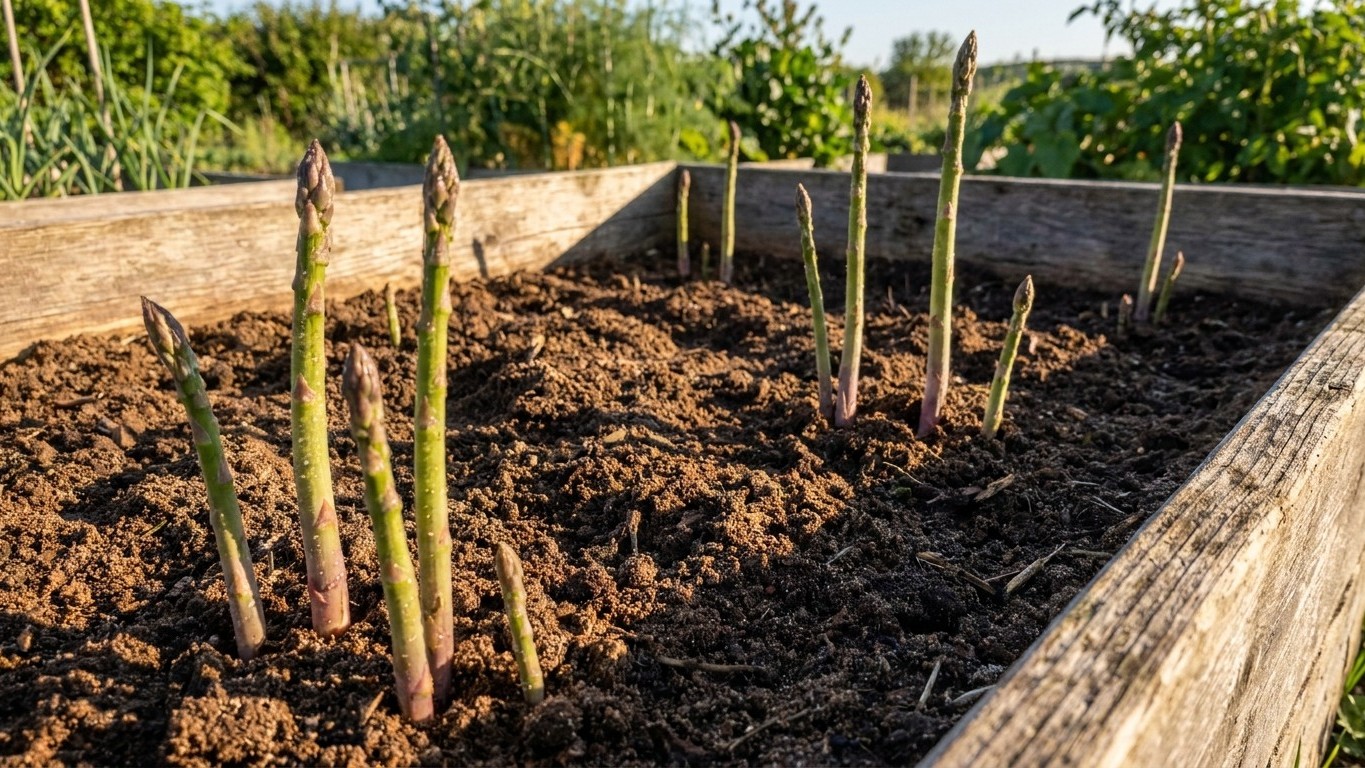

Montana’s state soil, the Scobey series, is rated well drained by USDA NRCS, and that single trait matters more than anything else for a bed meant to stay in one spot for 10 to 15 years. The answer is a qualified yes for ground that resembles Scobey. But a state soil is a survey average, not a soil test from your own back garden, and that gap is where the real planning happens.
The short answer
The Scobey series is a Mollisol, the same broad soil order that built the Corn Belt: dark, deep, and naturally fertile. USDA NRCS records the surface horizon of its major components as 35 percent sand, 31 percent clay, and 34 percent silt, with organic matter around 2.0 percent and a surface pH near 7.0, which is close to neutral. Montana named it the official state soil by law in 2015, and it stands in as a rough sketch of what a lot of the state’s prairie ground looks like below the topsoil.
Utah State University Extension’s asparagus guidance carries exactly one soil condition for a bed meant to bear for a decade or more: it has to drain. Not a pH range, not a fertility target, not a texture class. Just drainage. On that single test, Scobey passes. NRCS classifies it as well drained, and a Mollisol’s dark, organic-rich topsoil generally holds structure well enough to move water through without pooling around the crowns, which is the failure mode that actually kills an Asparagus Bed. Waterlogged crowns rot. A dry spell just stresses the plant.
The catch sits in that 31 percent clay figure. A soil can be officially “well drained” in a survey and still hold water noticeably longer than a sandy loam a few miles away, especially where the ground has been compacted by construction, driveway runoff, or years of foot traffic. Clay-leaning soils drain, but slowly, and slow drainage after a heavy spring rain is exactly the kind of thing a gardener only discovers the first time a bed sits soggy for three days straight.
None of this is a diagnosis of any one yard. Scobey is one series among hundreds mapped across Montana, and a garden in a river bottom, a hillside lot, or anywhere a builder has scraped and re-graded the topsoil can behave nothing like the survey average. The only way to know for certain is to dig a hole roughly a foot deep, fill it with water, and time how long it takes to disappear. Anything still standing after four hours suggests a drainage problem worth solving before crowns go in the ground, not after.
If that test comes back slow, the fix is not complicated, just permanent. Raised beds or berms lift the crowns above the slow-draining layer entirely. Working several inches of compost or coarse organic matter into the planting trench loosens clay-heavy ground and gives water somewhere to go besides sideways. Since this bed is meant to outlast most other decisions made in a yard, it is worth solving drainage once, thoroughly, before the crowns ever touch soil.
Will the summer here water it for you?
Utah State University Extension’s watering schedule for asparagus is straightforward on paper: 1 to 2 inches every other week for the first two growing seasons while the crowns establish, then a lighter routine of the same amount every three weeks once the bed matures. Measuring that against what a Montana summer actually delivers tells a gardener how much of the job the sky handles and how much falls to a hose.
- Add up the two-year establishment need. A rough June-through-August stretch runs about 13 weeks. At 1 to 2 inches every other week, that works out to roughly six to seven watering cycles over the summer, or somewhere near 9 to 13 inches of water across those three months during establishment years.
- Compare that to what summer rain provides. NOAA’s 1991-2020 climate normals for the reference station put summer rainfall at about 4.3 inches total across June, July, and August, broken down as 2.22 inches in June, 1.22 in July, and just 0.87 in August, the driest of the three months.
- Spot the gap. Even at the low end of the establishment target, natural rainfall covers less than half of what a young asparagus bed needs across a Montana summer. During those first two years, a gardener is likely supplementing with somewhere in the range of 5 to 9 inches of irrigation on top of whatever rain falls, and August, the driest month, is when a hose matters the most.
- Ease off, but don’t stop, once the bed matures. The lighter every-three-weeks schedule for an established bed needs far less supplemental water than the establishment years, but 4.3 inches of natural summer rain still falls short of covering it on its own, particularly in a low-rainfall August.
These are 1991-2020 normals for one reference station, an average built from thirty years of weather, not a forecast for any single summer and not a reading from any one yard. A slope, a fence line, or simple distance from that station changes the real number. A rain gauge staked next to the bed is the only instrument that tells a gardener what their own patch of ground is actually getting.
When to put the crowns in
Asparagus crowns go into the ground in early spring, planted about 8 inches deep in a furrow according to Utah State University Extension. For a Montana garden, “early spring” has to be measured against the last frost, and NOAA’s 1991-2020 normals put the mean last spring frost for the reference station somewhere between April 29 and May 10. That is an average built from three decades of freeze data, not a guarantee, so treat it as a window to plan around rather than a date to circle on the calendar. Mountain valleys elsewhere in Montana can see frost in any month of the year, which is a reminder that a local reading matters more than a statewide average.
Once the frost risk from that window has passed, crowns go into the furrow with their roots spread out, and the furrow gets backfilled gradually rather than all at once, adding roughly 2 inches of soil back over the crowns every other month across the season as the new growth pushes up. That gradual fill protects the emerging spears while still letting the crown settle into full planting depth by the time the first growing season winds down.
Crowns are the faster route to an established bed, but they are not the only one. Utah State University Extension’s guidance also allows for starting asparagus from seed instead, which is the slower path since the plant needs time to grow into something with the size and root structure of a purchased crown before it functions the same way in the garden. For a bed meant to produce for a decade or more, most home gardeners choose crowns simply to skip that early growing-in period.
On variety, the source names four options and nothing more: Jersey Giant and Jersey Knight, both all-male varieties, and UC 157 F1 and Purple Passion, which are male and female. That is the entire published distinction. No flavor comparison, no yield figures, no reason to favor one over another appears in the source, so any claim that one tastes better or produces more is not something Utah State University Extension has put in writing.
Whichever variety goes in, the harvest clock does not start early. There is no harvest at all in year one or year two, full stop. Year three brings the first cutting, limited to about 4 weeks. That window extends to 6 weeks the following year, then 8 weeks after that. The rule for knowing when to stop cutting in any given season is not a date but a condition: stop once most of the spears coming up are thinner than a pencil, since that is the signal the crown needs to put its energy back into foliage rather than spears.
Common questions
Does asparagus need a chilling period to grow in Montana?
Utah State University Extension’s guidance does not mention any winter chilling requirement for asparagus, and no such figure is published here. Montana’s cold winters are not a documented obstacle for the crop in this source, but no specific chilling hours or hardiness threshold is stated either.
What soil pH does asparagus actually need?
The source is silent on soil pH for asparagus specifically. The pH figure available here, about 7.0, describes Montana’s state soil, the Scobey series, not a requirement for the crop. Treat that number as background on regional soil chemistry rather than a target to hit in the bed.
Can I harvest anything the first two years?
No. Utah State University Extension is direct on this point: there is no harvest in year one or year two while the crowns establish their root system. The first cutting comes in year three, and even then it is limited to about 4 weeks before the plants need to be left alone to grow foliage.
How do I know when to stop cutting each spring?
Not by counting weeks. The stopping point is a visual one: once most of the new spears coming up are thinner than a pencil, it is time to let the bed alone for the season so the crown can rebuild its energy reserves for next year’s harvest.