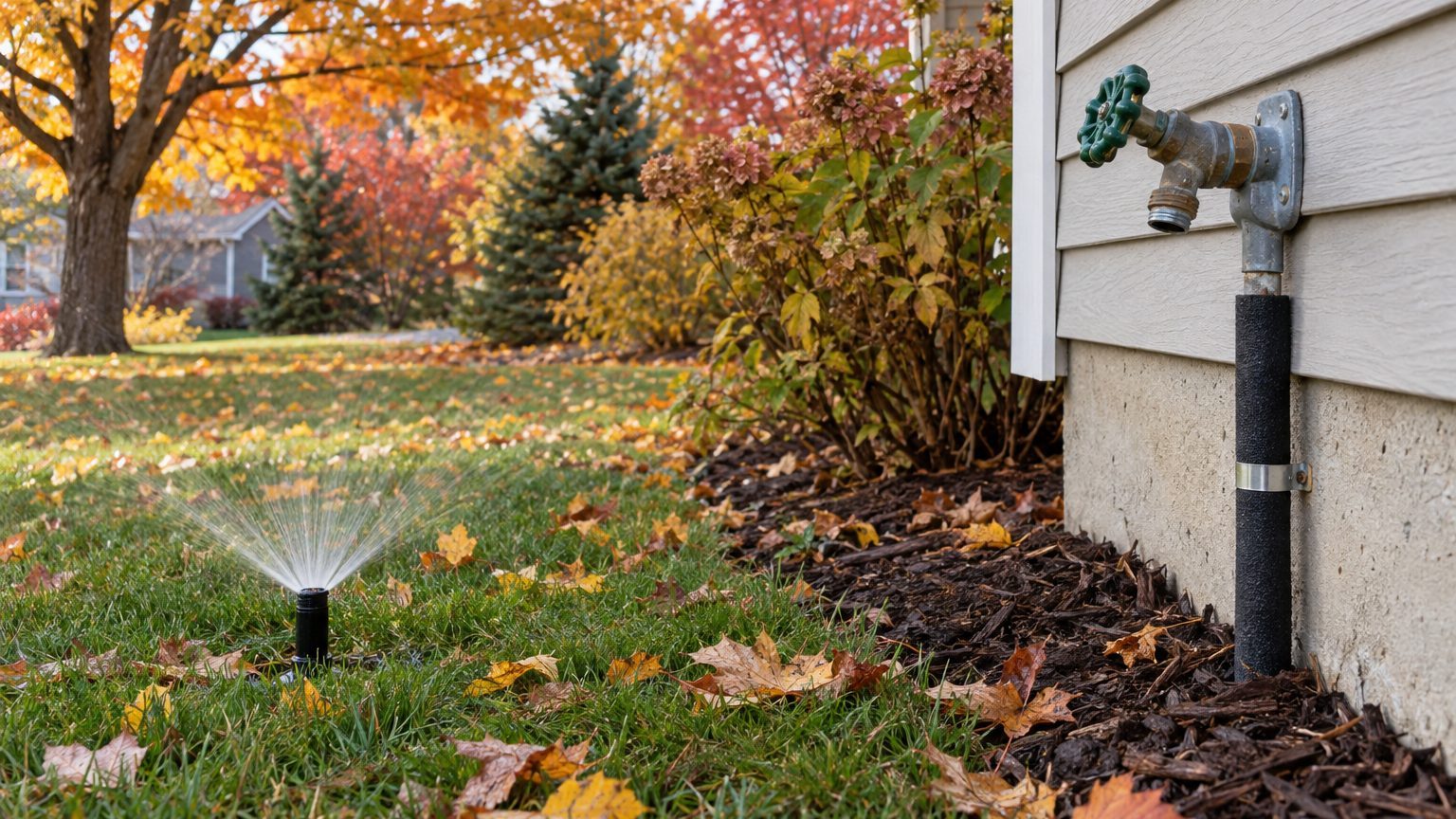

Montana’s cold arrives on a timetable set by elevation, not the calendar. Billings, one of the milder valleys, sees its first fall freeze in early to mid October. Any sprinkler line or hose bib still full of water by then is a repair waiting for spring. The higher or farther north you live, the sooner the job needs to be done. Other fall chores move with the same frost dates, and the Montana guides follow them season by season.
When to do it in Montana
In Billings, the window to drain a sprinkler system closes before the first fall freeze, which NOAA’s 1991-2020 Climate Normals put at October 1 to October 14 (the stretch where the odds of a 32°F freeze sit between 30 and 70 percent). Drain before the first hard freeze, not after the first light one. Late September is the practical target for most Billings yards, and anyone in a colder pocket should finish earlier than that.
The NOAA figures come from the Billings station data, and the station is a generous reference point. Billings is one of the milder valleys in the state. Mountain valleys elsewhere in Montana can see frost in any month, so a calendar date is only a starting point for you.
Why the first light freeze is the wrong signal
A light freeze, a night that dips just under 32°F and thaws by mid-morning, rarely does damage on its own. That is exactly why it lulls people. It feels like a warning shot, so folks wait for it before draining, and the next cold night is the one that lasts. A hard freeze holds below freezing for hours, and that is when water trapped in a backflow preventer, a hose bib, or a shallow lateral turns to ice and pushes outward.
Waiting for a warning is a bad bet in Montana for another reason. Cold fronts here can drop temperatures fast, and a mild afternoon can be followed by a night that catches every unprotected line. Draining a week early costs you a week of irrigation on a lawn that is already going dormant. Draining a day late can cost you a manifold.
No shortcut in this climate
Some places have winters mild enough that a full blowout is often unnecessary. Montana is not one of them. NOAA’s 1991-2020 normals put the mean daily minimum of the coldest month in Billings at 17.9°F, which means a typical January night is well below freezing, night after night. Nothing left holding water survives that. The USDA Plant Hardiness Zone Map (2023 edition) runs from 3a to 6a across the state, so conditions in the northern and high-elevation parts are harsher than Billings, not gentler.
The direction of the adjustment is simple. Colder ground, meaning higher elevation or farther north, has an earlier first fall frost, so fall tasks like draining move earlier there. If your yard sits above town, on a north-facing slope, or in a valley where cold air pools overnight, treat the Billings window as the latest you would ever want to be finishing. Reading this on September 30, 2026, a Billings-area homeowner is right at the edge of the safe stretch. Schedule the work this week rather than next month.
Sprinkler lines: drain or blow out
Water expands as it freezes, and pipes do not. PVC and polyethylene lines, valves, and the brass and plastic parts of a manifold all have a little give, but ice generates more force than they can absorb. The break usually happens at a fitting, a valve body, or a sprinkler head riser, and it stays invisible until the system is turned back on in spring and starts pushing water into the soil.
Three ways to get water out
Homeowners generally choose among three methods, and they are not equal in a climate like this one.
| Method | How it works | Where it falls short |
|---|---|---|
| Manual drain | You open drain valves at low points and let gravity empty the lines | Only works if the system was built with those valves and the pipe slopes toward them |
| Automatic drain | Valves open on their own when line pressure drops and release water | Can stick from debris or seal poorly, and leaves water in any section that sits below the valve |
| Compressed-air blowout | An air compressor pushes water out through the heads, zone by zone | Needs the right equipment, careful pressure control, and attention to safety |
Manual and automatic drains rely on gravity, and gravity does not clear every dip in a real yard. Lines that run uphill, across a swale, or around a driveway can hold pockets of water that never reach a drain point. Automatic drains are a reasonable backup, and a poor sole defense when the coldest month averages 17.9°F at night in Billings and colder elsewhere.
What this climate calls for
For most Montana systems, a compressed-air blowout is the method to use, with any manual drain valves opened as well. Air moves water out of the uphill runs and low spots that gravity leaves behind. The usual sequence is to shut off the water supply to the system, open the drain on the backflow preventer side as the manufacturer directs, connect the compressor at the blowout port, and work through one zone at a time until the heads spit only mist. Keep the pressure within what your pipe type and the equipment allow, and never stand over a head while air is running. Flying debris and a spinning riser are real hazards, so wear eye protection.
Hiring a professional is the sensible choice in several situations: you do not own or cannot safely rent a compressor of the right size, you are unsure of the pipe material or its pressure rating, you cannot find the shutoff or the backflow preventer, or the system has dozens of zones and drip lines. Overpressurizing can crack the very lines you are trying to protect, so a wrong guess is expensive. A pro also knows where a given system tends to trap water. Book early, because the last week of September and the first week of October are when everyone else is calling too.
Outdoor faucets and hoses
Hose bibs are the part of the plumbing that most often catches homeowners off guard, mostly because the job is small enough to forget. It takes minutes and involves nothing but turning valves. Do it the same day you handle the sprinklers so both are checked off before that October 1 to October 14 stretch.
The sequence
Start outside. Disconnect every hose, along with splitters, timers, and spray nozzles, and drain and coil the hoses for storage. A hose left attached traps water against the faucet, and a hose full of ice can hold that ice against the spigot all winter.
Go inside next. Find the shutoff valve that feeds the outdoor line, often in a basement, crawl space, or utility area near the wall where the faucet sits, and close it. If the valve has a small cap on its side, that is a bleeder, and opening it lets trapped water escape. Return outside and open the faucet fully. Leave it open all winter so any water that remains has room to expand and drain out. Foam faucet covers can add a layer of protection on cold nights, though they do not replace draining. The step-by-step details are in Winterizing Outdoor Faucets Before the First Freeze.
Why frost-free faucets still fail
A frost-free faucet puts the valve seat at the inner end of a long stem, inside the heated part of the wall, so the section exposed to cold air stays empty when the tap is shut off. That design works only if the water drains out of the barrel. It drains because the faucet is installed with a slight downward tilt. Attach a hose, and water backs up into the barrel and cannot leave. It freezes at the exposed end and can split the pipe behind the wall, where you cannot see it. The first sign is often water running inside the house in spring. The Frost-Free Outdoor Taps guide covers how these are built and how to tell whether yours drains properly.
Disconnect every hose from every faucet, including the frost-free ones, before the October 1 to October 14 stretch. That is the step that separates a working frost-free tap from a failed one. Anything beyond turning valves and removing hoses, such as replacing a faucet, adjusting its slope, cutting into pipe, or adding a shutoff where none exists, is a plumber’s job. The fix is not something to improvise in a wall.
What goes wrong here
Three failures show up again and again in Montana, and each has an obvious cause and an easy prevention.
The first is the early cold snap. Mountain valleys can frost in any month, and even in Billings a week of warm weather in late September can end overnight. Homeowners who planned to drain “sometime in October” find the lines frozen before they got around to it. In spring the damage looks like a head that geysers, a zone that has no pressure, or a wet patch in the lawn that appears when the system is turned on and does not go away. Prevention is unglamorous: finish the work in late September in Billings, and earlier if you live higher or farther north. Put the drain job on the calendar before the first week of October rather than waiting for a forecast.
The second is the forgotten hose. It is usually one, tucked behind a shed or coiled at the side of the garage, still screwed onto a faucet. The result is the split pipe behind the wall described above. It often stays dry until the tap is opened in spring, and then a hidden leak becomes a soaked wall cavity. A walk around the whole house, checking every faucet including the ones you rarely use, takes a couple of minutes. If a pipe does freeze, the guide to Frozen Pipes explains what to do while it is still frozen.
The third is the flooded valve box. The green lidded boxes in the lawn hold the valves that control each zone, and they can collect water from a leak, a sprinkler that ran past its schedule, or runoff. Water that sits around valves and fittings will freeze there regardless of whether the pipes are clear. In spring, the sign is a cracked valve body or a zone that leaks constantly. Lift the lids before the freeze, look for standing water, and clear debris and any water you find. If a box floods repeatedly, that is a drainage problem worth a professional look.
While you are outside, this is also a good moment to plan the rest of the yard. Lawn work follows the same frost timing, and Winterizing a Lawn picks up where the sprinkler shutdown leaves off.
Common questions
Can I wait for the first frost in the forecast before draining?
It is a risky habit. The first frost is often a light one, and the freeze that does the damage can follow within days. The safer approach in Billings is to finish before the October 1 to October 14 window begins, and earlier in colder, higher, or more northern locations.
Do frost-free faucets need to be winterized?
They need less, but not nothing. Remove every hose, splitter, and nozzle, and make sure the faucet is not holding water. A hose left attached defeats the design, because water stays in the barrel and freezes where it cannot drain.
Is it safe to blow out my own sprinkler system?
It can be done at home if you have the right equipment, know your pipe type, and keep air pressure within safe limits. Wear eye protection and stay clear of the heads. If any of that is uncertain, hire a professional, since too much pressure can crack lines and fittings.
What should I do if my system froze before I drained it?
Shut off the water supply to the system, open the drains, and leave everything alone until the lines thaw. Then blow out the remaining water as soon as conditions allow, and plan to inspect every zone in spring for cracked fittings and leaks. Some damage does not show until the system is running again.