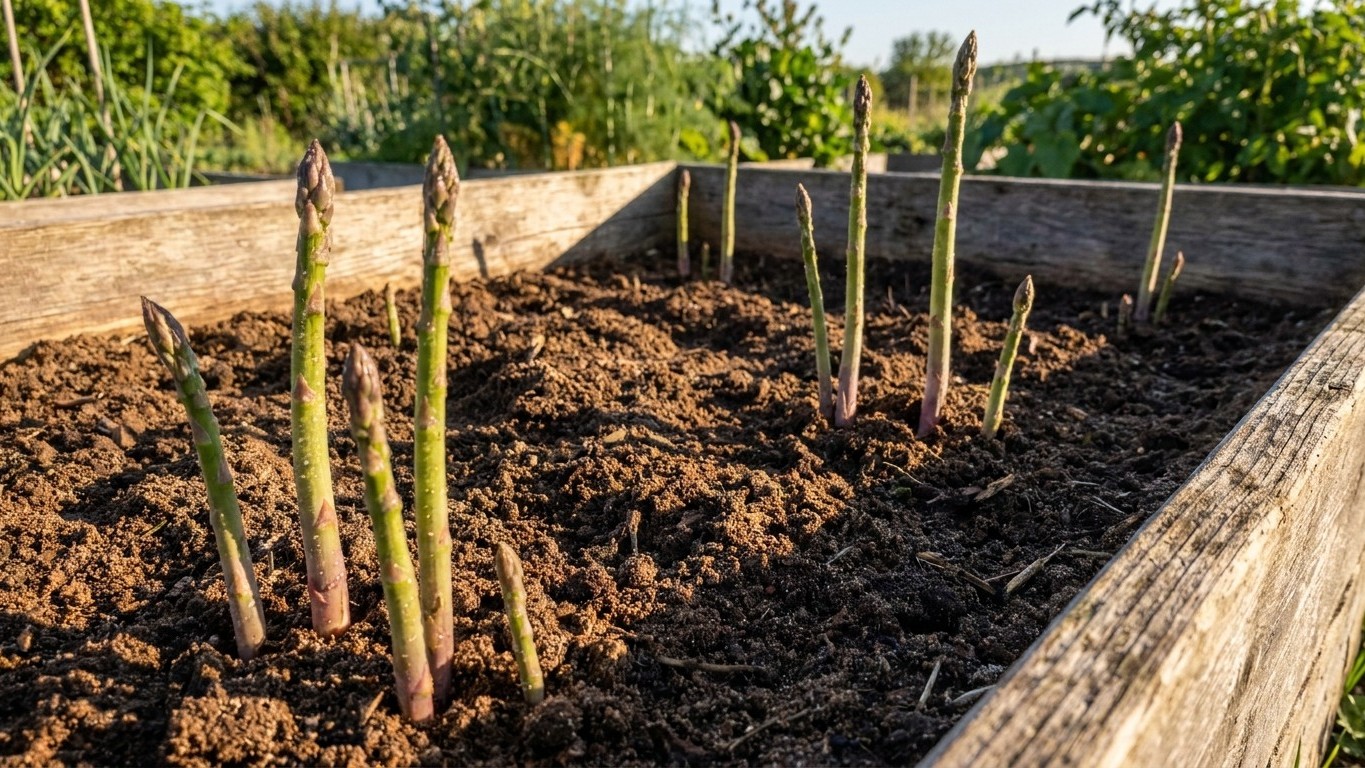

Yes, in most New Mexico gardens the ground itself won’t be the reason an Asparagus Bed fails before its time. The state’s representative soil sheds water well, which is the one soil condition asparagus actually asks for over a 10 to 15 year run. But “representative” is not “your yard,” and the fix for a soil that doesn’t drain is worth knowing before the crowns go in the ground, not after.
The short answer
Start with the mechanism, because it explains why drainage matters so much more here than, say, whether a tomato patch drains well. A bed of asparagus stays put for a decade or more. Utah State University Extension notes that most soils will grow asparagus fine, with one condition attached: they need to be well drained. A soggy spot that’s a minor annoyance for a season of lettuce becomes a slow-motion problem for a crop that isn’t coming up until year three and won’t finish producing until well into the next decade.
New Mexico’s dominant mapped soil, the Penistaja series, checks that box on paper. It’s an Aridisol, the classification for dry-climate ground, and USDA NRCS data lists it as well drained. The texture leans sandy: 69 percent sand, 15 percent clay and 16 percent silt in the surface horizon, based on representative values across 47 mapped components of the series. Sandy ground of that ratio doesn’t hold water long, which is exactly what a fifteen-year asparagus crown wants in its root zone.
What the numbers actually cover
The same USDA dataset puts surface pH at about 7.5, alkaline, and organic matter at about 1.4 percent, both typical of a dry-region soil that hasn’t built up much decayed plant matter. The source used for the asparagus bed itself is silent on soil pH and on any winter chilling requirement, so neither of those numbers should be read as an asparagus preference. They describe the state’s representative ground, not a verdict on whether asparagus likes it.
| Property | Penistaja series (surface) |
|---|---|
| Soil order | Aridisol |
| Drainage | Well drained |
| Sand / clay / silt | 69% / 15% / 16% |
| Surface pH | About 7.5 |
| Organic matter | About 1.4% |
The caution worth repeating: a state soil series is a starting point, not a diagnosis of one garden. New Mexico spans hundreds of soil series, and a river-bottom lot or a yard where a builder scraped and refilled the topsoil can behave nothing like the Penistaja profile. If a shovel test shows water sitting in a hole for hours after a rain, that patch of ground is not a fifteen-year commitment as-is. The practical fix is a raised bed, 10 to 12 inches of built-up soil over the native ground, which sidesteps the drainage question entirely rather than trying to amend heavy native clay every year for over a decade. A basic soil test, cheap and available through most county extension offices, settles the question for an individual plot far better than any state-level dataset can.
Will the summer here water it for you?
The source’s watering guidance is specific: 1 to 2 inches every other week for the first two years while roots establish, tapering to every three weeks after that. New Mexico’s summer, measured at the same reference station used for the frost dates below, delivers about 3.5 inches of rain across June, July and August combined, out of 8.8 inches for the whole year. That’s not close to enough on its own, and the gap is worth walking through step by step.
- June is the thinnest month. The driest summer month averages just 0.57 inches, barely a third of what a single watering cycle calls for.
- July picks up, but not by much. The wettest of the three months averages 1.64 inches, still well short of the 2 to 4 inches a bed can need across a full month during its first two establishment years.
- August settles back down. At 1.31 inches, the third month brings the three-month total to roughly 3.5 inches.
- Compare that to the every-other-week target. Over a 13-week summer, a schedule of 1 to 2 inches every other week adds up to somewhere around 6 to 13 inches of water, several times what June, July and August deliver between them.
- The shortfall has to come from a hose or a drip line. On sandy ground like the Penistaja series, water moves through quickly, so the gap between rainfall and the crop’s need has to be closed by the gardener, not left to summer storms.
- Year three onward eases the load. Once the every-three-week schedule kicks in, the gap narrows, but a rain gauge staked in the bed is still the only way to know what’s actually reaching the roots on a given plot.
The heat compounds the shortfall too, though the source used here doesn’t publish a temperature figure to attach to it, only that summer rain in this region tends to arrive as scattered storms rather than steady soaking rain, which runs off sandy ground faster than it soaks in. A drip system on a timer removes the guesswork; hand-watering a fifteen-year bed by memory is a good way to under-deliver without noticing.
When to put the crowns in
Crowns go into the ground in early spring, set into furrows about 8 inches deep. In this part of New Mexico, that window sits around the last spring frost, which the reference station’s 1991-2020 data places between March 31 and April 12. That’s an average across three decades of recorded freezes, not a guarantee for any single spring, and it comes from one airport weather station. Gardens outside town, especially at higher elevation, commonly see their last frost run later than that window by a week or two, so a planting date locked to a calendar rather than to actual soil conditions is asking for trouble.
The furrow itself isn’t filled in all at once. The source’s method backfills gradually, about 2 inches of soil added roughly every other month across the first year, rather than burying the crown under a full 8 inches on day one. That staged fill gives the emerging shoots room to push through loose soil instead of fighting their way up through a deep, compacted furrow.
Seed is the other route into an Asparagus Bed, and it exists as a real alternative for gardeners who don’t want to buy crowns. The extension source referenced throughout this piece addresses the crown method in detail; it doesn’t lay out a seed-specific timeline, so anyone choosing that path should expect it to add time before the bed reaches the same maturity a crown-planted bed starts from. Either way, patience is built into the crop from the start: no harvest at all in the first two years, then a short first-harvest window in year three, expanding gradually after that as the root system matures. The rule for knowing when to stop cutting in any given year isn’t a date on a calendar either, it’s the spears themselves: once most of them come up thinner than a pencil, the harvest for that season is over.
Four varieties turn up in the extension literature, distinguished only by their sex, since asparagus plants are either male or female (or, in hybrid seed lines, a mix). Jersey Giant and Jersey Knight are all-male selections; UC 157 F1 and Purple Passion are male/female lines. No flavor comparison, no yield figures and no reason to favor one over another appear in that source, so a gardener picking between them is choosing on availability rather than published performance.
Common questions
- Does asparagus need acidic or alkaline soil? The extension source used for this crop’s care doesn’t publish a pH preference, and the state soil figure of about 7.5 describes New Mexico’s representative ground, not an asparagus requirement. A soil test is the only way to know an individual bed’s pH.
- How many years until a full harvest? None in years one and two. Year three brings a short first harvest, roughly 4 weeks, then extending to about 6 weeks and eventually 8 weeks in following years as the crowns mature, always stopping once most spears come up thinner than a pencil.
- Can crowns go in before the last frost date? The planting window is described as early spring, tied loosely to the last frost. Since the reference station’s March 31 to April 12 window is an average from one location, a gardener at higher elevation or outside town should watch local soil and weather rather than plant strictly by that date.
- Is sandy soil actually a problem for asparagus? No. Sandy, well-drained ground like New Mexico’s representative Penistaja series is closer to ideal than a heavy, waterlogged soil would be, since the crop’s one firm soil requirement is drainage, not a particular texture.