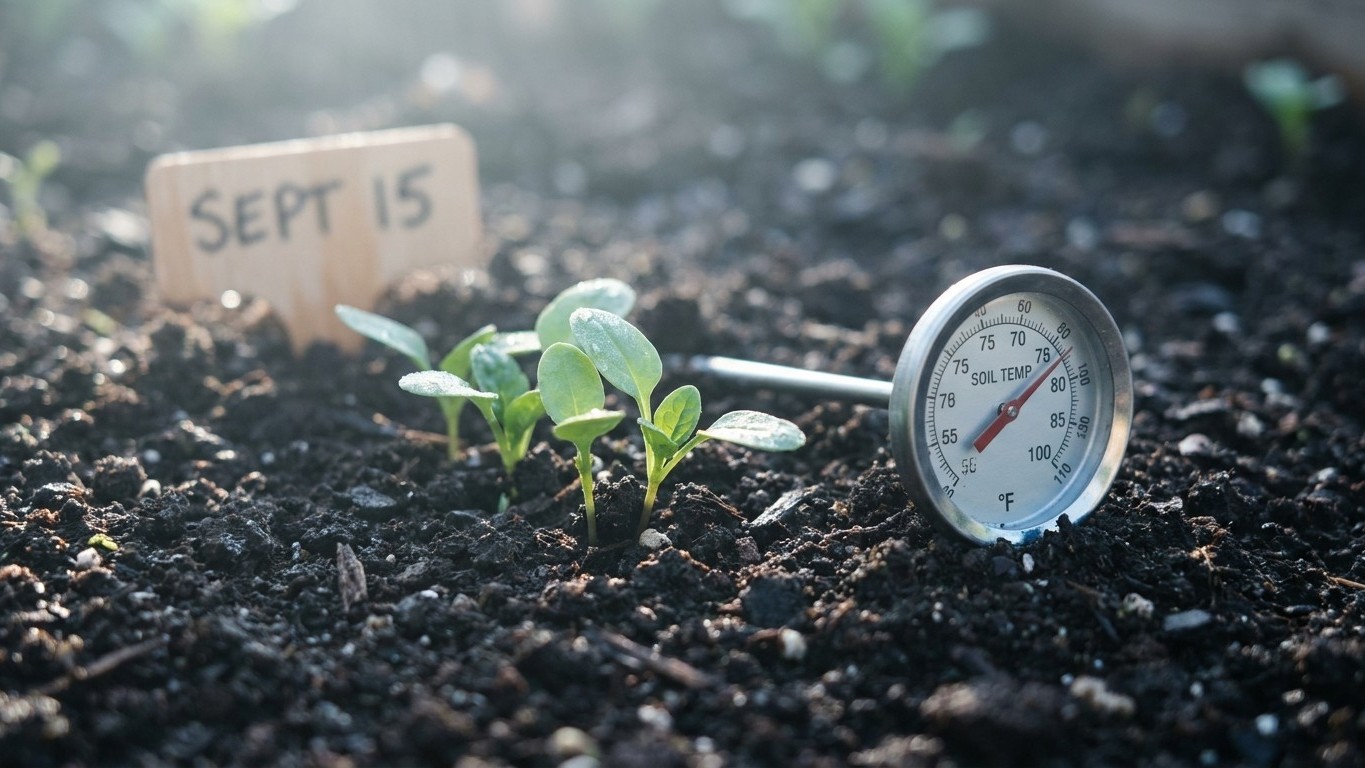

Spring spinach in New York City goes into the ground between March 2 and March 21, two to three weeks ahead of the average last frost. Fall spinach gets sown between roughly September 13 and October 8, counted 50 to 75 days back from a target harvest before the first frost arrives, sometime between November 14 and 27. Both windows are short, and both are set by different limits.
The short answer
Start with the number that most gardeners never think to check: on the longest day of the year, New York City sees 14 hours and 56 minutes of daylight. That’s a lot of light, and for spinach, light is a problem, not a gift. Long days trigger flowering, or bolting, in spinach regardless of how mild the summer feels. A cool, cloudy July does nothing to slow this down if the day length itself is pushing the plant toward seed. So the first ceiling on a New York spinach crop isn’t temperature at all. It’s the calendar, working through the plant’s own hormonal clock.
Heat piles on top of that. New York City averages 12.2 days a year at 90°F or above, a modest number compared to inland or southern states, but spinach doesn’t need 90°F to suffer. Growth quality falls apart once temperatures push past 75°F, and that same 75°F line is also where the leaves start turning bitter. Put those two facts together and the picture is clear: New York’s summer is disqualified for spinach twice over, once by day length and once by heat, and the two overlap almost perfectly. The longest days of the year land in June, right when temperatures are also climbing past that 75°F mark.
That’s why New York spinach is a two-season crop, never a summer one. Growers get a narrow slice of cool, shorter-day weather in spring before the solstice does its damage, and another slice in fall after the days shorten back down and the heat load drops. There’s no way to stretch a planting into July or August and expect leaves instead of a flower stalk. The plant reads the light meter before anything else, and by early summer in New York, that meter says: bolt.
The practical upshot is that timing matters more for spinach than for most vegetables in this region. Miss the spring window by even two weeks and the crop bolts before you get a real harvest. Miss the fall window and germination fails outright, because the seed itself struggles once soil temperatures run high. Both failure modes trace back to the same underlying fact: New York doesn’t have a long temperate season for this crop, it has two short ones bracketing a summer spinach simply cannot use.
How long the spring window really is
- Sowing date: Spinach seed goes in the ground two to three weeks before the average last frost. In New York City, that frost date falls between March 23 and April 3, which puts the sowing window at roughly March 2 through March 21.
- Early growth: Once seeded, spinach grows through the cool weeks of late March and April in soil and air temperatures that stay comfortably under the 75°F ceiling. This is the plant’s best stretch of the year, cool nights, moderate days, and daylight that hasn’t yet stretched into bolting territory.
- The closing point: As spring turns into early summer, two things move against the crop at once. Daylight lengthens toward that 14-hour-56-minute peak, and daytime temperatures start crossing above 75°F on a regular basis. Once both of those happen together, usually by late May or into early June in the city, spinach quality collapses and bolting becomes the plant’s dominant behavior.
- Usable window, in weeks: Counting from an early-March sowing to the point where heat and day length combine to end good growth, New York gardeners get somewhere around ten weeks of workable spring spinach. That’s a real harvest window, but it’s tight enough that a late sowing or a warm early spring can shave real days off the far end.
Ten weeks sounds like plenty until you remember that the plant needs several of those weeks just to reach usable leaf size. A sowing pushed to early April instead of early March doesn’t just start late, it also ends at the same fixed point in late May or early June, because that ceiling is set by the calendar and the thermometer, not by when you happened to plant. The spring window in New York rewards gardeners who sow at the early edge of the recommended range rather than the late one.
The autumn crop, and when the soil lets you sow
Fall spinach in New York solves the day-length problem automatically, since the days are shortening after the summer solstice instead of lengthening toward it. What stands in the way instead is soil that’s still holding onto summer heat, followed eventually by the season’s first hard frost. Both limits are real, and they define a fall sowing window that’s narrower than most gardeners expect.
Waiting for the soil to cool below 80°F
Spinach seed germinates poorly once soil temperature climbs above 80°F, according to Utah State University Extension. New York City’s summer heat load, that same 12.2 days a year at 90°F or higher, means soil at typical seeding depth often stays too warm through much of August, even after air temperatures start to feel more tolerable. Sowing spinach in the first half of August is usually wasted effort for this reason: the seed sits in warm soil and simply fails to come up in useful numbers. The practical fix is patience, waiting until soil has had a few weeks of cooler nights to shed that stored summer heat before committing seed to the ground.
Counting back from the first fall frost
Utah State University Extension gives no fixed days-to-maturity figure for spinach. What the source does say is to sow a fall crop 50 to 75 days before the date you want to harvest. New York City’s first fall frost arrives between November 14 and November 27, per NOAA climate normals. Aim to harvest close to that early edge, around November 14, and the 50-to-75-day count lands the sowing window between September 25 and August 31. Push the target harvest toward the later edge, November 27, and the same math shifts the window to between October 8 and September 13. Splitting the difference gives most New York gardeners a realistic sowing period from roughly the last week of August through the first two weeks of September.
Utah State University Extension names four spinach varieties, Bloomsdale, Melody, Teton, and Olympia, without publishing comparative data on any of them for bolt resistance, cold tolerance, or days to maturity. Anyone choosing among them for a New York fall crop is working from variety names alone, not from measured performance figures, at least as far as this source goes.
Common questions
Can spinach survive a New York summer if I keep it watered and shaded?
Not reliably. Bolting in spinach is triggered by long days as much as by heat, and shade or watering doesn’t change day length. Once the calendar pushes past the spring window, the plant is working against its own internal light-based clock, not just the thermometer.
Is early March too early to sow spinach in New York City?
Early March, specifically March 2 through March 21, is the recommended window, timed two to three weeks ahead of the average last frost of March 23 to April 3. Sowing right at the start of that range gives the crop the longest possible run before summer heat and day length end the season.
Why won’t fall spinach seed germinate in late August?
Soil temperature is usually still too high. Germination drops once soil holds above 80°F, and New York’s summer heat load can keep soil that warm well into late August in many yards. Waiting a bit longer, until soil has cooled from a few weeks of shorter, milder days, improves the odds.
How do I pick a harvest date for fall spinach in New York?
Work backward from the first fall frost window of November 14 to November 27, and subtract 50 to 75 days as the source recommends. That puts most fall sowings somewhere between late August and mid-September, depending on how close to the frost date you’re comfortable harvesting.