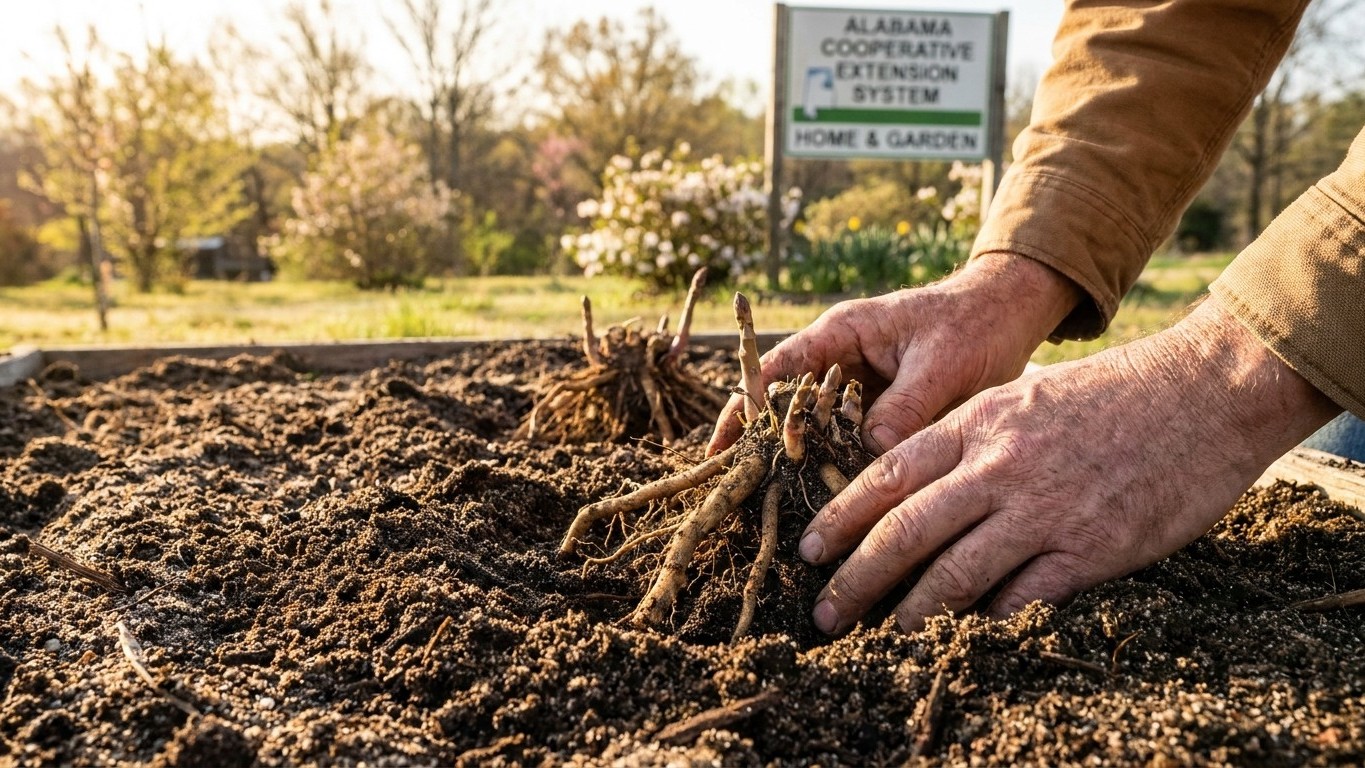

Plant asparagus crowns in Nova Scotia in early spring, once the ground has thawed and dried enough to dig an 8-inch furrow, roughly around the region’s average last frost date near May 7. That’s the planting window in one line. The real question a Nova Scotia gardener needs answered before crowns go in the ground is whether the soil under their feet drains well enough to host a bed that will sit in that same spot for a decade or more.
The short answer
Every asparagus guide says the same single sentence about soil: it must drain. Utah State University Extension, the only authority behind these numbers, doesn’t ask for a particular pH or a particular texture, just water that moves through instead of sitting still. That’s a low bar for most vegetables, planted and replanted every year. Asparagus is different. Once those crowns go into an 8-inch furrow, the bed stays put for 10 to 15 years before it’s worth digging up. A soil that’s merely inconvenient for a season of tomatoes becomes, under asparagus, a decision the gardener lives with for over a decade.
That makes Nova Scotia’s dominant ground worth a closer look before the shovel comes out. Data from Agriculture and Agri-Food Canada’s Canadian Soil Information Service puts the province’s most common mapped soil in the Podzol order, the acid, leached profile that forms under conifer forest, where decades of rain wash the calcium and other bases out of the topsoil and leave it sour. The median surface reading across the mapped agricultural components comes in at pH 5.2, strongly acid, with a texture close to loam (52 percent sand, 38 percent silt, 10 percent clay) and organic matter around 2.1 percent. None of that touches asparagus’s one real requirement. What does is the drainage class attached to that same profile: imperfectly drained.
Imperfectly drained doesn’t mean swampy, but it does mean water lingers longer in the root zone than a well-drained sandy loam would allow, especially where the surface flattens out or a hardpan sits underneath. For a crop planted for one season, that’s an amendment problem. For a bed that will not move again this decade, it’s worth testing before committing a location. If a dug hole still holds water after several hours, the fix isn’t a bag of compost worked into the topsoil once. It’s a raised bed or a mounded furrow that lifts the crowns above the water table permanently, because there’s no going back to re-grade the ground once the roots have spread.
Worth repeating: this provincial figure is a starting point, not a verdict on any one backyard. The survey behind it covers the mapped agricultural regions of Nova Scotia, not every acre, and a river bottom, a bog edge, or ground a builder has filled and graded will behave nothing like the median. A gardener’s own soil test, or a simple drainage test, settles the question a provincial average can only gesture at. Soil pH for asparagus itself isn’t published in the Utah State source at all, so no number is given here to chase.
Will the summer here water it for you?
An asparagus bed has a simple watering rule for its first two seasons: 1 to 2 inches of water every other week while the crowns establish, then a lighter 1 to 2 inches every three weeks once the fern is mature and rooted deep. Set that against what the Halifax Stanfield climate normals record for an average Nova Scotia summer, and the numbers land closer than a lot of new gardeners expect, though not close enough to ignore a rain gauge.
- June averages 3.79 inches of rain, spread, in a normal year, across roughly four weeks. Split into two-week blocks, that’s close to 1.9 inches every fortnight, right inside the 1-2 inch target for a young bed.
- July comes in at 3.76 inches, almost identical to June, so a bed in its second establishment summer is again riding close to what it needs without a hose.
- August is the driest of the three at 3.68 inches, and it’s also the month when heat and longer daylight push evaporation hardest. A fortnight’s worth of average August rain, roughly 1.8 inches, still sits inside the target range on paper, but a single dry week inside that month can leave the bed short even if the monthly total looks fine.
- Averaged across the season, 11.2 inches over June, July and August works out to a little under an inch a week, which tracks the bed’s need reasonably well on a per-month basis but says nothing about how that rain actually arrives.
- The number that doesn’t show up in a monthly normal is distribution. A summer thunderstorm can drop an inch in an afternoon and leave two weeks dry on either side. On Nova Scotia’s imperfectly drained Podzol soils, that pattern means water can pool right after a storm and then the bed can run short before the next one, so the safest habit is a rain gauge on the actual bed and a hose ready for any stretch of ten or more dry days, especially through the two establishment years before the roots run deep.
When to put the crowns in
Crowns go into the ground in early spring, as soon as the soil in Nova Scotia’s Podzol-heavy ground has thawed, dried enough to work, and can be opened into an 8-inch furrow without the walls collapsing. The nearest fixed point on the calendar is the region’s average last spring frost, recorded at around May 7 by the Environment and Climate Change Canada climate normals for the Halifax Stanfield station. That date is a mean, not a guarantee. In one year out of two, the last frost actually falls later than May 7, so treat it as the middle of a window rather than a green light. Waiting a week or two past that average date costs nothing with a crop that won’t produce a single spear this year regardless; pushing crowns into cold, still-wet ground to hit an arbitrary early date risks rot in soil that’s already imperfectly drained to begin with.
Once the crowns sit in the furrow, the covering isn’t a one-time job. Backfill happens gradually across the season, adding about 2 inches of soil back over the crowns every other month rather than filling the trench flat on planting day. That staged approach lets the emerging shoots push through loose ground instead of forcing their way up through several inches of compacted soil all at once.
Four named varieties come up in the Utah State University Extension guidance, and the source is specific about one thing only: their sex. Jersey Giant and Jersey Knight are all-male hybrids; UC 157 F1 and Purple Passion produce both male and female plants. Nothing is published there about flavor, yield, or a reason to favor one over another for a Nova Scotia bed, so there’s no ranking to pass along, only the sex of the plant.
Seed is the alternative to buying crowns, and it’s a slower route. Instead of a ready two-year-old root system going straight into the furrow, seed-grown plants need to be raised to transplantable size before they can go into a permanent bed at all. For a gardener without access to crowns, or simply curious about growing from seed, that’s the trade: more patience up front in exchange for not depending on a nursery’s crown supply.
Common questions
How soon can I harvest after planting asparagus crowns in Nova Scotia?
Not in the first year, and not in the second. Utah State University Extension is direct on this: asparagus isn’t harvested until the third year after crowns are planted. That first harvest is short, about 4 weeks, then extends to roughly 6 weeks the following year, then to about 8 weeks in following seasons once the root system is fully established. Skipping ahead and cutting spears early weakens the crown before it’s built the reserves to support years of future harvests.
How do I know when to stop cutting spears each season?
Not by counting weeks on a calendar. The rule is tied to the spear itself: stop harvesting once most of the spears coming up are thinner than a pencil. That thinning is the plant’s signal that it’s shifting energy toward growing fern for the rest of the season rather than pushing up harvestable spears, and cutting past that point year after year weakens the bed.
Does Nova Scotia’s acidic soil need to be adjusted before planting asparagus?
The Utah State University Extension guidance used for this bed doesn’t publish a pH requirement for asparagus at all, so no target number is given here. What is published is that the soil needs to drain well, which matters more in Nova Scotia than pH does, given the province’s dominant Podzol profile runs imperfectly drained. A soil test on the actual planting site is the way to find both numbers for a specific yard, since the provincial median of pH 5.2 describes the mapped agricultural region as a whole, not any one garden.
Does asparagus need a certain amount of winter cold to grow well in Nova Scotia?
That’s not answered in the source behind these figures. The Utah State University Extension guidance is silent on any winter chilling requirement for asparagus, so no chilling-hour figure is offered here, and none should be inferred just from Nova Scotia’s hardiness zone. What is established is the planting and harvest timeline, from crowns in the furrow to a first light harvest three years later.