
Yes, in most cases. Oklahoma’s state soil, the Port series, is a well-drained loam-to-silt that can carry an asparagus bed through its full 10 to 15 year run without the drainage problems that kill this crop early. But “state soil” describes a representative profile, not the ground under any one gardener’s feet, and the fifteen-year bet only pays off if the actual bed drains as well as that profile suggests.
The short answer
Asparagus is unusual among garden crops because the planting decision is not annual. Utah State University Extension notes that a bed, once established from crowns, produces for 10 to 15 years and that harvest does not even begin until the third year after planting. That is a long horizon to build on a guess. The source’s soil requirement is narrow but non-negotiable: the ground has to drain. Beyond that, USU Extension says most soils will do.
Oklahoma’s official state soil, the Port series, was named by state law in 1987 as part of the USDA NRCS State Soils program. Sampled across 93 representative components, its surface horizon runs 12 percent sand, 19 percent clay and 69 percent silt, a texture that lands squarely in the loam-to-silt range Extension services generally favor for root crops. Organic matter sits around 2.0 percent, typical of a working agricultural topsoil rather than a raw mineral subsoil or an undecomposed organic layer. Surface pH averages about 7.0, close to neutral, though the source behind the asparagus timeline is silent on pH preference, so that figure is background, not a target to chase. Most relevant here: NRCS classifies the Port series as well drained. That single word is the whole ballgame for a fifteen-year bed.
A well-drained loam-silt profile like Port lets water move through instead of pooling around the crown, which is exactly the failure mode that shortens an asparagus bed’s life. Standing water rots crowns regardless of how good the fertility numbers look.
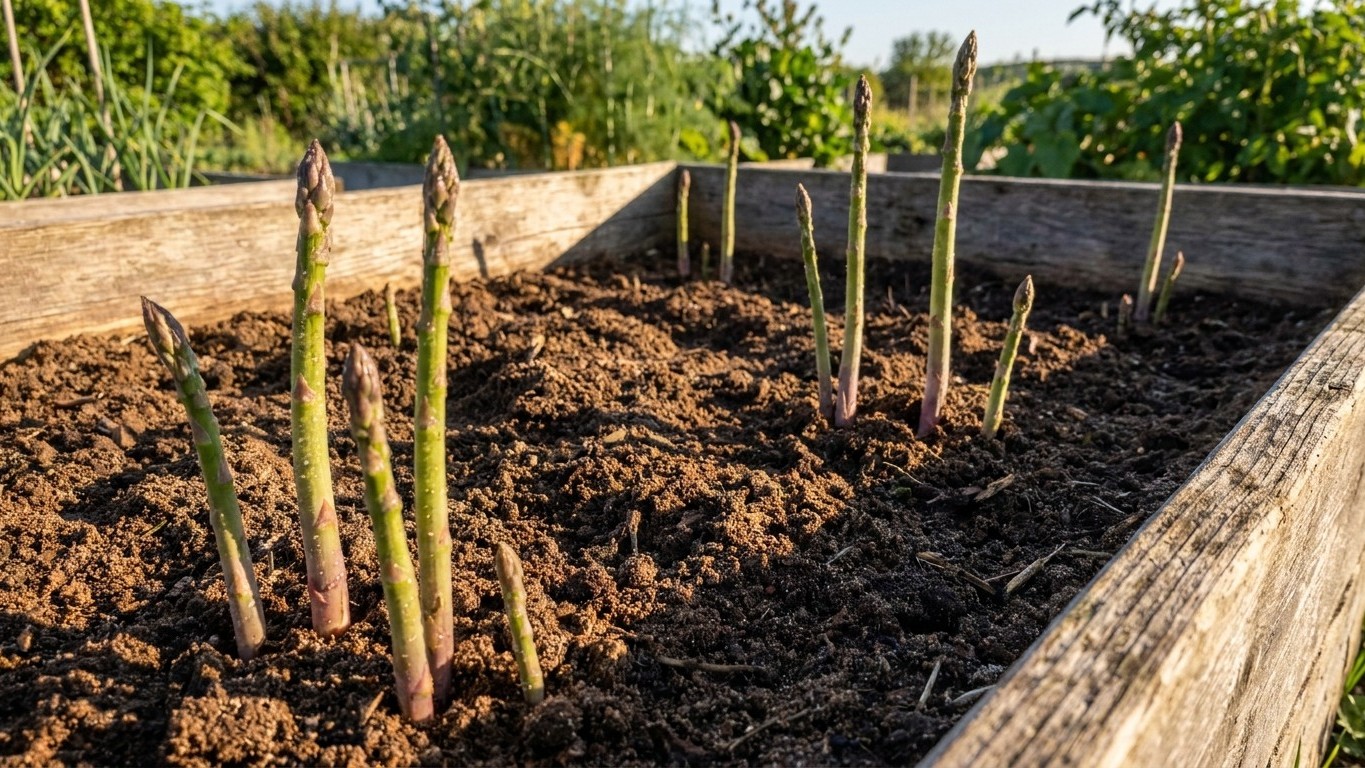
None of that is a diagnosis of any particular backyard. The Port series is what NRCS maps as representative of Oklahoma’s agricultural ground broadly, drawn from river-terrace and prairie landscapes across the Corn Belt’s southern edge. A lot filled by a builder, a low spot that collects runoff, or heavy clay trucked in during construction can behave nothing like it. The only way to know is a simple field test: dig a hole about a foot deep, fill it with water, and watch how long it takes to drain. If water is still sitting there after several hours, that spot is not ready for a fifteen-year commitment as-is. The fix Extension programs commonly point to is raising the bed, building a mounded or framed planting area 8 to 12 inches above grade so the crowns sit above the saturated zone even when the surrounding soil holds water longer.
Utah State University Extension names four varieties by sex alone, with no published data on flavor or yield differences between them:
| Variety | Sex type |
|---|---|
| Jersey Giant | All-male |
| Jersey Knight | All-male |
| UC 157 F1 | Male/female |
| Purple Passion | Male/female |
The source gives no reason to prefer one over another, so the drainage question, not the variety label, is what actually decides whether an Oklahoma bed makes it to year fifteen.
Will the summer here water it for you?
Utah State University Extension’s watering guidance for an asparagus bed is specific and changes over time: 1 to 2 inches of water every other week for the first two years, then every three weeks once the planting matures. NOAA’s 1991-2020 climate normals for the reference station give Oklahoma’s summer rainfall as follows.
- June: 4.49 inches recorded, against a target of roughly 2 to 4 inches for the month depending on which two-week cycle the schedule falls on. June is the one month where natural rainfall alone can plausibly cover the bed’s needs, assuming it falls in useful increments rather than one large event.
- July: 3.59 inches, the driest of the three summer months. Against the same 1-to-2-inch-per-cycle target, July still lands in range on paper, but summer rain in this region tends to arrive as thunderstorms rather than steady soaking, so a chunk of that total likely runs off instead of reaching the crown zone.
- August: 3.6 inches, essentially matching July. Combined, the three months total about 11.7 inches against a full year of 36.4 inches, meaning summer carries roughly a third of Oklahoma’s annual rain but arrives during the hottest stretch, when evaporation is working against every inch that falls.
The practical reading: Oklahoma’s summer rainfall totals look adequate on a monthly average, but averages hide the pattern that actually matters for a fifteen-year bed. A single storm dropping an inch and a half in twenty minutes does not soak a loam-silt profile the way a slow, even rain does, and weeks can pass between storms during a dry stretch even inside a wet month. A rain gauge staked next to the bed is the only way to know whether the two-week or three-week cycle has actually been met, and a garden hose or drip line should fill the gap on any cycle where it has not. Treating the NOAA normals as a guarantee, rather than a long-run average for one reference station, is the mistake that leaves a bed underwatered during a dry July even in a state whose seasonal totals look reasonable on paper.
When to put the crowns in
Utah State University Extension’s instructions are straightforward on method and vague, deliberately, on exact timing: crowns go into furrows about 8 inches deep in early spring, and the furrow is not filled in all at once but backfilled gradually, roughly two inches every other month across the first growing season as the new growth pushes up. The gradual fill protects tender shoots while still letting the crown settle into full planting depth by year’s end.
Anchoring “early spring” to Oklahoma’s actual climate means looking at frost risk rather than a calendar date. NOAA’s 1991-2020 normals put the reference station’s last spring freeze, using the 32F threshold, somewhere in the window around March 28 to April 10. That is a probability band, not a fixed day, built from three decades of station data, and it should be read as around late March to early April rather than a hard line to plant against. Suburban and rural gardens away from the airport station that generated this figure typically see their last frost land later, sometimes by a week or two, and gardens at higher elevation later still. The safer read for most Oklahoma gardeners is to treat mid-April as a reasonable planting target and to watch local conditions rather than counting days on a calendar.
Crowns are the faster route to that first, distant harvest, since they are already a year or more old when planted and shave time off the wait. Seed is the alternative Extension programs mention, started indoors and transplanted out once frost risk has passed, but it adds a full growing season before the plant reaches crown-planting size, pushing the eventual harvest date back accordingly. For a bed meant to produce for up to fifteen years, that extra season barely registers against the long run, but for a gardener eager to reach year three’s first cutting, crowns remain the quicker path.
Whichever start is used, the first harvest is fixed regardless: none in year one, none in year two, and only in year three does cutting begin, starting at roughly four weeks of harvest and lengthening in subsequent years to six, then eight weeks as the crowns mature. The stopping point each season is not a date but a condition: harvest ends when most spears coming up are thinner than a pencil, a sign the plant needs to redirect its energy into building next year’s crown rather than feeding another cutting.
Common questions
Does Oklahoma’s neutral soil pH mean asparagus will thrive without adjustment?
The Port series surface pH runs about 7.0, near neutral, but the Utah State University Extension guidance behind the fifteen-year timeline is silent on pH preference entirely. That figure describes the state soil’s chemistry, not a documented requirement for asparagus, so it should not be treated as a target either way.
Can a raised bed fix a soil that does not drain well?
Raising the planting area above the surrounding grade is a common way gardeners work around slow-draining ground, since it lifts the crown zone above where water tends to sit. It does not change the soil’s texture, but it changes where the crown sits relative to standing water, which is the failure point for a bed meant to last over a decade.
Is there a published winter chilling requirement for asparagus in Oklahoma?
No. The Utah State University Extension source used here covers planting depth, spacing, watering and harvest timing, but it does not address winter chilling hours, and the state’s hardiness zone should not be converted into a chilling figure that no cited source actually provides.
Should a gardener test their own soil before planting a bed meant to last fifteen years?
Yes. The Port series figures describe NRCS’s representative sampling of the state soil, not any individual yard, and features like fill dirt, compaction from construction, or a low-lying lot can produce drainage and texture nothing like the state average. A simple drainage test, and ideally a soil test through a local extension office, is the only way to know what is actually under a specific bed.