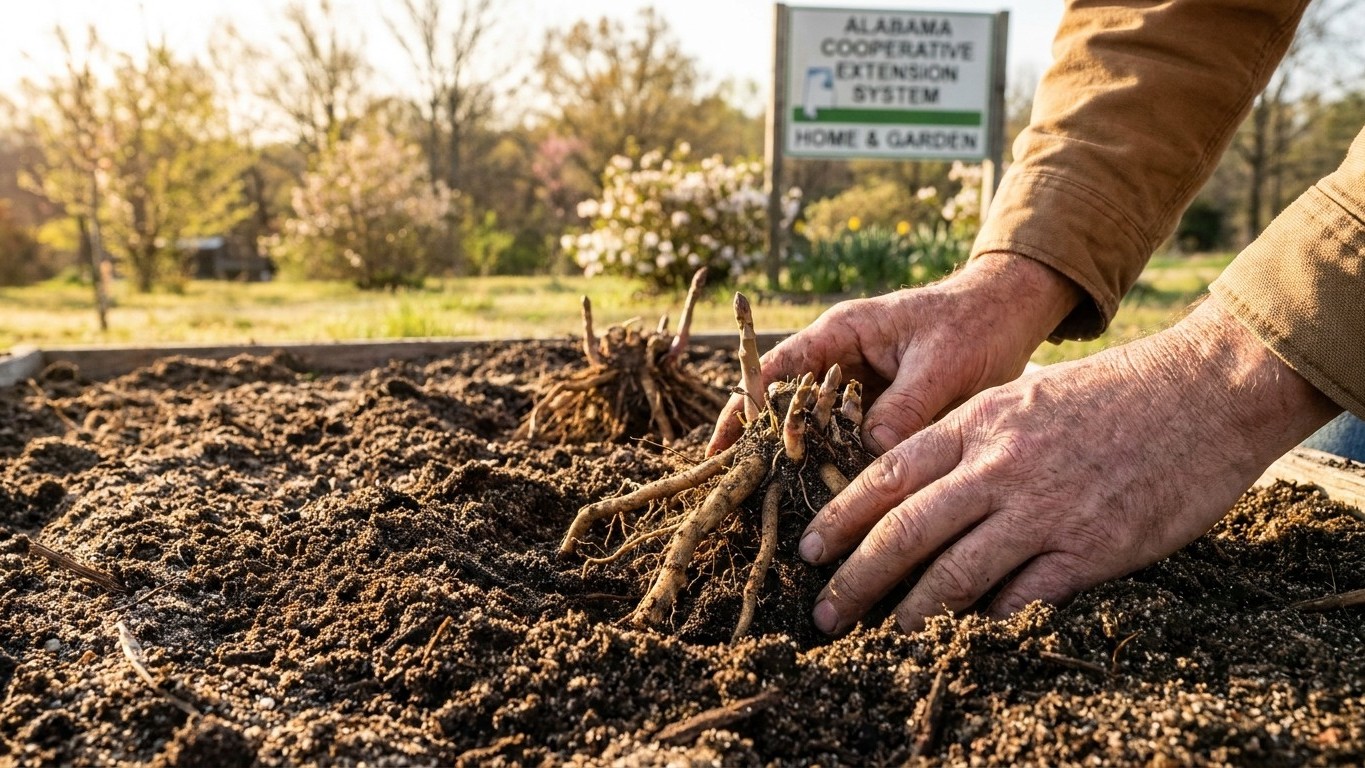

Early spring is the answer, timed to when the ground has dried enough to work rather than to a fixed date on the calendar. In the Toronto area that usually falls around late April, close to the mean last frost of April 30. Crowns go into 8-inch furrows and won’t yield a single spear for three years, then keep producing for 10 to 15 more. That long horizon is what should really shape the planting decision here.
The short answer
Ten to fifteen years. That’s how long an asparagus bed stays in one spot once the crowns go in, and it’s the number that should frame every other decision, including the date. Utah State University Extension, the source behind the planting method used on this site, makes only one demand of the soil: it has to drain. No pH target, no fertility threshold, nothing about winter chilling. Just drainage, because a crown sitting in standing water for fifteen years is a slow-motion failure, not a fixable annual problem.
So does Ontario’s ground clear that bar? The dominant mapped soil across the province’s agricultural regions is a Luvisol, a forest-derived soil where clay has washed down out of the topsoil into a denser subsoil layer below. It covers 39 percent of the mapped surface, more than any other soil order, and its texture runs loam to silt: 43 percent sand, 17 percent clay, 41 percent silt, with organic matter around 4.3 percent in the surface layer. Agriculture and Agri-Food Canada’s Soil Information Service classes that surface layer as well drained. That’s a workable starting point for a bed that has to sit undisturbed for over a decade.
But a provincial median is not a soil test for one backyard. The second most common order mapped in Ontario is Gleysolic, a wetter, poorly drained profile typical of low spots and old wetland ground, and it shows up often enough that plenty of Ontario properties sit closer to that end of the spectrum than to the Luvisol median. River bottoms, low-lying clay pockets, and anywhere a house pad was scraped or filled will behave nothing like the survey average, no matter what the provincial number says.
What to do if the spot doesn’t drain
The fix isn’t complicated, but it has to happen before the crowns go in, not after. Water that pools an hour after a hard rain, or a spade that comes out of the ground caked and sticky rather than crumbly, is the signal to build up rather than dig down: a raised bed or a mounded row lifts the crowns above the slow-draining layer entirely. Working several inches of compost or aged organic matter into a wide planting strip helps too, though on genuinely heavy ground it’s a supplement to raised planting, not a substitute for it. None of this is a one-season chore to repeat every spring the way it might be for a bed of annual vegetables. Get the drainage right once, because this crop doesn’t give a gardener a second chance to move it in year four.
Will the summer here water it for you?
Not entirely, and the shortfall changes depending on the age of the bed. Utah State University Extension’s watering guide asks for 1 to 2 inches of water every other week through the first two growing seasons, then eases off to roughly every three weeks once the roots are established. Line that against what a Toronto-area summer actually delivers and the gap becomes concrete rather than abstract.
- What the bed asks for in years one and two: 1 to 2 inches every other week works out to somewhere around 2 to 4 inches of water across a typical month, delivered in a fairly steady rhythm rather than all at once.
- What the sky provides: Environment and Climate Change Canada’s 1981-2010 normals for the Toronto Lester B. Pearson station put summer rainfall at about 8.9 inches total across June, July and August, broken down as 2.81 inches in June, 2.98 in July and 3.07 in August. June, the driest of the three, sits right at the low edge of what a young bed needs and sometimes below it.
- Why the average still misspends the water: normals describe a season, not a week. A month’s worth of rain arriving as two heavy thunderstorms rather than a steady drizzle means much of it runs off a clay-heavy surface instead of soaking down to the roots, so the monthly total can look adequate on paper and still leave a young bed thirsty by the middle of a dry stretch.
- What that means for a gardener: during the first two seasons, a rain gauge on the actual bed, not the regional average, is what decides whether supplemental watering is needed that week. Once the bed matures and the requirement drops to roughly every three weeks, an average Ontario summer is doing more of the work on its own.
The takeaway isn’t that Ontario is a dry-summer province, it isn’t, but that averages smooth over the dry stretch inside a wet season, and a bed that has to survive fifteen years shouldn’t be planned around the smoothed number alone.
When to put the crowns in
Crowns go into the ground in early spring, as soon as the soil is workable rather than waterlogged from snowmelt. In the Toronto area that timing sits around the mean last spring frost of April 30, though that date is an average, not a guarantee. Environment and Climate Change Canada’s own figures mean that in roughly one year out of two, frost arrives later than April 30, sometimes well into May. Treat the date as the middle of a window, not a green light, and let the condition of the soil, not the calendar page, make the final call.
The planting method itself is straightforward: dig an 8-inch furrow, set the crowns in with roots spread out, and cover them with only a couple of inches of soil at first. The rest of the furrow gets filled in gradually over the course of the year, adding roughly two inches every other month rather than burying the crown all at once. That staged backfilling gives the emerging shoots room to push through without being smothered early, and it’s a detail worth not skipping even though it stretches a single planting task across several visits to the bed.
Seed is the other route, and it exists as a real alternative rather than a fallback for gardeners who can’t find crowns. Starting from seed simply adds a year or more onto an already long timeline before the first harvest, since seedlings need to grow to transplant size before they go into the permanent bed. Either way, the harvest clock doesn’t start ticking early: no spears get cut in year one or year two regardless of planting method, and the first harvest doesn’t come until year three.
Once that third year arrives, harvest still starts modestly. The guide calls for cutting spears for about 4 weeks the first harvest year, extending to about 6 weeks the year after, then up to 8 weeks in following years. The stopping point isn’t a date circled on a calendar either: harvest ends for the season once most of the spears coming up are thinner than a pencil, a physical signal that the crown’s energy reserves need to go back into building foliage rather than more cuttable spears.
On variety, Utah State University Extension names four: Jersey Giant and Jersey Knight, both all-male varieties, and UC 157 F1 and Purple Passion, both male/female. The source doesn’t rank them by flavor, yield, or suitability for any particular garden, and no nursery is named here either. The choice among these four, as far as the published information goes, comes down to availability rather than a documented reason to prefer one over another.
Common questions
Can asparagus crowns go in the ground before the last frost date?
Crowns are planted in early spring timed to workable soil rather than to a specific frost-free guarantee, and the mean last frost for the Toronto area sits around April 30. Because that date is an average, waiting for soil that’s dry enough to dig, rather than racing a calendar date, is the more reliable cue.
Does Ontario’s soil need to be amended before planting asparagus?
The dominant provincial soil profile is described as well drained, which meets the one condition the source sets. But that’s a provincial median, not a test of any individual yard, and low-lying or heavy clay ground common in wetter pockets of the province may need raised planting rather than in-ground amendment alone.
How much should an Ontario asparagus bed be watered in its first two years?
The target is 1 to 2 inches every other week. Toronto-area summer rainfall averages close to that on a monthly basis, but arrives unevenly, so checking an actual rain gauge on the bed rather than relying on the seasonal average is the safer approach through the establishment years.
When is the first asparagus harvest after planting crowns?
Not until year three, and even then only for about 4 weeks. Harvest extends to roughly 6 weeks the following year and up to 8 weeks after that, and each season’s cutting stops once most of the spears coming up are thinner than a pencil.