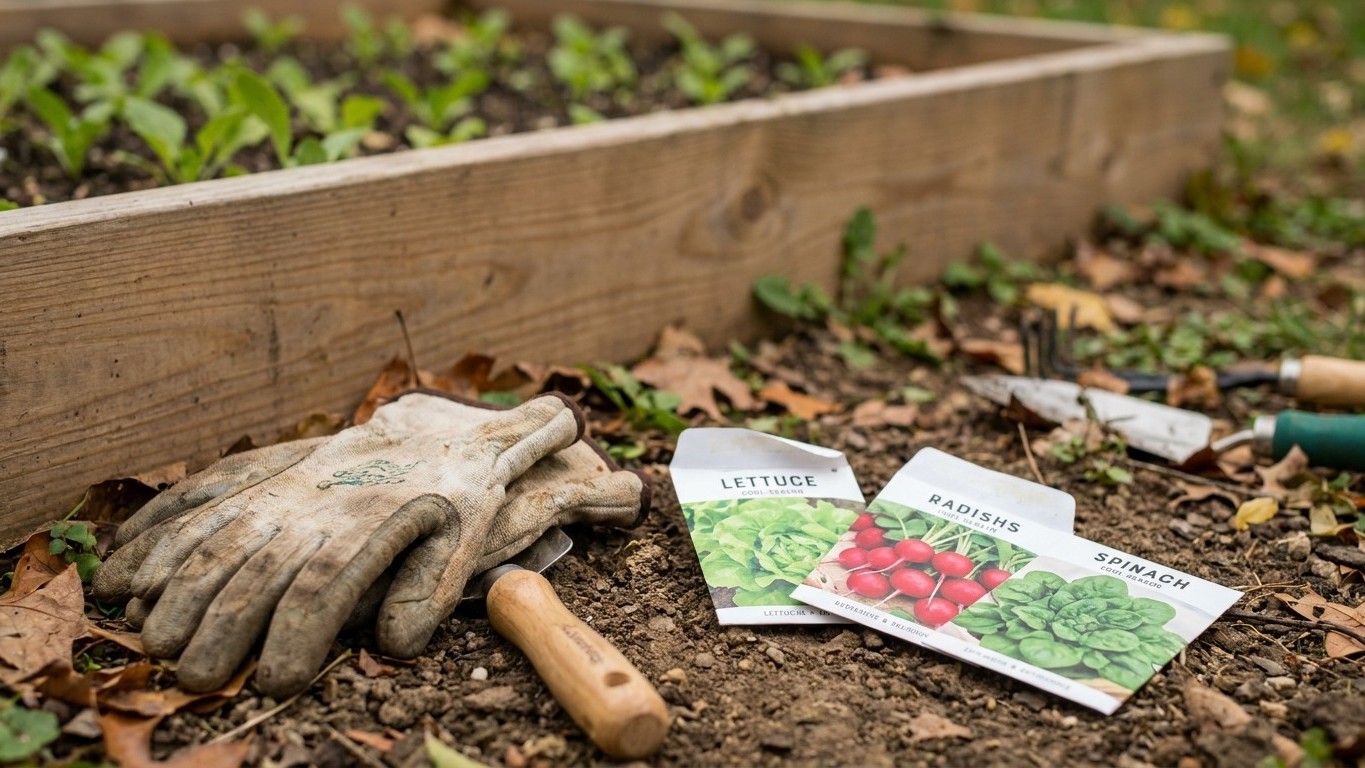

September in Ontario still belongs to the growing season more than to the shutdown. With the average first fall frost landing around October 16, most of the province has roughly six weeks left to fill the garden with fast, cool-tolerant crops, finish the harvest, and set up next year’s beds before the ground closes for the season.
What goes in the ground in September

The six-week runway before the average frost date is real, but it only works for crops that mature fast or actually prefer cooling soil. Soil temperature, not the calendar, decides what germinates reliably now: warm-season seeds like beans or squash will sit and rot in soil that’s dropping through the 60s, while radishes, spinach, and mustard greens germinate happily in the same conditions.
Direct-sowing quick greens is the safest bet this month. Arugula, mesclun mixes, spinach, and radishes can all go from seed to table before the average frost arrives, and several of them shrug off a light frost once they’re established. Turnips sown early in the month have just enough time to size up. Garlic and shallots belong in the ground too, though most Ontario growers wait until the soil has cooled further, often into October, before tucking in cloves for next summer.
Here’s how the arithmetic works against the October 16 average:
| Crop | Days to maturity | Latest safe sowing (working back from Oct. 16) |
|---|---|---|
| Radish | 25-30 | Late September |
| Arugula | 30-40 | Mid-September |
| Spinach | 40-45 | Early September |
| Turnip (greens or roots) | 35-55 | Early September |
Remember the caution built into that October 16 figure: it’s a mean from Environment and Climate Change Canada’s 1981-2010 normals for the Pearson Airport station, not a guarantee. In roughly half of all years, frost arrives later than that date, but it can just as easily arrive earlier. Treat it as the midpoint of a window, not a finish line, and push your last sowings toward the earlier end of these ranges if your garden sits somewhere colder than the Toronto area, such as an inland valley or a higher-elevation county.
What to start under cover
Starting seeds under cover in September is less about beating frost and less about the calendar date, and more about beating shortening daylight. A lettuce or spinach transplant started indoors or under a cold frame in early September still has enough light to bulk up before growth slows in October, but wait two extra weeks and the same seedling stalls half-grown.
The arithmetic is the same backward-counting exercise as outdoor sowing, just shifted a few days earlier because transplants need time to establish after they move outside. Take a leafy green needing 40 days to maturity: start it under cover by the first days of September, move it out under a row cover or cold frame around two weeks later, and it should still finish before growth grinds to a halt with the shorter days of late fall. Push the start date to mid-month and there’s a real chance it never fully matures before cold and darkness stop it.
Two mistakes show up every fall. The first is starting too early, back in high summer, which leaves gardeners with leggy, rootbound seedlings sitting in trays with nowhere to go because outdoor beds are still full of summer crops. The second is starting too late, trusting that “there’s still time before frost” without accounting for the fact that daylight, not just temperature, is what shuts fall growth down. A cold frame or a simple row cover buys extra weeks on both ends, but it doesn’t buy extra sunlight.
What is ready to pick
September is the busiest harvest month of the year in Ontario, with summer crops finishing at the same time fall crops are just hitting their stride. Tomatoes, peppers, and cucumbers are still producing early in the month, though their pace slows noticeably as nights cool. Sweet corn should be picked as soon as the silks turn brown and dry while the husk stays green, and it doesn’t hold well once ready, so check plantings every couple of days rather than waiting for a convenient afternoon.
Winter squash and pumpkins are a September signature crop. They’re ready when the rind resists a fingernail scratch and the stem has started to dry and turn woody; picking too early means poor storage and a squash that shrivels within weeks rather than months. Apples follow a similar logic: a slight twist should release the fruit easily from the branch when it’s ready, and skin color shifting away from solid green is a better clue than the date on a calendar.
Beans, both snap and dry, keep producing through September if picked regularly, since letting pods mature fully on the vine signals the plant to stop flowering. Fall brassicas like broccoli side shoots and early cabbage heads may also be ready depending on when they went in during summer. For anything stored from earlier harvests, garlic, onions, and any potatoes already dug, this is a good month to check the storage area for soft spots or sprouting before a single bad bulb spreads rot through the whole bin.
The jobs that matter this month

September rewards gardeners who treat it as setup work for the next several months, not just a harvest month to coast through. Soil preparation tops the list: beds emptied of spent summer crops can be amended with compost now, while the soil is still workable and before fall rains turn heavy clay into something closer to modeling clay. Waiting until November means fighting wet, cold ground for the same job.
Mulching newly seeded fall greens helps regulate the swinging temperatures typical of this month, warm afternoons followed by genuinely cool nights, and it also suppresses the last flush of weed seeds trying to germinate before frost. Staking still matters for anything still producing, since heavy September dew and the season’s first real winds can snap unsupported tomato or pepper branches loaded with fruit.
Watering rhythm needs adjusting rather than abandoning. Days are shorter and evaporation has slowed, so beds that needed water every two days in July might only need it weekly now, but newly sown fall greens still need consistent moisture to germinate. Succession sowing of the fastest greens, radishes and arugula especially, can continue in small batches right up until the point where the arithmetic from the section above stops working.
Pest scouting shouldn’t stop just because the season feels like it’s winding down. Squash vine borer damage often shows up clearly in September as vines suddenly wilt, and cabbage moth caterpillars keep working on brassicas until a hard freeze. This is also the window to start ordering seed for crops with long lead times or popular varieties, since the best selections at seed suppliers tend to sell out well before spring planting season begins.
What not to do in September
The most common September mistake is trusting a warm afternoon over the soil thermometer. Air temperature in the 70s doesn’t mean the soil has warmed to match, and planting warm-season transplants like peppers or basil now almost always ends in stunted growth or an early death when the first cool night arrives. If it’s warm-season, this month is for harvesting it, not starting it.
A second mistake is feeding nitrogen-heavy fertilizer to perennials, shrubs, or lawns late in the month. Nitrogen pushes soft, leafy new growth, and that new growth has no time to harden off before the cooler nights of October and the average frost arrive. The result is tender growth that dies back and can weaken the whole plant heading into dormancy. If feeding is needed at all this time of year, a lower-nitrogen, higher-potassium approach supports root and hardiness development instead.
A third mistake is treating the October 16 average frost date as a safe deadline rather than a midpoint. Because frost falls later than that average in roughly half of all years, gardeners who assume they’re clear right up to that date sometimes get caught out by an earlier cold snap, especially in low-lying or inland areas that run cooler than the Toronto-area station this figure comes from. Keep a row cover or old sheet on hand through the whole month rather than waiting for a frost warning to go shopping for one.
Checking this against your own county
A province-wide frost date and hardiness zone are a starting point, not a personal forecast. Ontario stretches from the moderating influence of the Great Lakes in the south to colder inland and northern districts, and elevation alone can shift a local frost window by a couple of weeks in either direction. The reference hardiness zone of 7a cited here, using Natural Resources Canada’s system built on seven climate variables rather than the single-variable USDA approach, applies to the reference city behind that figure, not to the whole province.
For local planting windows and crop guidance specific to your county, the Ontario Ministry of Agriculture, Food and Rural Affairs is the place to check before locking in a September planting plan.
Common questions
Is it too late to plant a vegetable garden in Ontario in September?
Not for fast-maturing crops. Radishes, arugula, spinach, and turnip greens can all still reach harvest before the average frost around October 16, though anything needing more than about 45 days is cutting it close.
Can I still plant garlic in September in Ontario?
Garlic can go in during September in some areas, but most Ontario growers wait until the soil has cooled further, typically into October, so the cloves don’t sprout excessive top growth before winter.
What is the average first frost date in Ontario?
Based on Environment and Climate Change Canada’s 1981-2010 normals for the Toronto Pearson Airport station, the average first fall frost falls around October 16. It’s a midpoint, not a guarantee, since frost arrives later than that date in about half of all years and can arrive earlier too.
Should I fertilize my garden in September?
Avoid heavy nitrogen feeding this month. It encourages soft new growth that won’t harden off before frost. A lower-nitrogen amendment or simply adding compost supports the soil without pushing vulnerable growth.
Gardeners who plant by the Moon can check the September 2027 moon planting calendar, a tradition rather than a proven method.