
The short window for planting asparagus crowns in Quebec sits around early spring, anchored to an average last frost date of May 6. That’s not a hard deadline, just the midpoint of a spring that swings earlier or later depending on where in the province you garden. What actually decides whether that planting succeeds, though, has less to do with the calendar and more to do with what’s under your boots.
The short answer
Asparagus is a fifteen-year decision disguised as a vegetable. Once crowns go into the ground, the bed isn’t harvested until year three, then produces for another 10 to 15 years after that, first for four weeks, then six, then eight, expanding each season until you stop cutting whenever most of the spears coming up are thinner than a pencil. There’s no relocating an asparagus bed halfway through that run without starting the whole clock over. That’s why the only soil requirement that matters, according to Utah State University Extension, is drainage. Not fertility, not a particular texture — just water that moves through and doesn’t sit.
So does Quebec’s ground drain? The province’s most common mapped soil is a Podzol, the acid, leached profile that forms under conifer cover as rain strips bases out of the topsoil, and it accounts for 36 percent of the mapped agricultural surface, ahead of Gleysolic soils in second place. According to the Canadian Soil Information Service’s survey of 248 mapped soil components, that dominant Podzol runs loam to silt (51 percent sand, 15 percent clay, 34 percent silt), carries about 6.2 percent organic matter, and is classified as well drained. For a fifteen-year crop, that’s a genuinely encouraging baseline, a well-drained, moderately sandy profile is close to what asparagus wants.
But a provincial median is a starting point, not a verdict on your backyard. The survey covers the agricultural regions of Quebec, not the far north, and it says nothing about the low spot behind your garage, the clay a builder left after grading, or the muskeg edge some rural lots back onto. River bottoms and low ground can hold water for days after a soil like this would have shed it. If a shovel test after rain shows standing water or the soil stays greasy and dark well past when neighboring ground has dried, don’t fight it for fifteen years. Build a raised bed or a mounded row 8 to 10 inches high instead, and mix in coarse organic matter to open up the structure. That single adjustment, made before crowns go in the ground, is far cheaper than trying to fix drainage under an established bed five years later.
Will the summer here water it for you?
An asparagus bed asks for 1 to 2 inches of water every other week through its first two seasons, then eases to about every three weeks once established. Quebec’s summers don’t quite hand that over on their own, so here’s how the math actually breaks down.
- What the bed asks for: Roughly 1 to 2 inches, delivered every 14 days for two years, then stretched to roughly every 21 days after that, call it somewhere between 2 and 4 inches a month in the early going.
- What the region delivers: Environment and Climate Change Canada’s 1981-2010 normals for the Montreal/Pierre Elliott Trudeau station put summer rainfall at about 10.6 inches across June, July and August combined : June the driest at 3.42 inches, July at 3.52, August at 3.71.
- Do the monthly math: Averaged out, that’s a little under 3.6 inches a month of rain across the summer, which lands close to the upper end of what a young bed wants but arrives as scattered rain events, not on the tidy two-week schedule the plant actually needs.
- Why the average still misleads: A single thunderstorm that drops an inch in twenty minutes mostly runs off rather than soaking down to new roots, and any stretch of 90-degree days pulls moisture out of the topsoil faster than a normal week would. The monthly total can look adequate and the bed can still dry out between storms.
- What that means for the gardener: Track rainfall with a simple gauge on the bed itself rather than trusting the seasonal average, and plan to supplement with a hose or drip line during any stretch of 10 days or more without a soaking rain, especially in June, the driest month on the books and the one right after spring planting when new crowns have the least root reserve to fall back on.
When to put the crowns in
Crowns want to go into the ground in early spring, once the soil has dried out enough to work without turning into mud under a shovel. For the Montreal/St-Hubert area, that timing sits around the average last spring frost date of May 6, and it’s worth being blunt about what “average” means here: this is a mean drawn from the 1981-2010 Canadian Climate Normals, not a guarantee. In roughly half of all years, frost has actually arrived later than that date, so treat May 6 as the middle of a window rather than the green light itself. Gardeners farther north or at higher elevation than the reference station should expect that window to land later still, sometimes by weeks.
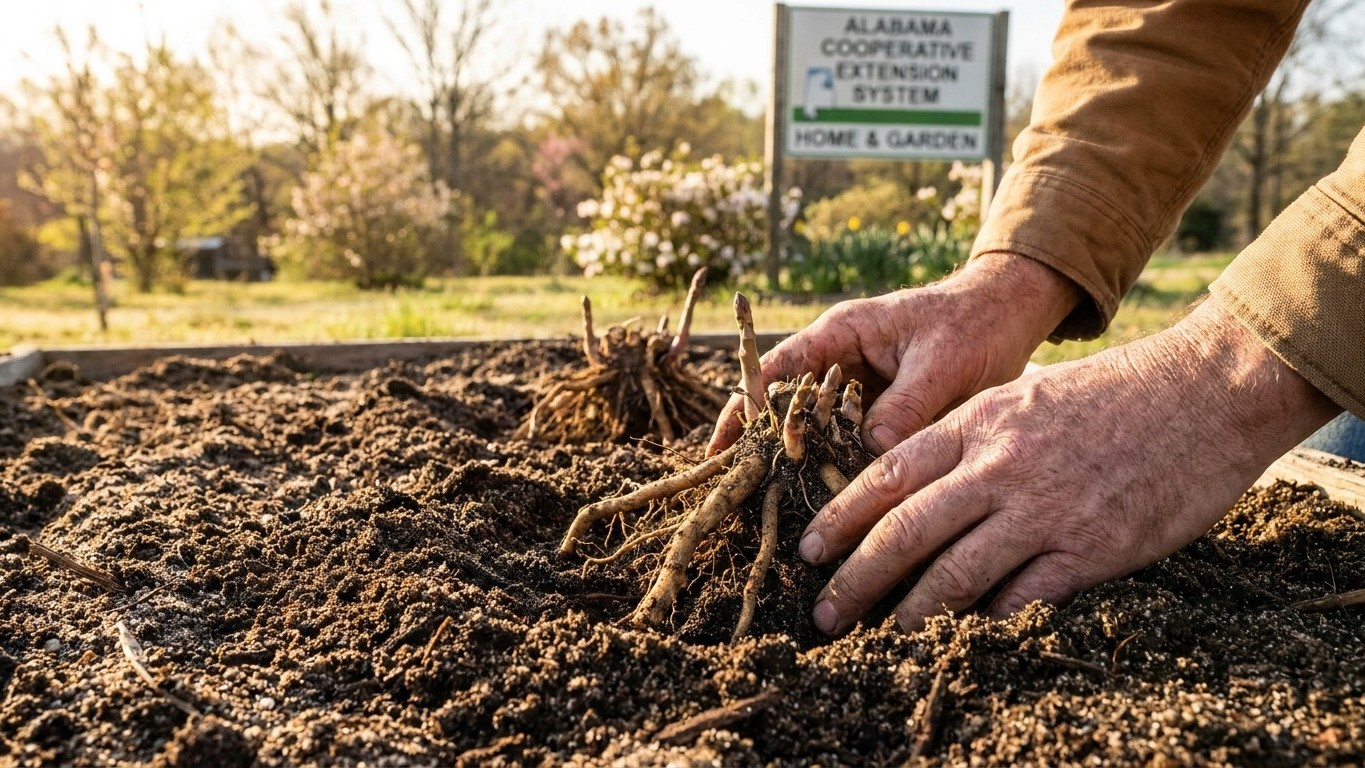
The planting method itself follows the same logic across most of the continent: crowns go into furrows about 8 inches deep, spaced out along the row, and covered gradually rather than all at once. Backfill the furrow in stages, adding roughly 2 inches of soil every other month across the season as the emerging shoots grow, rather than burying the crown under a full 8 inches on day one. That staged approach lets new growth keep pushing toward light instead of struggling under a deep layer of soil it has to fight through immediately.
Seed is the other route in, and it’s a legitimate one, but it changes the timeline more than most gardeners expect. Starting from seed means growing your own crowns before you ever get to the point crown-planting starts from, which pushes the entire project back by a full growing season compared to buying crowns and putting them straight into an 8-inch furrow. For a crop where the payoff is already three years out before the first harvest, most home gardeners in Quebec choose crowns for exactly that reason: it’s the shorter of two long waits.
Common questions
Can I plant asparagus in clay soil in Quebec?
Only if that clay drains. The province’s dominant mapped soil profile is a well-drained Podzol, but heavier clay pockets do exist locally, particularly in low-lying or river-bottom ground. If water stands after a rain or the soil stays wet for days, raise the bed rather than planting into standing clay, asparagus’s one non-negotiable requirement is drainage, and there’s no published workaround for a bed that stays soggy.
Do I need to test my soil pH before planting asparagus?
The Utah State University Extension source used here is silent on any pH requirement for asparagus, so no target number is published for this crop. What is known is that Quebec’s dominant agricultural soil runs a median surface pH of about 5.5, slightly acid, worth knowing about the region generally, but not a substitute for testing your own plot before committing a bed you won’t move for over a decade.
How long until I can harvest asparagus planted in Quebec?
No harvest at all in the first two years. Cutting starts in year three, and even then it’s limited: about four weeks of harvest that first cutting year, expanding to six weeks, then eight weeks in the years after. Regardless of the calendar, the rule for when to stop each season is the same every year, stop cutting once most of the spears coming up are thinner than a pencil.
Which asparagus variety should I plant?
The Utah State University Extension source names four: Jersey Giant and Jersey Knight, both all-male varieties, and UC 157 F1 and Purple Passion, both male/female. That source doesn’t publish flavor, yield or regional-suitability differences between them, so no variety is recommended over another here. All four share the same drainage requirement and the same three-year wait before harvest.