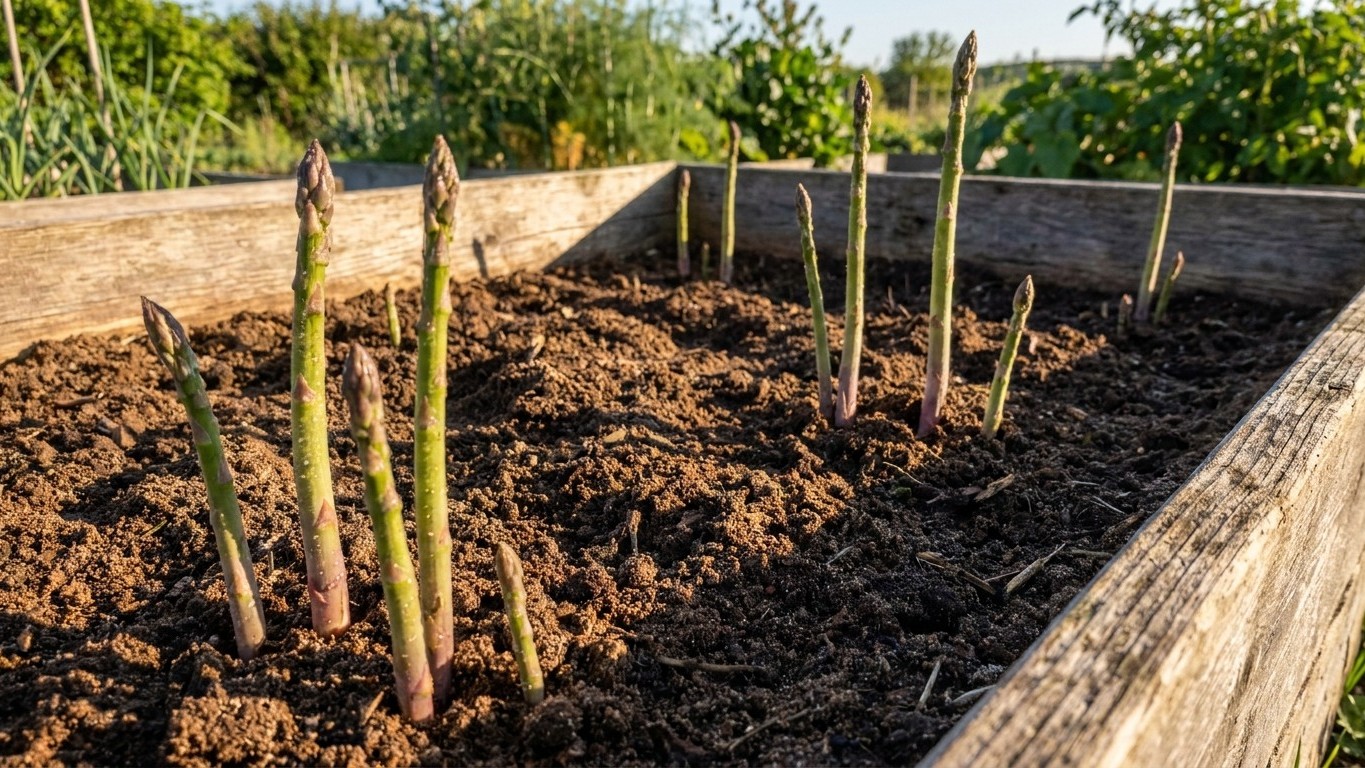

Rhode Island’s representative soil, the Narragansett series, drains well enough to carry an asparagus bed through its full 10 to 15 year run. That’s the one condition Utah State University Extension attaches to this crop: most soils work, provided they drain. The state figure isn’t a guarantee for every yard, though, and what happens below the surface over the next decade matters as much as what’s true on planting day.
The short answer
USDA NRCS lists the Narragansett series as the soil representative of Rhode Island, and its surface horizon reads as loam to silt: 34 percent sand, 6 percent clay, 60 percent silt, with organic matter around 4.0 percent. Classified as well drained, it’s exactly the texture asparagus tolerates well. Utah State University Extension puts it plainly: crowns go into an 8-inch furrow, the plant sits untouched until year three, and from there it produces for a decade and a half. Almost any soil handles that timeline as long as water moves through it instead of sitting on top of the roots.
The Narragansett series is also young, an Inceptisol that hasn’t developed strong horizons yet, and its surface tests strongly acid at roughly pH 5.3. Utah State University Extension’s guidance on asparagus doesn’t set a pH target, so there’s no published number to chase here, and this article won’t invent one. What can be said is that a strongly acid reading is a flag worth checking with a home soil test before crowns go in the ground, since a fifteen-year planting isn’t the place to guess.
Why the state figure isn’t your garden’s figure
A state soil series is a composite drawn from many sampled sites across the state, not a reading from any single backyard. Rhode Island runs from coastal terraces to hill country to the fill dirt around a newer subdivision, and a builder’s grading work can leave compacted subsoil that behaves nothing like the mapped surface horizon. Treat the Narragansett numbers as a regional tendency, well drained, moderately acid, loam to silt, and confirm the specific plot with a shovel test: dig a hole, fill it with water, and see how fast it disappears. If it’s still standing after an hour, that’s a poorly drained spot, and asparagus crowns there will rot before they ever reach a third-year harvest. The fix isn’t complicated. A raised bed or a mounded row lifts the crowns above a slow-draining subsoil, and that single adjustment turns a marginal site into a workable one for the full fifteen-year run.
Will the summer here water it for you?
Utah State University Extension’s watering guidance for a young asparagus bed is specific: 1 to 2 inches every other week for the first two growing seasons, then a lighter schedule of the same amount every three weeks once the crowns are established. Rhode Island’s summer, based on three decades of NOAA climate normals from the state’s reference station, delivers about 10.3 inches across June, July and August combined, with June the wettest month at 3.81 inches, August close behind at 3.59 inches, and July the driest stretch at 2.91 inches.
- Years one and two: the bed asks for roughly 2 to 4 inches every two weeks, which lines up reasonably well with June and August rainfall totals but runs short in July, the month that averages under 3 inches for the entire 31 days. A gardener following the every-other-week schedule will likely need to supplement during July in most years, and possibly during a dry stretch in either of the other two months.
- Year three onward: once the schedule eases to every three weeks, the same monthly totals cover the requirement more comfortably, though a rain gauge on the actual bed is the only way to know for certain in a given season.
- What the rainfall total doesn’t show: a summer thunderstorm can dump an inch in twenty minutes and much of it runs off before it soaks past the root zone, so a monthly total that looks adequate on paper can still leave the bed dry between storms.
- What the soil adds to the equation: the Narragansett series’ silt-heavy texture holds moisture better than a sandy soil would, which works in the gardener’s favor during a light rain month like July, but a garden with a sandier or more compacted profile will dry out faster than these regional averages suggest.
None of this is a forecast for any single yard. It’s a normal, drawn from three decades of station data, describing what the region tends to deliver. A gauge staked next to the asparagus row settles the question far better than any regional average can.
When to put the crowns in
Crowns go into the ground in early spring, and for Rhode Island that window sits around the state’s mean last spring frost date, which the same NOAA reference station places between April 7 and April 17. That’s an average drawn from three decades of freeze probability data at one airport station, not a fixed calendar date, and a suburban or rural yard away from that station often sees its last frost run one to two weeks later, more at elevation. Check a county-level frost record before committing crowns to the furrow.
The furrow itself isn’t backfilled all at once. Utah State University Extension’s method calls for filling it in gradually, adding about 2 inches of soil every other month across the first growing season, rather than covering the crown completely on planting day. That staged approach lets the emerging shoots keep reaching sunlight as the trench fills in behind them.
The three-year wait, and what comes after
No spear gets cut in year one or year two, full stop. Utah State University Extension is direct about this: the plant needs that time to build a root system strong enough to support repeated cutting. Year three brings the first harvest window, roughly 4 weeks long. That window extends to about 6 weeks the following year, then to about 8 weeks once the bed is fully mature. The stopping point each season isn’t a date on the calendar, either; it’s a visual cue. When most of the spears coming up are thinner than a pencil, harvest stops for the year and the plant is left to grow into ferns that feed next season’s crop.
Crowns or seed
The alternative to buying crowns is starting from seed, which pushes the timeline back roughly a year since the seedlings need a season of growth before they’re set out as young plants. It’s a slower route, and it asks more of the gardener in the first year, but it does let a gardener grow out more starts than a crown order typically provides and select the strongest ones for the permanent bed.
Utah State University Extension names four varieties by sex alone, without publishing flavor, yield, or a reason to prefer one over another:
| Variety | Sex |
|---|---|
| Jersey Giant | All-male |
| Jersey Knight | All-male |
| UC 157 F1 | Male/female |
| Purple Passion | Male/female |
All-male varieties are often chosen because male plants don’t spend energy on seed production, but that’s a general horticultural point, not a claim this source makes about these four specifically. No nursery source is named here beyond Utah State University Extension itself, and the choice between these four comes down to what a local supplier stocks and what a gardener wants to grow.
Common questions
Does Rhode Island’s soil need lime before planting asparagus?
Utah State University Extension’s guidance doesn’t set a pH target for this crop, so there’s no published threshold to aim for. What’s known is that the state’s representative soil, the Narragansett series, tests strongly acid at roughly pH 5.3 at the surface. A home soil test on the actual planting site is the only way to know where that particular garden stands, and a county extension office can interpret the results if lime turns out to be warranted.
Can I harvest asparagus in the first or second year?
No. Utah State University Extension is specific that no spears are cut until year three. Cutting earlier weakens the root system the plant needs to support a decade-plus of production, which defeats the purpose of a bed meant to last 10 to 15 years.
What if my yard’s soil doesn’t drain well?
A raised bed or a mounded row is the standard fix. Since the only real requirement this crop carries is drainage, lifting the crowns above a slow-draining subsoil, rather than trying to plant into it directly, turns a poor site into a workable one without changing anything else about the timeline or care.
How do I know when to stop cutting spears each season?
Watch the spears themselves, not the calendar. Utah State University Extension’s rule is to stop harvesting once most of the spears coming up are thinner than a pencil. That signals the plant needs to shift its energy into growing ferns for the rest of the season.