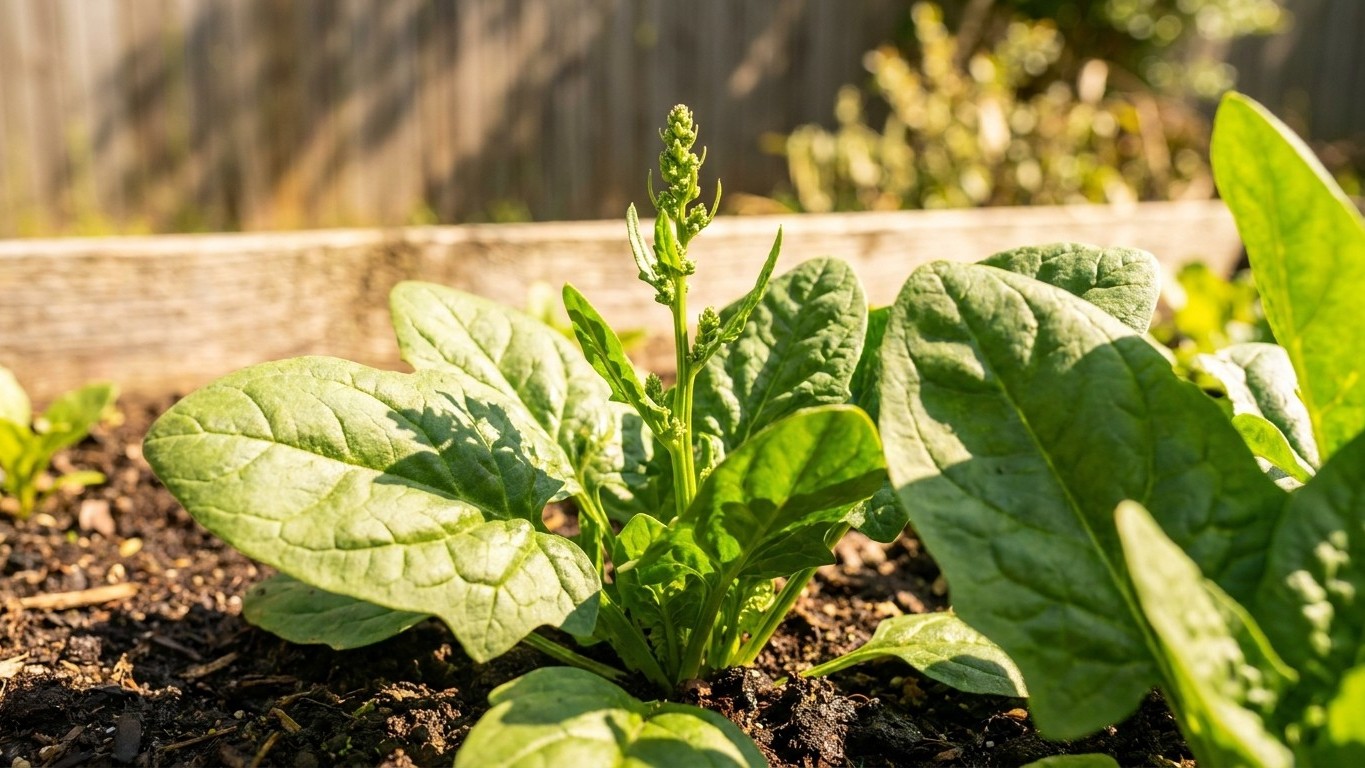

Yes, Saskatchewan gardeners routinely watch spinach shoot up a flower stalk before they’ve cut more than a couple of harvests. The reason isn’t the province’s short, cool summer, it’s the opposite: the long daylight hours that come with a northern prairie summer trigger flowering directly. Saskatoon’s growing season carries almost zero days above 90 F, but that mild heat record doesn’t cancel the day-length signal. The reliable spinach crops here are the spring one and the fall one, with summer largely off the table.
The short answer
On the longest day of the year, Saskatoon sits at 16 hours and 31 minutes of daylight. That’s an enormous amount of light compared to almost anywhere south of the border, and it matters because spinach flowers in response to long days as well as to warmth. The plant reads day length as a signal to stop making leaves and start making seed, and once the days stretch out past a certain point, nothing about a cool summer reverses that switch. A gardener in a hot southern state and a gardener in Saskatchewan can hit the same bolting response for entirely different reasons: heat down south, day length up here.
This is the detail that trips up a lot of new growers on the prairies. They assume that because Saskatoon almost never sees a 90 F day (the climate normal average is 0.0 such days a year), spinach should be able to grow right through summer without complaint. It can’t, not reliably. The long daylight hours alone are enough to push the plant toward bolting even when the thermometer stays perfectly comfortable. So the limiting factor here is day length first, with heat playing a supporting role rather than the leading one.
Heat still matters, just not the way it does farther south. Spinach grows best where temperatures stay under 75 F, and that same 75 F mark is also where the leaves start turning bitter. Saskatchewan’s mild summer temperatures mean the crop rarely gets baked into bitterness the way it would in a place with regular 90-degree stretches. The problem is that by the time daytime highs are comfortably below that 75 F ceiling, the days are often already long enough to trigger flowering anyway. The two thresholds, the day-length trigger and the 75 F heat ceiling, don’t always line up in the gardener’s favor.
So the honest answer is that Saskatchewan spinach faces both constraints, but day length is the one that closes the door first in most years. A cool July doesn’t buy extra weeks the way it might for a heat-sensitive crop growing somewhere with scorching summers. The plant is responding to the clock and the calendar, not just the thermometer, and on the northern prairies the clock runs against it earlier than most gardeners expect.
How long the spring window really is
- Start with the frost date. Saskatoon’s average last spring frost falls on May 18. That’s a mean date from Environment and Climate Change Canada’s climate normals, not a guarantee: in roughly half of all years, frost arrives later than that, so treating May 18 as a hard deadline is risky.
- Back up the sowing date. Spinach seed goes in the ground two to three weeks before the last frost, which lands the sowing window somewhere around late April into the first days of May, and later still in a cold spring.
- Watch the daylight climb. From that sowing date, day length is already increasing quickly and keeps climbing toward the June solstice peak of 16 hours and 31 minutes. Every week that passes after sowing pushes the plant closer to the day-length trigger for flowering.
- Recognize the growth ceiling. Growth stays good only while temperatures stay under 75 F. Saskatchewan’s mild spring keeps that ceiling out of reach for a good stretch, which helps, but it doesn’t stop the daylight clock from running.
- Add it up. Between a sowing date in late April or early May and a bolting risk that rises sharply as the solstice approaches in late June, the usable spring window works out to roughly six to seven weeks of dependable growth before the crop is likely to start bolting.
That’s a narrower window than the calendar alone would suggest, and it’s why market gardeners in the region treat spring spinach as a fast, early crop rather than something to plant and forget. Harvest early and often during that window, because waiting for bigger leaves later in June usually means waiting for a flower stalk instead.
The autumn crop, and when the soil lets you sow
The fall crop flips the problem. Instead of racing daylight, the gardener is racing warm soil on one end and the first hard frost on the other. Both boundaries matter, and they don’t move at the same pace.
Soil too warm to germinate
Spinach seed germinates poorly once soil temperatures climb above 80 F, according to Utah State University Extension. In a hot southern state, that can shut the door on late-summer sowing for weeks. Saskatchewan’s mild summer, with an average of 0.0 days reaching 90 F, means soil temperatures rarely get pushed that high in the first place, and any warm spell that does push soil past 80 F tends to break earlier here than it would in a hotter climate. That’s an advantage for prairie gardeners: the fall sowing window can often open earlier in late summer than it would farther south, simply because the soil cools off sooner.
The frost that ends the season
The other boundary is the first fall frost, which averages September 18 at the Saskatoon reference station. Like the spring frost date, this is a mean figure, not a promise, and in roughly half of all years the first frost arrives later than that. Utah State University Extension recommends sowing a fall crop 50 to 75 days before the target harvest date, and no maturity figure beyond that range is published for spinach by this source. Counting back from a harvest date near the average first frost puts the sowing window somewhere between early July and late August, with the exact date depending on how much of a margin a gardener wants against an early frost year.
Four spinach varieties commonly show up in seed catalogs and extension guidance for home gardens:
- Bloomsdale
- Melody
- Teton
- Olympia
The source used for this page names these four varieties but publishes no performance data, days-to-maturity figures, or bolt-resistance ratings for any of them, so no comparison can be made here beyond listing the names.
Common questions
Does a cooler Saskatchewan summer mean spinach can be grown all season?
No. Even with an average of 0.0 days above 90 F, the long summer daylight, peaking at 16 hours and 31 minutes on the longest day, triggers flowering on its own. Heat and day length are two separate signals, and the day-length one doesn’t take a break just because the thermometer stays mild.
Is May 18 a safe date to sow spinach outdoors?
It’s the average last frost date at the Saskatoon reference station, which means frost arrives later than that in roughly half of all years. Sowing two to three weeks before that average, with an eye on the actual forecast rather than the calendar, is the more reliable approach.
Why does fall spinach sometimes fail to sprout even though the calendar says it’s time?
Warm soil, not cold, is usually the culprit. Germination drops once soil temperatures climb above 80 F, so sowing into soil that’s still holding summer heat can leave seed sitting without sprouting. Waiting for the soil to cool, rather than sowing on a fixed date, solves the problem.
How far apart are the spring and fall spinach seasons in Saskatchewan?
The spring window runs from roughly late April into early June, closing as daylight approaches its June peak. The fall window opens once soil cools below 80 F in later summer and needs to allow 50 to 75 days before a harvest date near the average first frost of September 18, which itself can arrive later in about half of all years.