
January in Saskatchewan means frozen ground down to two feet or more, and nothing goes into open soil outdoors. The mean last-spring-frost date sits at May 18, four months out, so the real gardening happens indoors this month: seed orders, dormant pruning on the mild days, and the long-lead-time seedlings that need a head start before that frost window even opens.
What goes in the ground in January

The honest answer for this month is that nothing goes into open ground in Saskatchewan. The mean last-spring-frost date for the region, drawn from Environment and Climate Change Canada’s Canadian Climate Normals at the Saskatoon SRC station, falls on May 18, and that’s a midpoint, not a guarantee. In one year out of two the last frost actually lands later than that date, which means treating mid-May as a safe planting cue is already optimistic, let alone January.
Most of the province sits in Canadian hardiness zone 3a, based on Natural Resources Canada’s Plant Hardiness classification for the reference station. That’s the Canadian system, built from seven climate variables rather than the single minimum-temperature measure the USDA scale uses south of the border, so it doesn’t convert directly onto USDA zone numbers gardeners may see referenced elsewhere. What it tells a Saskatchewan gardener plainly is that January is usually the coldest stretch of the year, with soil locked hard well below the frost line.
That doesn’t mean there’s nothing to do with living plants. A few things still make sense this month:
- Forcing rhubarb crowns or chicory roots indoors in a dark, cool space for an early harvest of tender stalks or blanched heads.
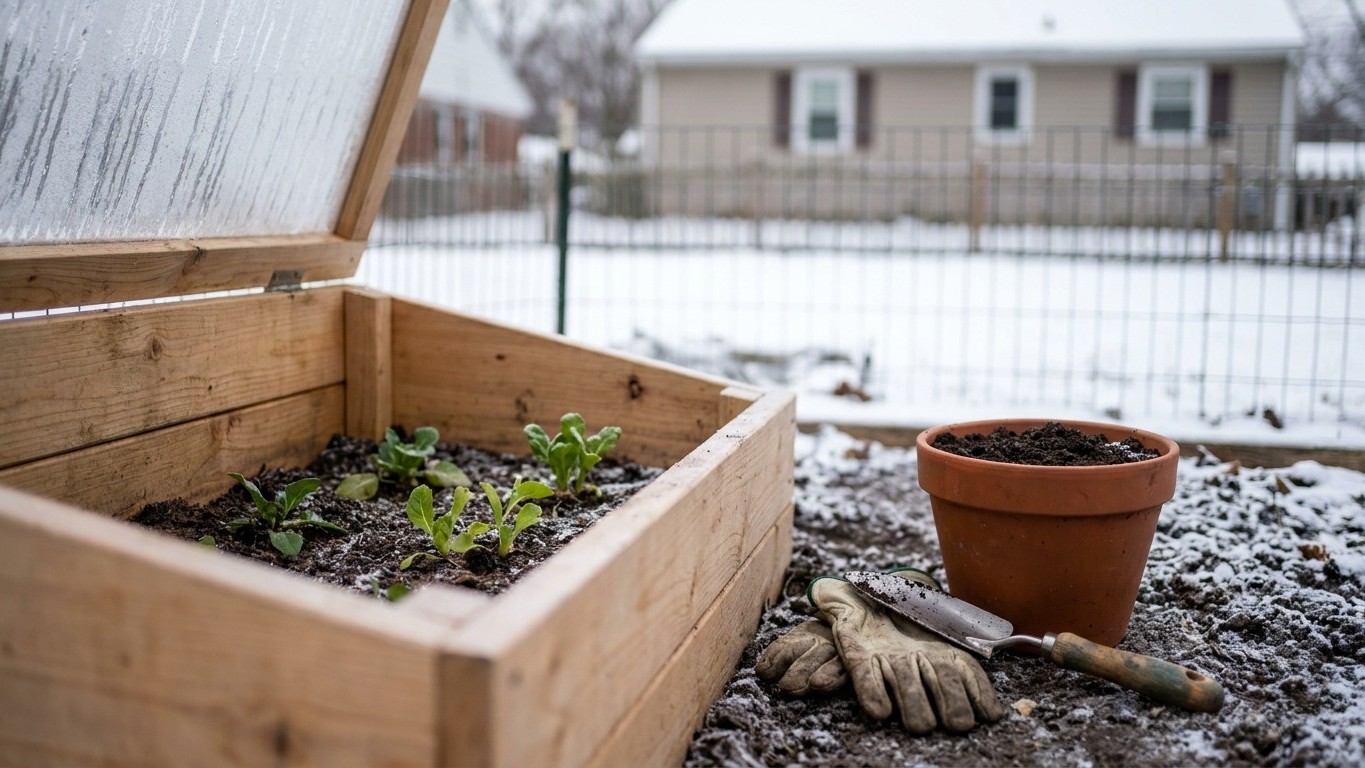
- Checking cold frames or low tunnels over anything planted the previous fall, mainly to confirm insulation is holding, not to open them up.
- Starting dormant bare-root fruit stock in pots indoors under cover, if it arrived by mail order, rather than leaving it to sit in frozen packaging.
- Keeping mulch layers thick and undisturbed over any perennial beds or garlic planted the previous autumn.
Garlic itself went into the ground in fall for overwintering, so January isn’t a garlic-planting month here. Anyone tempted to try direct-sowing hardy greens or peas outdoors this month should hold off. Zone 3a cold doesn’t negotiate with a hardy pea seed sitting in frozen clay.
What to start under cover
Counting backward from the mean May 18 frost date is the only way this month makes sense as a seed-starting window. If a crop needs 10 to 12 weeks of indoor growth before it’s ready to transplant, and the transplant date lands somewhere around that mid-May mark (with a real chance it slips later), then sowing now, roughly 16 to 18 weeks ahead, gives the slowest growers time to size up without rushing. Onions and leeks from seed fall into that category, and January is a reasonable point to get them started under lights.
Faster crops don’t belong on this month’s list. Tomatoes and peppers typically need only 8 to 10 weeks indoors, so starting them now means they’ll be rootbound and leggy long before the ground and air are anywhere close to ready in a zone 3a climate. That’s the first failure mode: starting too early and ending up with stretched, weak transplants that sulk for weeks after they finally go outside. The second failure mode runs the other way, waiting so long that a short prairie season leaves no time for a slow crop to mature at all.
| Crop | Approx. weeks needed indoors | January start makes sense? |
|---|---|---|
| Onions (from seed) | 10-12 weeks | Yes |
| Leeks | 10-12 weeks | Yes |
| Peppers | 8-10 weeks | No, wait |
| Tomatoes | 6-8 weeks | No, wait |
Anything started this month needs strong light and steady bottom heat, since a windowsill in a Saskatchewan house in January rarely offers enough of either on its own.
What is ready to pick
Outdoors, there’s little to nothing to harvest across most of Saskatchewan this month, and that’s worth saying plainly rather than stretching the point. Any kale or leeks left in the ground under snow cover from fall may still be edible if the cold hasn’t penetrated the mulch, but in a true zone 3a winter that’s the exception rather than something to count on for the table.
The household kitchen still gets fed from a few reliable sources this month. Sprouts and microgreens grown indoors on a countertop finish in days rather than weeks and need no more than a jar or a shallow tray. A well-insulated cold frame that’s held its heat might still be yielding a few hardy salad leaves, though it’s worth checking rather than assuming. Stored crops carry most of the weight in January: potatoes, winter squash, and onions kept in a cool, dark spot should get pulled out and checked over, since one soft or sprouting potato left among the rest speeds up rot in its neighbors. Any squash with a soft spot near the stem end should get used first, before it spreads.
The jobs that matter this month

Dormant pruning of fruit trees and cane fruit is one of January’s real jobs, done on the milder days rather than during a hard cold snap, since wood cut in extreme cold is more prone to cracking at the cut. Apple and pear trees, currants, and raspberry canes all take pruning well while they’re fully dormant, and getting to it before sap starts moving in late winter matters more than doing it on a specific date.
Seed ordering belongs on this month’s list too, and it carries a real deadline: the shorter-season varieties bred to mature within Saskatchewan’s roughly four-month frost-free window sell out from smaller seed houses well before spring. Waiting until the ground thaws to order often means settling for whatever’s left rather than the variety actually suited to a short prairie season.
A handful of other tasks fit naturally into this quiet stretch:
- Planning next season’s rotation on paper, especially where alliums, brassicas, and nightshades were grown the previous year.
- Sending soil samples for testing while there’s time to act on the results before planting, since frozen ground rules out sampling later.
- Turning an insulated compost pile if it’s still generating any heat, to keep it breaking down rather than freezing solid.
- Cleaning and sharpening pruning shears, hoes, and spades so they’re ready the moment the ground softens.
- Checking raised beds, trellises, and fencing for snow-load damage before it worsens under another storm.
None of this is filler work. Skipping seed orders or dormant pruning now doesn’t just delay the season, it can cost varieties and yield outright.
What not to do in January
The most common misstep is treating a stretch of mild weather as a sign the season’s turning. A few days above freezing in January means nothing about the actual frost window: the mean last-frost date is May 18, and remember that in half of all years frost arrives even later than that. Uncovering mulch, pulling back row cover, or hardening off anything based on a warm spell this early is a gamble that usually ends with damaged or dead plants once the cold returns, which it will.
Starting warm-season seedlings this month is the second classic error. Tomatoes, peppers, and squash sown now will be leggy and rootbound long before the outdoor season actually opens in a zone 3a climate, and a stretched, stressed seedling rarely catches up once it’s transplanted.
Pruning fruit trees or canes during the coldest snaps of the month is worth avoiding too. Wood cut at extreme low temperatures is more likely to crack or die back around the cut than wood pruned on a calmer, milder day within the same dormant season.
Feeding nitrogen to anything indoors this early is the last trap. Seedlings that haven’t yet built real root mass respond to nitrogen with soft, floppy top growth rather than sturdy stems, which just makes the leggy-transplant problem worse once they finally go outside.
Checking this against your own county
A province-wide month is a starting point, not a fixed instruction. Saskatchewan spans a wide range of elevation and latitude, and the frost dates measured at the Saskatoon SRC station don’t hold evenly from the southern grain belt up toward the northern forest fringe, where the same window can run weeks behind. Local microclimates, wind exposure, and snow cover all shift the practical dates further still.
The Saskatchewan Ministry of Agriculture’s agribusiness resources are the place to check current guidance and any region-specific planting calendars for a particular county before committing seed to soil.
Common questions
Can I plant garlic in January in Saskatchewan?
No. Garlic for overwintering goes into the ground in fall. By January the soil is frozen solid across the province, and any garlic meant for this season should already be under mulch from a fall planting.
What hardiness zone is Saskatchewan for planting purposes?
Most of the province, including the area around the Saskatoon reference station, sits in Canadian hardiness zone 3a according to Natural Resources Canada. This is the Canadian system based on seven climate variables and does not convert directly to a USDA zone number.
When is the last spring frost in Saskatchewan?
The mean last-spring-frost date at the Saskatoon SRC station is May 18, based on Canadian Climate Normals from Environment and Climate Change Canada. That’s a midpoint: frost arrives later than this date in roughly half of all years, so it should be treated as a guide, not a safe cutoff.
Can I start seeds indoors in January in Saskatchewan?
Yes, for slow growers only. Onions and leeks, which need 10 to 12 weeks indoors before transplanting, fit a January start when counted back from the mean May frost window. Fast growers like tomatoes and peppers should wait, since starting them this early leaves them leggy and rootbound long before it’s safe to move them outside.
Gardeners who plant by the Moon can check the January 2027 moon planting calendar, a tradition rather than a proven method.