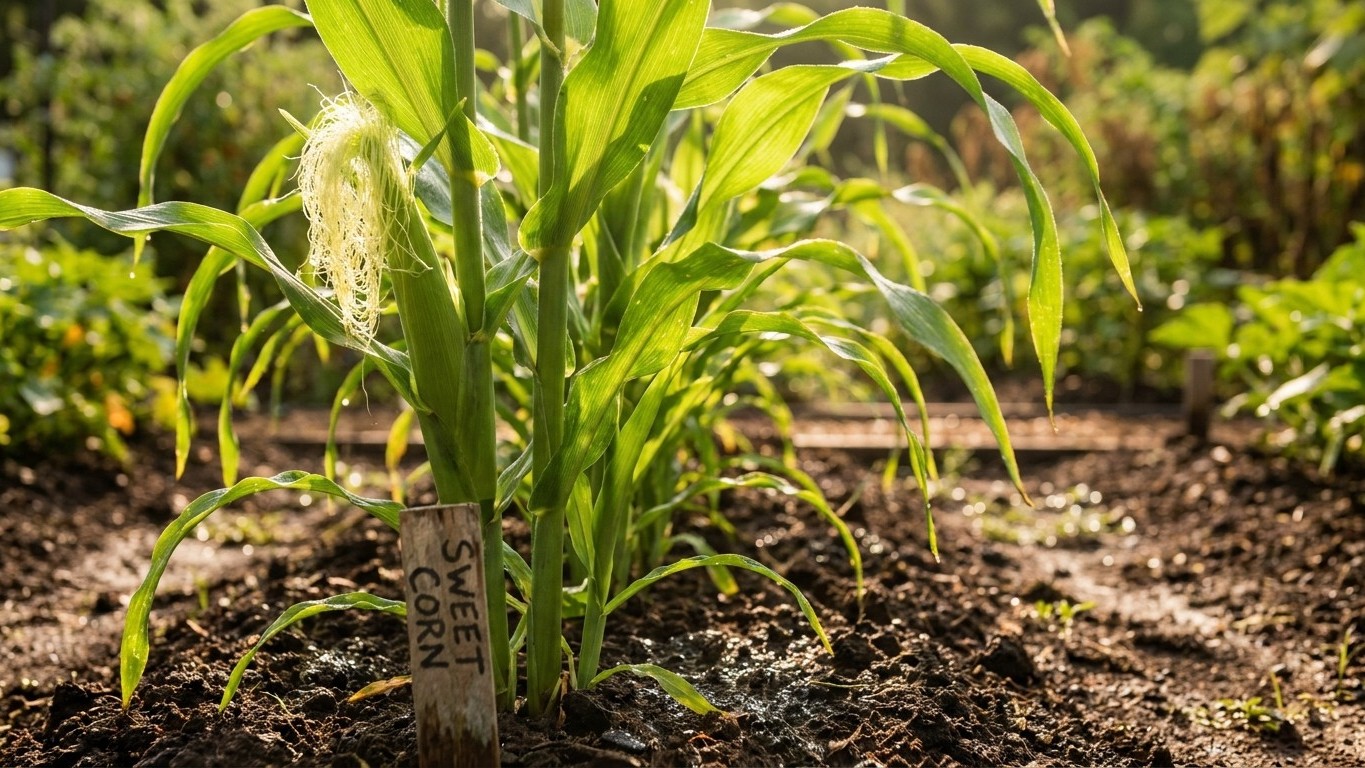

Yes, sweet corn ripens in Tennessee in most years, and the numbers back it up: the state’s frost-free stretch runs long enough to fit even a slow-maturing variety with room to spare. The catch isn’t whether corn will ripen. It’s getting the timing right at the front end, when soil temperature, not the calendar, decides the start date.
The short answer
Here’s what most gardeners get wrong first: they plant sweet corn the week after the last frost date, treating that date as the green light. It isn’t. Sweet corn seed needs soil above 60°F to germinate reliably, and that threshold arrives weeks after the air stops freezing. Tennessee’s last spring frost, based on NOAA climate data for the reference station near Nashville, falls between March 31 and April 12. Soil takes time to catch up with that warming air, so the actual planting window opens later, often well into spring, once the ground itself has banked enough heat rather than just the atmosphere above it.
That delay matters less than it sounds like it should. Tennessee’s first fall frost, per the same NOAA station data, lands between October 28 and November 8. Stretch the calendar from the earliest last frost (March 31) to the latest first frost (November 8), and you get a frost-free window of roughly 222 days. Even using the tighter combination, latest last frost (April 12) paired with the earliest first frost (October 28), the state still holds close to 199 days between frost risks. Sweet corn needs 60 to 90 days from planting to harvest. Subtract several weeks for soil to climb past 60°F after the air has already cleared frost risk, and there’s still a comfortable 150-plus days left on the clock in most of the state. That’s more than enough runway for even the slower end of the sweet corn spectrum.
Summer heat is the other half of the equation, and it cuts both ways. Nashville’s reference station averages 40.0 days a year at 90°F or above. That’s a heavy heat load, and it drives up water demand right when corn is establishing roots and building stalks. It doesn’t shrink the ripening window, but it does mean a crop planted on schedule can still stall or stress if watering falls behind during July’s hottest stretch. The season fits. Keeping the crop hydrated through it is the part that takes ongoing attention.
Does a late variety fit here?
Whether a variety fits Tennessee’s season comes down to counting backward from the first fall frost and forward from the point when soil is actually warm enough to plant, not from the last frost date itself. That’s where most of the confusion creeps in.
A 60-day variety
A short-season sweet corn built around 60 days from planting to harvest is the easiest fit anywhere in Tennessee. Even accounting for a delayed start while soil climbs above 60°F, and even in a year where the first fall frost arrives on the early side (October 28), there’s a wide cushion left over. This is also the variety that rewards a second or third planting, since gardeners can space plantings two to three weeks apart and still bring in a full harvest before frost risk returns in the fall. For anyone new to sweet corn, or gardening at higher elevation where spring drags its feet, the 60-day option removes most of the guesswork.
A 90-day variety
A full 90-day sweet corn still fits comfortably across most of Tennessee, based on the frost-date math above. Statewide, even the conservative frost-window calculation (around 199 days) leaves more than 100 days of margin after accounting for a slower soil warm-up in spring. That’s a real buffer, not a razor’s edge.
The exception sits in the cooler pockets of East Tennessee and the Cumberland Plateau, where spring arrives later and soil takes longer to cross that 60°F line. NOAA’s own data flags these areas as running cooler and later than the reference station used for the statewide dates above. In those higher, cooler locations, a 90-day variety loses much of its buffer, and if soil warm-up drags on longer than usual, the countdown to the first frost can get uncomfortably tight. In that specific terrain, the late variety does not fit as safely as it does across the rest of the state, and gardeners there are better off leaning toward the shorter end of the sweet corn range.
| Variety type | Days to maturity | Statewide fit | East TN / Cumberland Plateau fit |
|---|---|---|---|
| Short-season | 60 days | Comfortable, wide margin | Comfortable, safest choice |
| Full-season | 90 days | Comfortable, solid margin | Tight, riskier in cooler years |
What goes wrong here
- Soil sown too cold. Planting the week after the last frost, before soil has actually crossed 60°F, is the most common failure. Seed sits in cool, damp ground and rots or germinates unevenly. The fix is simple: check soil temperature directly with a soil thermometer pushed a few inches down, rather than trusting the last-frost date on a calendar.
- A variety too late for the season. This mostly shows up in the cooler high country of East Tennessee and the Cumberland Plateau, where a 90-day variety planted after a slow spring can run out of runway before the first fall frost arrives. The remedy is choosing a shorter-season type in those areas, or planting as early as soil conditions genuinely allow rather than waiting for a fixed date.
- Sweetness lost because two types tasseled together. This one has nothing to do with Tennessee’s climate. Sweet corn comes in different sugar types (su, se, and sh2), and if two different types tassel at the same time nearby, cross-pollination ruins the flavor of the sweeter type, turning it starchy instead of sweet. There’s no published isolation distance to lean on here. What matters is timing: stagger planting dates so the types don’t tassel together, or grow only one sugar type per season, and plant sweet corn in blocks of three or more rows rather than a single thin row, since block planting improves pollination regardless of type.
Common questions
How do I know sweet corn is ready to pick in Tennessee?
Look for three signs together, not just one: the silks have turned dry and brown, the husk underneath is still moist and green, and a punctured kernel releases milky juice rather than clear liquid or a dry, doughy texture. All three need to line up before the ear is truly ready.
Can I plant sweet corn in Tennessee before the last frost date?
No. Planting before the last frost risks the seed sitting in cold, wet soil that hasn’t reached the 60°F mark sweet corn needs to germinate, which is a separate and later milestone than the last frost date itself.
Why does spacing matter if there’s no listed isolation distance?
Because the risk isn’t about how far apart plantings sit, it’s about whether their tassels release pollen at the same time. Two sugar types planted right next to each other but staggered by several weeks in tasseling timing won’t cross, while two types planted farther apart but tasseling simultaneously still can.
What’s the difference between the 60-to-90-day clock and the harvest countdown after silks appear?
They answer two different questions. The 60-to-90-day figure runs from planting and tells you whether the variety fits Tennessee’s season at all. Once silks actually emerge on the ears, a separate, shorter countdown of 17 to 24 days determines which week to actually pick. Mixing the two up leads to picking either far too early or letting ears go past their peak.