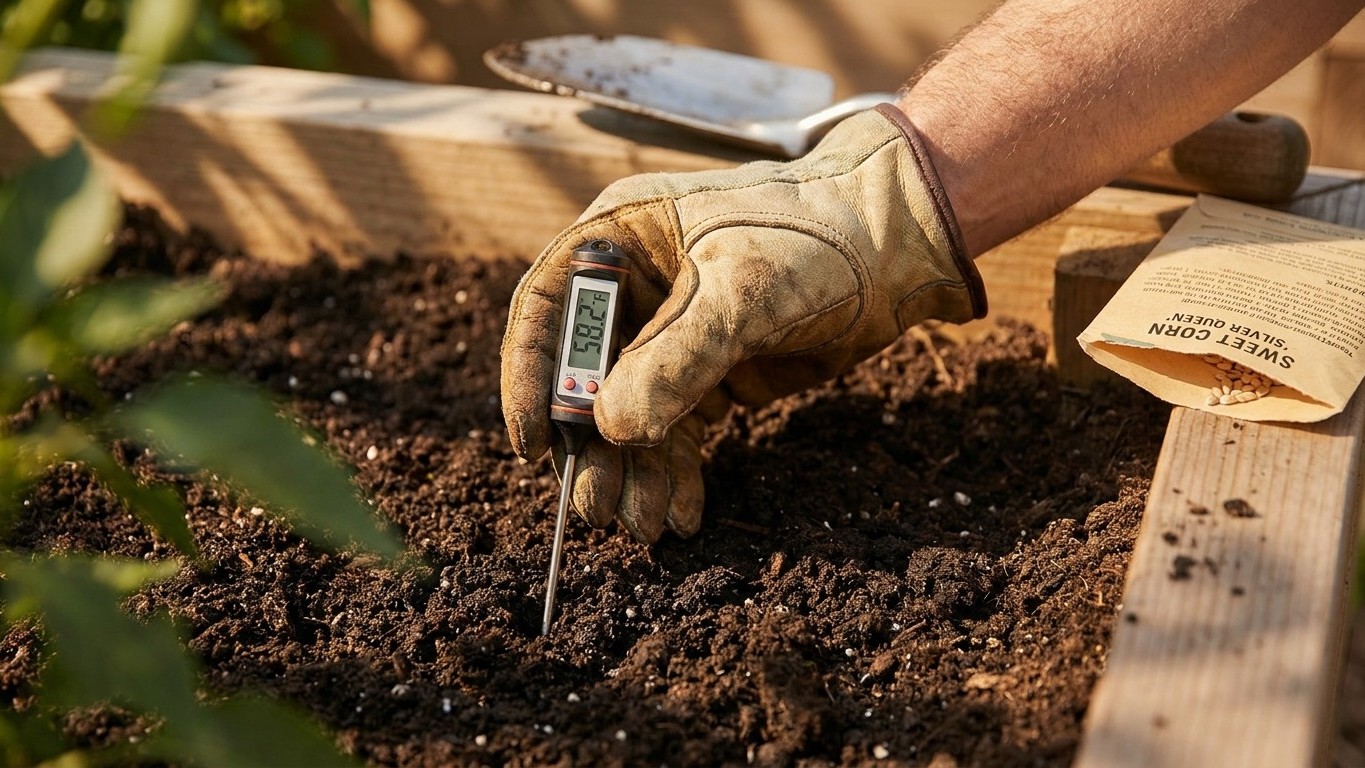

In western Washington, sweet corn goes in the ground once soil temperatures climb past 60°F, which lands well after the last frost, typically not until late spring turns toward early summer. From that point, a 60- to 75-day variety has a comfortable runway before the first fall frost arrives in mid-to-late November. A 90-day variety is a tighter, riskier call in this cool, cloudy climate.
The short answer
Frost dates and planting dates are not the same question, and mixing them up is the single most common mistake gardeners make with corn in this region. The last spring frost across western Washington, based on NOAA’s 1991-2020 climate normals for the Seattle-area station, falls somewhere between February 27 and March 18. That sounds early. It is not an invitation to plant corn in March.
Sweet corn seed doesn’t germinate reliably until the soil itself, not the air, holds steady above 60°F. In a maritime climate like this one, with cool nights, marine cloud cover, and slow-warming clay-heavy soils, that threshold usually isn’t crossed until well after the frost risk has passed, often not until the days are noticeably longer and the sun has had time to bake some warmth into the topsoil. Planting into cold, wet soil before that point doesn’t get you a head start. It gets you seed that rots or sits dormant while weeds take over the bed.
Once soil temperature does clear 60°F, the corn clock starts, and it runs 60 to 90 days depending on the variety. The fall side of the calendar gives some breathing room here: the first fall frost across this same western Washington zone doesn’t typically show up until November 13 to November 30. That’s a wide gap between a late-spring planting and a late-fall frost, at least on paper.
The complication is heat, or the lack of it. This part of the state averages only 3.0 days a year reaching 90°F or higher, based on NOAA’s climate normals for the Seattle reference station. Corn is a heat-hungry crop bred and tested largely in regions that rack up far more warm days than that. A “70-day” variety assumes a certain amount of accumulated warmth, not just 70 calendar pages flipping by. In a summer with mild highs and overcast mornings, that same variety can take noticeably longer to tassel, fill, and ripen than the seed packet suggests. Calendar math says there’s room. Actual heat load says budget extra patience, and lean toward the shorter end of what’s available rather than the longer end.
Does a late variety fit here?
The Utah State University Extension guidance on sweet corn lays out the core rule plainly: the crop needs soil above 60°F and a window of 60 to 90 days from planting to harvest, depending on the variety chosen. In a mild maritime zone with only a handful of hot days a year, that range stops being an abstract spec sheet and turns into a real constraint on what will actually finish before the garden shuts down for the season.
A 60-day variety
A shorter-season type is the safer bet here, and it isn’t close. If soil crosses 60°F sometime in late spring and the crop needs roughly 60 days to reach harvest, that puts ripening comfortably in mid-to-late summer, months ahead of the November frost window. Even accounting for this region’s low heat accumulation slowing things down by a week or two beyond the printed number, there’s still generous margin left before the first fall freeze arrives. This is the length of season that maritime Washington gardens are built for.
A 90-day variety
The math looks fine until you factor in heat, and then it doesn’t. Ninety days of calendar time fits inside the gap between a late-spring planting and a late-November frost. But 90-day sweet corn varieties are generally bred with the expectation of a warmer, sunnier stretch of summer than this region reliably delivers. With only about three days a year reaching 90°F, the accumulated warmth that drives tasseling, pollination, and kernel fill simply isn’t there at the pace the variety assumes. The plant can stall in cool, overcast weeks, push its actual harvest date later than 90 days, and then run uncomfortably close to the fall frost, sometimes past it in a cooler-than-average year. For this territory, a 90-day variety does not fit with any real confidence. Shorter-season types are the dependable choice, not the compromise.
What goes wrong here
- Soil sown too cold. Planting right after the last frost date, rather than waiting for the soil itself to clear 60°F, is the most common failure in this climate. Cold, damp soil holds seed hostage, inviting rot before it ever sprouts. The fix is patience: check soil temperature directly, at planting depth, rather than trusting the frost date alone.
- A variety too late for the season. Choosing a 90-day type because the fall frost date looks distant ignores how little heat this region banks in a typical summer. The remedy is to size the variety to the region’s actual warmth, not to the calendar gap between planting and frost, and to lean toward the 60- to 75-day range instead.
- Sweetness lost because two types tasselled together. This one has nothing to do with weather. If a sugary-enhanced (se) type and a supersweet (sh2) type, or any mix of su, se, and sh2 corn, shed pollen and silk at the same time nearby, cross-pollination dulls the sweetness of the supersweet ears, often noticeably. The source publishing this guidance gives no specific separation distance to follow, so don’t rely on a spacing rule of thumb here. What matters is timing: stagger planting dates so the varieties tassel at different times, or grow only one type in a given season, and keep corn planted in blocks of three or more rows rather than a single thin row, since block planting is what makes pollination reliable in the first place.
Common questions
Can I plant sweet corn in Washington in March?
Not in western Washington. The last frost may clear by mid-March in some years, but soil temperature, not air temperature, is what corn responds to, and it typically hasn’t reached the 60°F threshold that early. Planting into cold soil usually means rot, not an early harvest.
How many days does sweet corn really take to mature here?
Sixty to 90 days from planting, depending on the variety, per Utah State University Extension. In this region’s cooler, lower-heat summers, lean toward the shorter end of that range, since a 90-day variety can run longer than its label suggests when warm days are scarce.
How do I know when the corn is actually ripe?
Look for three signs together, not just one: the silks have turned dry and brown, the husks are still moist and green, and a punctured kernel releases milky juice rather than clear liquid. All three should line up before you pick.
Can I grow two different sweet corn types in the same garden?
Yes, but not if they tassel at the same time. Mixing su, se, and sh2 types when their pollen sheds simultaneously will dull the sweetness of the supersweet variety. Stagger the planting dates so the two crops flower at different points in the season, and keep each type in its own block of three or more rows.
If you follow the almanac, here is when to plant corn by the moon. It is a tradition, not a proven method.