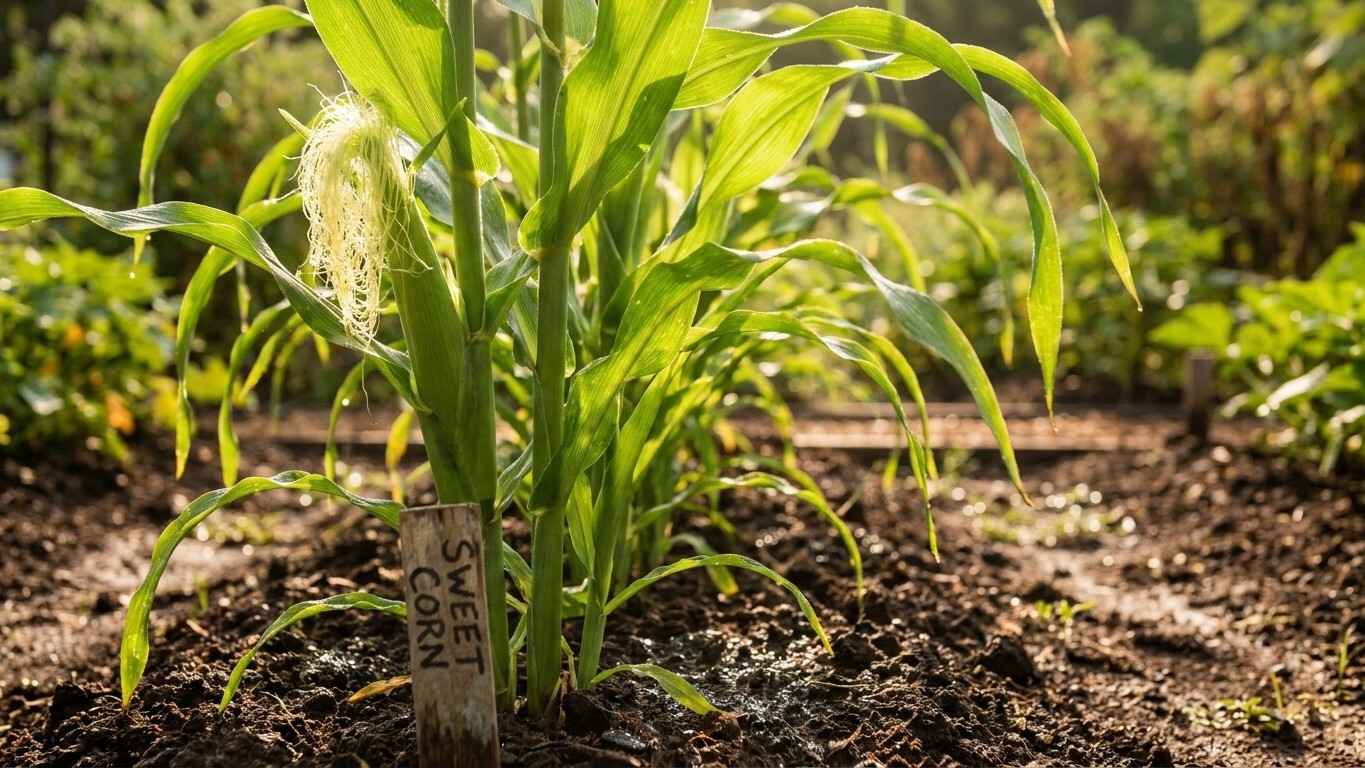

Yes, sweet corn ripens reliably in western Washington, but the calendar that matters is not the frost date most gardeners circle in April. It’s the soil temperature and the number of frost-free days that follow it. Get those two numbers right, and even a slow-maturing variety has room to finish before the rains and cold return in November.
The short answer
Start with the number gardeners usually skip: soil temperature. Sweet corn seed sits and rots in cold ground, and it needs the soil above 60 F before it will germinate reliably. That threshold has nothing to do with the last spring frost. In this part of Washington, west of the Cascades, the last spring frost typically falls somewhere between February 27 and March 18, according to NOAA’s 1991-2020 Climate Normals for this station. But soil doesn’t warm at the same pace as the air. Low winter light, persistent cloud cover, and soaked ground through late winter mean the soil here lags well behind that frost date. A gardener who plants corn seed the week after the last frost, in early March, is planting into ground that is still too cold to sprout the seed rather than rot it. The practical move is to wait, watch the soil rather than the calendar, and confirm 60 F with a simple soil thermometer before dropping seed.
Once the soil clears that bar, the second clock starts: sweet corn needs 60 to 90 days from planting to reach harvest, depending on the variety. The question that decides whether corn ripens here isn’t whether the season is long enough on paper. It’s whether the days between a realistically late soil-warming date and the first fall frost still add up to 60, or even 90, days with margin left over.
The back end of the season is generous in this part of the state. NOAA’s Climate Normals put the first fall frost between November 13 and November 30. That gives a frost-free stretch that runs from roughly early spring into late autumn, one of the longer growing windows in the state. The catch is heat, not time. This station averages only 3.0 days a year above 90 F. Sweet corn doesn’t just need days on a calendar, it needs warmth to push through pollination and ear fill. A long, cool, cloudy summer can stretch a “70-day” variety closer to 80 or 85 days in practice, even though the frost-free window never closes on it.
| Factor | Value |
|---|---|
| Last spring frost (32 F) | February 27 to March 18 |
| First fall frost (32 F) | November 13 to November 30 |
| Soil temperature needed to plant | 60 F, reached after the frost date, not on it |
| Days above 90 F per year (average) | 3.0 |
Put together, the frost-free season here is long enough that sweet corn is not a gamble. The gamble, if there is one, is heat, and it shows up more in flavor and fill than in whether the plant survives to harvest.
Does a late variety fit here?
A 60-day variety
A 60-day type is the low-risk choice for this territory. Even allowing for soil that doesn’t clear 60 F until well into spring, a gardener still has months of frost-free time left before the November frost window opens. Add the modest heat load, only 3.0 days a year above 90 F, and a fast variety is the one least likely to be caught out by a cool, gray July. It reaches maturity on the calendar side of the equation with room to spare, and it asks less of a summer that rarely gets genuinely hot.
A 90-day variety
On paper, a 90-day variety fits too. The frost-free window here, stretching from late winter into late November, is wide enough to hold 90 days even if planting is pushed back to wait for warm soil. But paper and practice diverge once the heat question enters. A 90-day count assumes a certain accumulation of warmth along the way, and this station’s summers rarely supply much of it. Three days above 90 F a year is a low heat load for a crop that fills its ears on warmth. A 90-day variety planted here is more likely to run past its nominal count, edging toward the fall frost window rather than finishing comfortably ahead of it. It does not fail outright in this territory. But it carries meaningfully more risk than the 60-day option, and a gardener choosing it should expect to push planting as early as soil allows and accept a harvest that lands later than the seed packet promises.
What goes wrong here
- Soil sown too cold. Planting right after the last spring frost, rather than waiting for the ground to clear 60 F, is the most common mistake in this climate. Cold, wet soil rots seed instead of sprouting it. The remedy is patience: check soil temperature directly and wait for it to hold above 60 F before planting, even if that means planting weeks after the last frost has already passed.
- A variety too late for the season. A 90-day type stretched by a cool, low-heat summer can drift close to the fall frost window instead of finishing well ahead of it. The remedy is matching the variety to the heat on offer here, leaning toward the 60-day end of the range unless planting can start unusually early.
- Sweetness lost to a shared tassel. This one has nothing to do with frost dates or soil temperature. Sweet corn types (su, se, and sh2) lose their sweetness when different types tassel at the same time nearby, cross-pollinating and dulling the flavor of the harvest. No published isolation distance covers this here. What matters is timing: staggering planting dates so the varieties don’t tassel together, or growing only one type in a given season, protects the sweetness regardless of how the plots are laid out.
Common questions
Can I plant sweet corn right after the last frost in western Washington?
Not reliably. The last frost date (February 27 to March 18 at this station) tells you when freezing air is unlikely, not when the soil is warm enough. Soil here typically stays below the 60 F threshold sweet corn needs for weeks after that frost date passes, so planting on the frost date alone risks rotted seed.
Does the long frost-free season here guarantee a 90-day variety will ripen?
It gives it enough calendar time, since the frost-free window runs from late winter into late November. But this station averages only 3.0 days a year above 90 F, and a 90-day variety depends on more summer heat than that to fill its ears on schedule, so it carries more risk than a 60-day type even with the extra calendar room.
How do I know when the corn is actually ready to pick?
Look for three signs together: dry, browned silks, husks that are still moist and green, and milky (not clear or thick) juice from a punctured kernel. Any one sign alone is not a reliable indicator; all three together are what confirm ripeness.
Do I need a set distance between different corn varieties to protect sweetness?
No published distance applies here. What decides sweetness is whether su, se, and sh2 types tassel at the same time. Stagger planting so tasseling doesn’t overlap, or grow a single type in a season, rather than relying on a spacing rule.