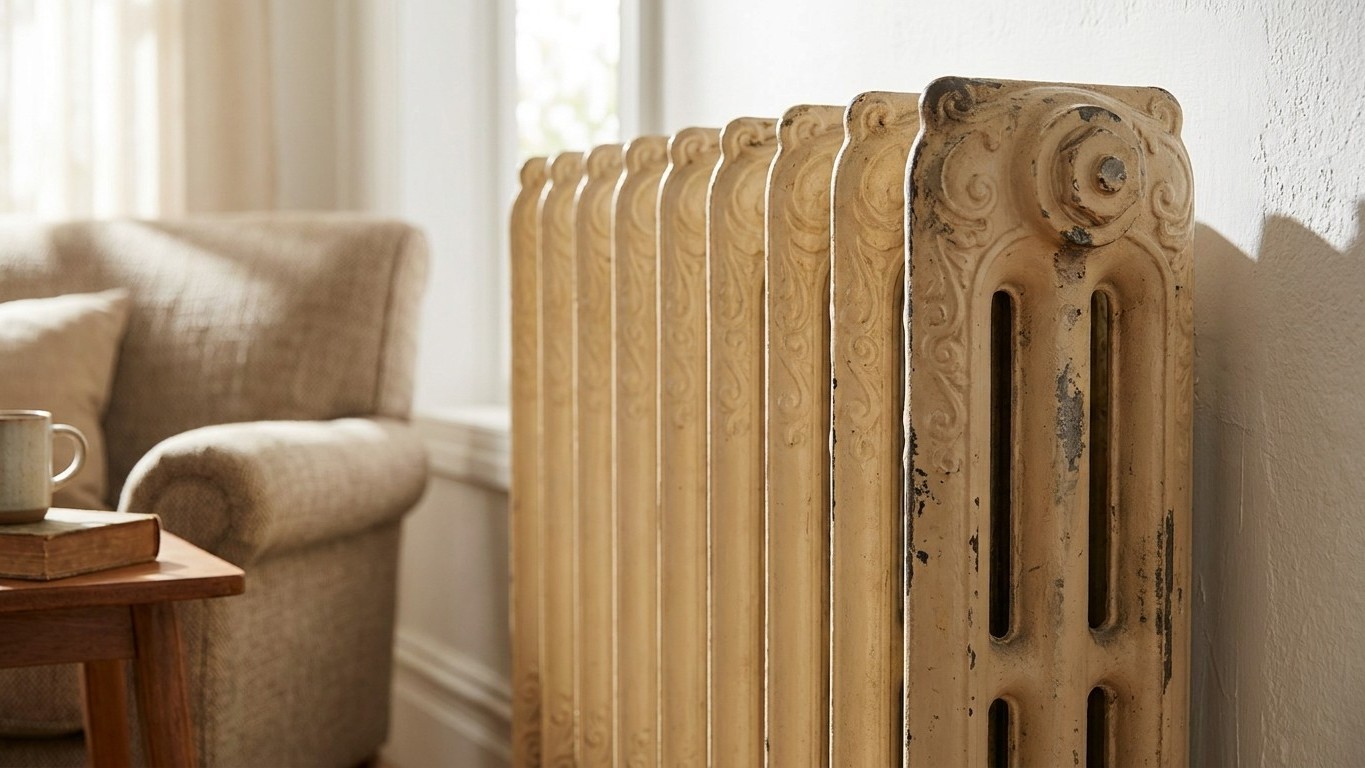

Most old cast-iron radiators don’t need to go anywhere. The metal outlasts furnaces, roofs, and usually the people who install them. The real question isn’t whether the radiator is old, it’s whether the room works the way you want it to, whether the boiler loop feeding it is sound, and whether you’re willing to live with a heat source that behaves nothing like a modern panel. That’s a judgment call, not a repair diagnosis.
What you actually have
Start with the distinction that decides everything else: a radiator is not a heating system. It’s the object a boiler pushes heat into, either as steam or as hot water. Government housing surveys file this under “steam or hot water system,” and every fault that shows up in that survey category, corrosion, leaks, uneven heat, belongs to the loop, not to the iron sitting in your living room. Before you touch a valve or a bleed screw, know which family you’re dealing with. A steam radiator has no bleed key at all, and opening it the way you’d open a hot-water unit can push water where it shouldn’t go.
The object itself is straightforward. A period cast-iron radiator is a dense block of metal, sectioned into columns, designed to hold a lot of hot water or steam and release that heat slowly into the room. It takes longer to warm up than a thin steel panel. It also keeps radiating warmth for an hour or more after the boiler shuts off, because all that mass has to cool down before the heat stops. People call this sluggish. It’s also the reason a room with cast iron doesn’t feel like it’s on a Thermostat rollercoaster the way a room with baseboard convectors often does.
Where this hardware is still common
This isn’t a style preference scattered evenly across the country. Federal residential energy survey data (RECS 2020) puts steam or hot water radiator systems in 36% of homes in Alaska, 35% in New York, 33% in Rhode Island, 31% in Maine, 26% in Massachusetts, and 25% each in New Hampshire, New Jersey, and Vermont. Compare that to California, where the figure sits at 1%. Twenty-seven states come in under 5%. What you’re looking at is old, cold housing stock built before forced-air ductwork became the default, concentrated in places with long winters and pre-war construction. If your house has cast iron, it’s very likely older than the neighborhood expects, and the radiator has probably been doing its job since before anyone alive in the house was born.
None of that means “old” equals “failing.” Cast iron doesn’t fatigue the way sheet steel does. Sections crack from specific abuse, not from age alone. A radiator that’s been sitting in a bedroom for eighty years, quietly heating that room every winter, isn’t on borrowed time just because of its birth year.
The honest comparison
Every option here trades something for something else. None is objectively correct, and the “drawback” people complain about most, slow response, is the same physical property that makes cast iron comfortable to live with once it’s running.
| Option | How the room feels | Response time | What the work involves | Irreversible? |
|---|---|---|---|---|
| Keep and restore | Same steady, radiant warmth as always; original look preserved | Slow to heat, slow to cool, no change from current behavior | Strip, treat rust, prime, repaint the existing unit in place or off-site | No, this is maintenance |
| Keep and repaint | Cosmetic refresh only; heat output and feel unchanged | Unchanged | Surface prep and a new coat, lighter job than a full restoration | No |
| Replace with modern panel | Faster swings from hot to cool; less ambient radiant warmth between cycles | Much quicker to warm and cool | Removing the old unit, connecting the loop to a new emitter, matching output | Yes, the original casting is gone |
| Replace with reproduction | Similar look to the original, new internal construction | Varies by design, often closer to modern panels than to true cast iron | Removal of the old unit, installation of new hardware sized to the room | Yes |
Keeping and restoring changes almost nothing about how the room behaves. It’s the same slow-building, long-holding heat you’ve always had, just under a repaired surface. Keeping and repainting is the lightest touch of all four, cosmetic only, and it’s reversible in the sense that you haven’t altered anything structural.
Replacing with a modern panel is the option that changes the room’s personality. A thin steel panel responds to the Thermostat much faster, which some people want, especially in a room used briefly, like a mudroom or a guest bath. But it loses the slow bleed of residual heat that keeps a cast-iron room comfortable for an hour after the system cycles off. Replacing with a reproduction splits the difference visually, keeping the traditional column look, but the internal engineering is new, and thermal behavior depends on the specific design rather than on the mass of old iron.
What actually drives the cost of any of these paths isn’t the option itself, it’s the access to the unit, whether the loop has to be drained to work on it, whether the radiator is a standard modern size or an oddball period casting that needs custom fitting, and whether you’re touching one emitter or reworking the whole system. A contractor’s quote is what settles those variables for your specific house. Nothing here substitutes for that.
Restoring one
Restoration is a sequence, and skipping steps is how people end up repainting over a problem instead of fixing it.
- Assess for weeps first. Before sanding or stripping anything, check every joint, section seam, and valve connection for signs of moisture, staining, or active leaking. There’s no point refinishing a radiator that’s quietly failing at a joint.
- Strip carefully. Old paint on a period radiator, in a period house, is exactly the kind of surface where you test for lead before assuming anything. Don’t guess based on the house’s age or the paint’s appearance. Test it, and if it’s positive, disturbing it becomes a different job entirely, one with its own containment and cleanup requirements.
- Deal with the rust. Surface corrosion on cast iron is common and usually cosmetic, but it needs to be addressed mechanically, not just painted over, or it will keep bleeding through the new finish.
- Prime for metal. A primer formulated for iron and steel gives the topcoat something to hold onto and helps prevent new rust from starting under the paint.
- Repaint. This is where finish choice and application technique matter most, and it’s covered in more detail in this site’s guide to painting a radiator rather than repeated here.
One option worth knowing about: stripping a radiator off-site. Some owners disconnect the unit and send it out for dip-stripping or media blasting rather than doing the paint removal in place. It’s a real choice, and people take it because it keeps lead dust and chemical stripper out of the living space entirely, and because a shop can get into every recessed section and joint that’s nearly impossible to reach with a hand scraper while the radiator is bolted to the floor.
What actually ends one
Cast iron doesn’t wear out from age. It fails from specific events, and there are really three of them. A cracked section is the big one, a fracture in the casting itself, usually from mechanical stress or from freezing, and it’s not something you patch. A leaking body, as opposed to a leaking joint, means the casting has failed somewhere along its wall, and that’s the radiator’s structural integrity, gone. Threads at the union, the fitting where the radiator connects to the supply piping, can also wear to the point where they no longer seal no matter how much fresh tape or compound you add.
Freezing is the classic killer, and the mechanism is simple physics. Water expands as it freezes. In a closed casting full of water, that expansion has nowhere to go, and the iron cracks under the pressure from the inside. This is exactly why an unheated house in winter, a vacant property, a vacation home with the heat turned off, a section left with no boiler running during a cold snap, is the situation that kills more old radiators than eighty years of daily use ever will. If a house is going to sit unheated through freezing weather, draining the system isn’t optional, it’s what stands between a radiator surviving another winter and needing to be scrapped.
If a radiator on your wall is already showing signs of trouble, weeping at a joint, rust streaks below a section, standing water at the base, that’s a separate diagnosis from the restore-or-replace decision covered here. This site’s guide to a leaking radiator walks through what to check and what to do next.
Common questions
Do old cast-iron radiators use more energy than modern ones?
The radiator itself doesn’t consume energy, the boiler does. Efficiency depends on the boiler and the loop, not on the age of the iron in the room.
Can I mix cast-iron radiators with modern panels on the same system?
Yes, this is common in renovated homes, though balancing output between very different emitter types on one loop is something a heating contractor needs to size correctly.
Is it safe to bleed a cast-iron radiator?
Only if it’s a hot-water system. A steam radiator has no bleed valve and works on an entirely different principle, so applying hot-water instructions to a steam unit is a mistake, not a shortcut.
Does removing a cast-iron radiator increase a home’s resale value?
There’s no reliable data connecting radiator removal to resale value on its own. Buyers weigh comfort, heating costs, and aesthetics differently, and in regions where cast-iron systems are common, buyers are often used to them.